Backtracking
解题思路 :加“.”分割字符串
注意 :isValid()中,如果得到的子串str为空,说明字符串s已经有三个“.”分割,并且最后一个点在最后一个位置,比如101.0.23.,
s = s.substring(0, i + 1) + "." + s.substring(i + 1);得到字符串s = 101.0.23.
++pointNum;
进入下一轮backtracking(s, i + 2, pointNum); i + 2为.后面一位9
此时pointNum == 3,判断ip是否合法if (isValid(s, start, s.length() - 1))
String str = s.substring(start, end + 1); 此时start为9,end + 1为9,String.subString左闭右开,所以得到的str为空
这种情况返回false
1
2
3
4
5
6
7
8
9
10
11
12
13
14
15
16
17
18
19
20
21
22
23
24
25
26
27
28
29
30
31
32
33
34
35
36
class Solution {new LinkedList <>();public List<String> restoreIpAddresses (String s) {if (s.length() > 12 )return res;0 , 0 );return res;private void backtracking (String s, int start, int pointNum) {if (pointNum == 3 ) {if (isValid(s, start, s.length() - 1 ))return ;for (int i = start; i < s.length(); ++i) {if (isValid(s, start, i)) {0 , i + 1 ) + "." + s.substring(i + 1 );2 , pointNum);0 , i + 1 ) + s.substring(i + 2 ); else break ;private boolean isValid (String s, int start, int end) {String str = s.substring(start, end + 1 );if (str.isEmpty())return false ;return Integer.valueOf(str) <= 255 && (str.equals("0" ) ||str.charAt(0 ) != '0' );
方法二:回溯(StringBuilder)
需要注意很多细节
isValid
首先需要判断字符串是否为空;
Integer.valueOf(s) <= 255的前提是以下else需要break,不然会超出整型最大值
1
2
3
4
5
6
7
8
9
10
11
for (int i = start; i < s.length(); ++i) {String str = s.substring(start, i + 1 );if (isValid(str)) {"." );1 , split + 1 );else break ;
要么为0要么第一个字符不为0,s.equals("0") || s.charAt(0) != '0'
删除函数
一般会做两次path.append操作,先append子串,再append .,所以删除操作先把.删除了,再删除上一个.之前的子串
1
2
3
4
5
private void deleteSub () {1 );while (path.length() != 0 && path.charAt(path.length() - 1 ) != '.' )1 );
注意base case,如果剩余子串满足条件,那么会将子串append到path中,再加到res中,所以在此之后需要回溯一次,将新加入的子串删掉
1
2
3
4
5
6
7
8
9
if (split == 3 ) {String str = s.substring(start);if (isValid(str)) {return ;
代码
1
2
3
4
5
6
7
8
9
10
11
12
13
14
15
16
17
18
19
20
21
22
23
24
25
26
27
28
29
30
31
32
33
34
35
36
37
38
39
40
41
42
43
44
45
class Solution {new LinkedList <>();StringBuilder path = new StringBuilder ();public List<String> restoreIpAddresses (String s) {if (s.length() > 12 )return res;0 , 0 );return res;private void backtracking (String s, int start, int split) {if (split == 3 ) {String str = s.substring(start);if (isValid(str)) {return ;for (int i = start; i < s.length(); ++i) {String str = s.substring(start, i + 1 );if (isValid(str)) {"." );1 , split + 1 );else break ;private void deleteSub () {1 );while (path.length() != 0 && path.charAt(path.length() - 1 ) != '.' )1 );private boolean isValid (String s) {if (s.isEmpty())return false ;return Integer.valueOf(s) <= 255 && (s.equals("0" ) || s.charAt(0 ) != '0' );
方法三:StringBuilder + 剪枝
在方法二的基础上加入剪枝
s.length() - start表示未被选择的子串的长度,记为x吧,举例说明
如果split = 0,表示还没有进行分割,如果x > 12,一定不能满足条件,return;
如果split = 1,表示分割了一段,如果x > 9,一定不能满足条件,return;
1
2
if (s.length() - start > 3 * (4 - split))return ;
代码
1
2
3
4
5
6
7
8
9
10
11
12
13
14
15
16
17
18
19
20
21
22
23
24
25
26
27
28
29
30
31
32
33
34
35
36
37
38
39
40
41
42
43
44
45
class Solution {new LinkedList <>();StringBuilder path = new StringBuilder ();public List<String> restoreIpAddresses (String s) {0 , 0 );return res;private void backtracking (String s, int start, int split) {if (split == 3 ) {String str = s.substring(start);if (isValid(str)) {return ;if (s.length() - start > 3 * (4 - split))return ;for (int i = start; i < s.length(); ++i) {String str = s.substring(start, i + 1 );if (isValid(str)) {"." );1 , split + 1 );else break ;private void deleteSub () {1 );while (path.length() != 0 && path.charAt(path.length() - 1 ) != '.' )1 );private boolean isValid (String s) {if (s.isEmpty())return false ;return Integer.valueOf(s) <= 255 && (s.equals("0" ) || s.charAt(0 ) != '0' );
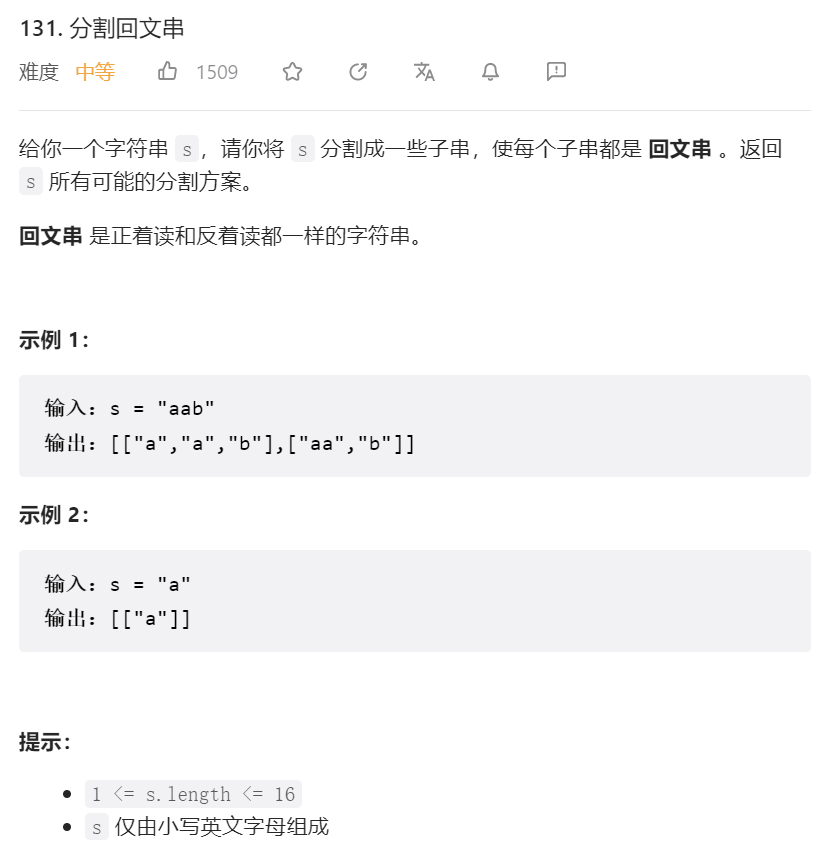
方法一:回溯
二刷
1
2
3
4
5
6
7
8
9
10
11
12
13
14
15
16
17
18
19
20
21
22
23
24
25
26
27
28
29
30
31
32
33
34
35
class Solution {new LinkedList <>();new LinkedList <>();public List<List<String>> partition (String s) {0 );return res;private void backtracking (String s, int start) {if (start == s.length()) {new LinkedList <>(path));return ;for (int i = start; i < s.length(); ++i) {String split = s.substring(start, i + 1 );if (isValid(split)) {1 );private boolean isValid (String split) {int start = 0 , end = split.length() - 1 ;while (start < end) {if (split.charAt(start++) != split.charAt(end--))return false ;return true ;
方法二:回溯 + DP预处理
使用动态规划得到所有子串是否是回文
状态:dp[i][j] 表示字符串s在[i,j]区间的子串是否是一个回文串。 状态转移方程:当 s[i] == s[j] && (j - i < 2 || dp[i + 1][j - 1]) 时,dp[i][j]=true,否则为false 这个状态转移方程是什么意思呢?
当只有一个字符时,比如 a 自然是一个回文串。 当有两个字符时,如果是相等的,比如 aa,也是一个回文串。 当有三个及以上字符时,比如 ababa 这个字符记作串 1,把两边的 a 去掉,也就是 bab 记作串 2,可以看出只要串2是一个回文串,那么左右各多了一个 a 的串 1 必定也是回文串。所以当 s[i]==s[j] 时,自然要看 dp[i+1][j-1] 是不是一个回文串。
1
2
3
4
5
6
7
8
9
10
11
12
13
14
15
16
17
18
19
20
21
22
23
24
25
26
27
28
29
30
31
32
33
34
35
36
37
38
39
class Solution {public List<List<String>> partition (String s) {this .s = s;new boolean [n][n];for (int i = n - 1 ; i >= 0 ; --i) {for (int j = i; j < n; ++j) {if (s.charAt(i) == s.charAt(j) && (j - i + 1 <= 2 || dp[i + 1 ][j - 1 ]))true ;0 );return res;public void dfs (int index) {if (index == n) {new LinkedList (path));return ;for (int i = index; i < n; ++i) {String sub = s.substring(index, i + 1 );if (dp[index][i]) {1 );boolean [][] dp;new LinkedList <>();new LinkedList <>();int n;
1
2
3
4
5
6
7
8
9
10
11
12
13
14
15
16
17
18
19
20
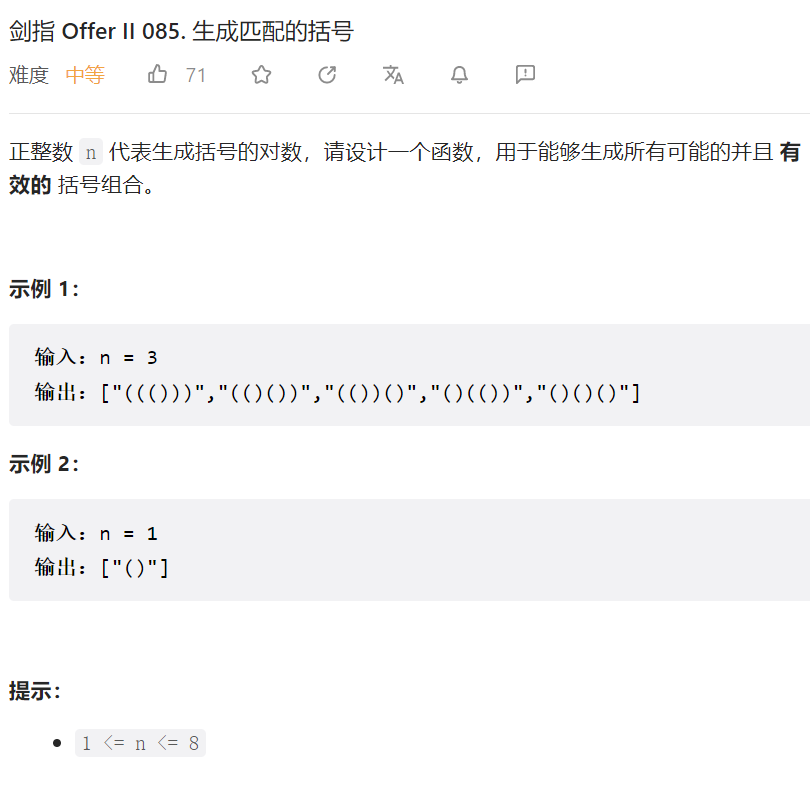
class Solution {new LinkedList <>();public List<String> generateParenthesis (int n) {"" );return res;private void backtracking (int leftNum, int rightNum, String parenthesis) {if (leftNum == 0 && rightNum == 0 ) {return ;if (leftNum > 0 ) {1 , rightNum, parenthesis + "(" );if (leftNum < rightNum) {1 , parenthesis + ")" );
方法二:StringBuilder
1
2
3
4
5
6
7
8
9
10
11
12
13
14
15
16
17
18
19
20
21
22
23
24
25
class Solution {new LinkedList <>();StringBuilder path = new StringBuilder ();public List<String> generateParenthesis (int n) {return res;private void backtracking (int left, int right) {if (left == 0 && right == 0 ) {return ;if (left > 0 ) {"(" );1 , right);1 );if (left < right) {")" );1 );1 );
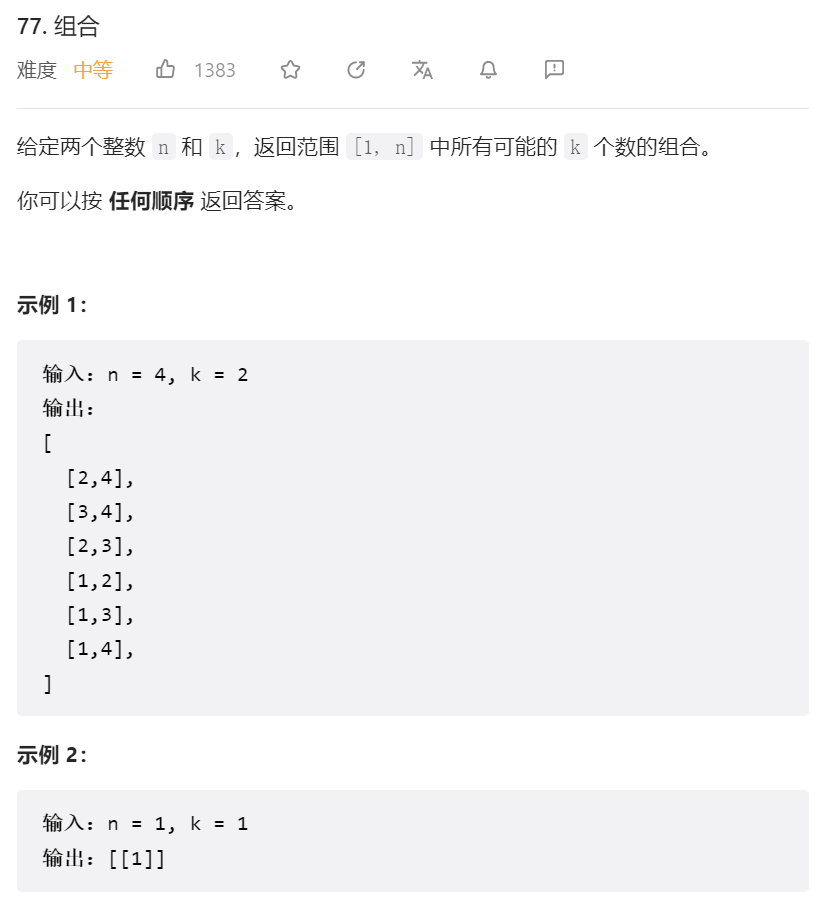
方法一:
剪枝:
当前最多用n - i + 1 当前还需要加入k - path.size()个数组
n - i + 1 >= k - path.size
1
2
3
4
5
6
7
8
9
10
11
12
13
14
15
16
17
18
19
20
class Solution {new LinkedList <>();new LinkedList <>();public List<List<Integer>> combine (int n, int k) {1 );return res;private void backtracking (int n, int k, int start) {if (path.size() == k) {new LinkedList <>(path));return ;for (int i = start; i <= n - (k - path.size()) + 1 ; ++i) {1 );
方法二:
1
2
3
4
5
6
7
8
9
10
11
12
13
14
15
16
17
18
19
20
21
22
23
24
class Solution {new LinkedList <>();public List<List<Integer>> combine (int n, int k) {new ArrayDeque <>(k);1 );return res;private void backtracking (Deque<Integer> path, int n, int k, int start) {if (k == 0 ) {new LinkedList <>(path));return ;int bound = n - k + 1 ;if (start > bound)return ;1 );1 , start + 1 );
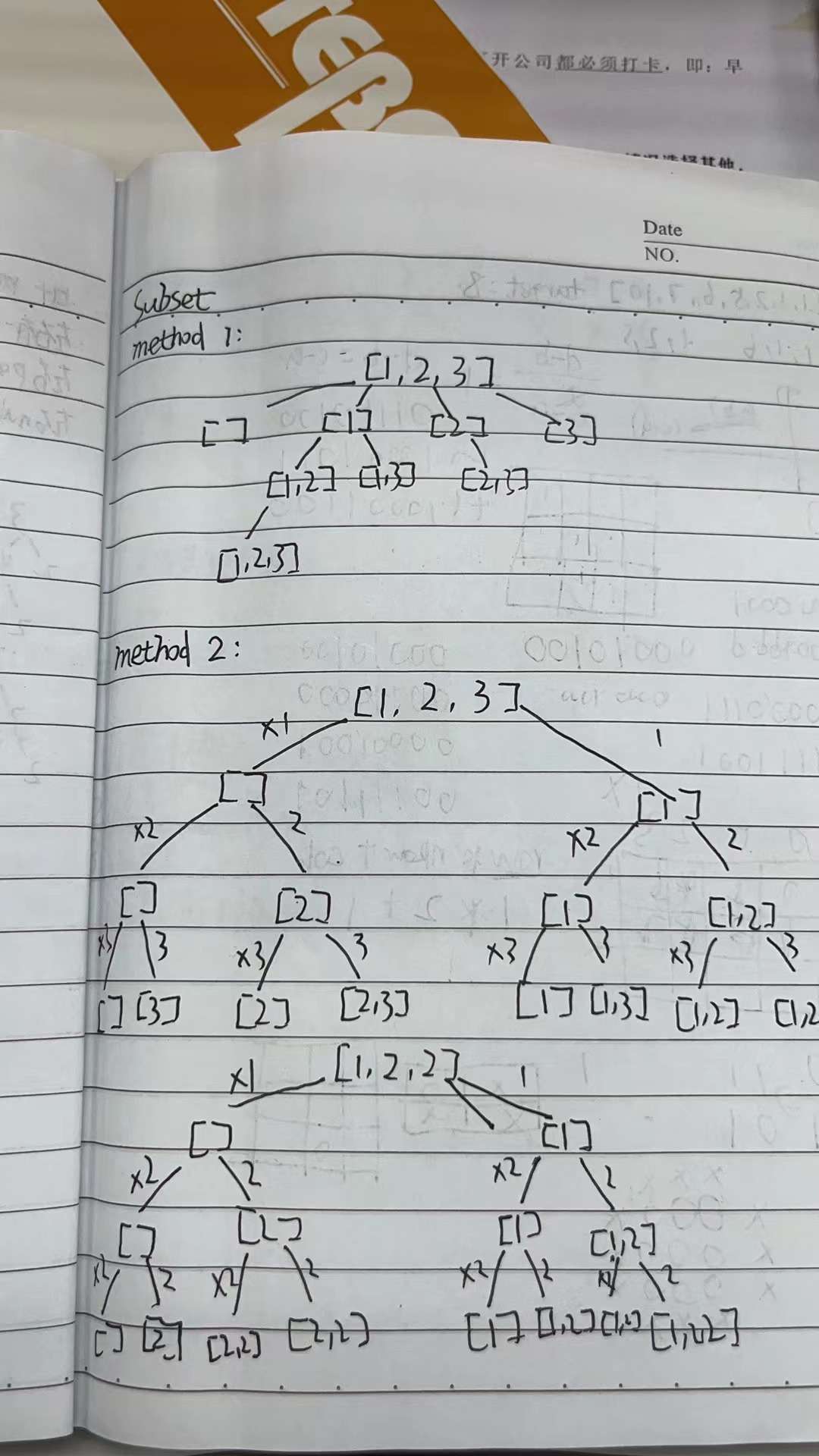
两种方法的树形结构(求子集为例子)
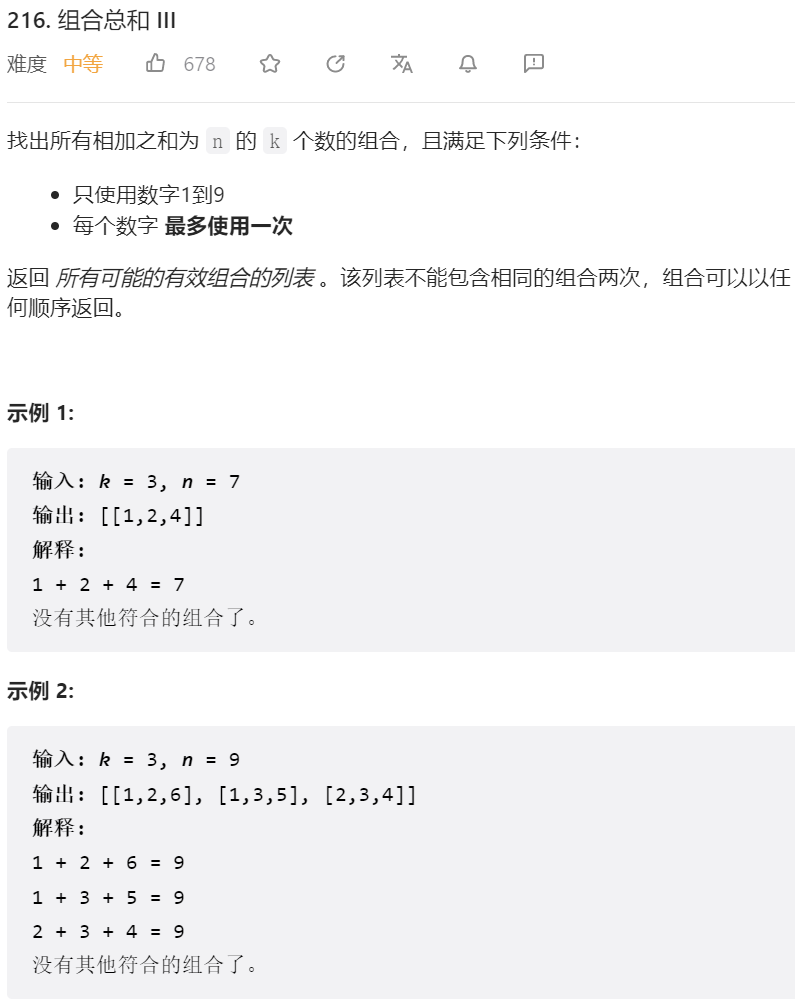
方法一:
注意:backtracking(k - 1, n - i, i + 1);k - 1,别写成--k!!!
1
2
3
4
5
6
7
8
9
10
11
12
13
14
15
16
17
18
19
20
public class Solution {new LinkedList <>();new LinkedList <>();public List<List<Integer>> combinationSum3 (int k, int n) {1 );return res;private void backtracking (int k, int n, int start) {if (k == 0 ) {if (n == 0 )new LinkedList <>(path));return ;for (int i = start; i <= 9 - (k - path.size()) + 1 ; ++i) {1 , n - i, i + 1 );
方法二:
1
2
3
4
5
6
7
8
9
10
11
12
13
14
15
16
17
18
19
20
21
22
23
public class Solution {new LinkedList <>();new LinkedList <>();public List<List<Integer>> combinationSum3 (int k, int n) {1 );return res;private void backtracking (int k, int n, int start) {if (k == 0 ) {if (n == 0 )new LinkedList <>(path));return ;int bound = 9 - k + 1 ;if (start > bound)return ;1 );1 , n - start, start + 1 );
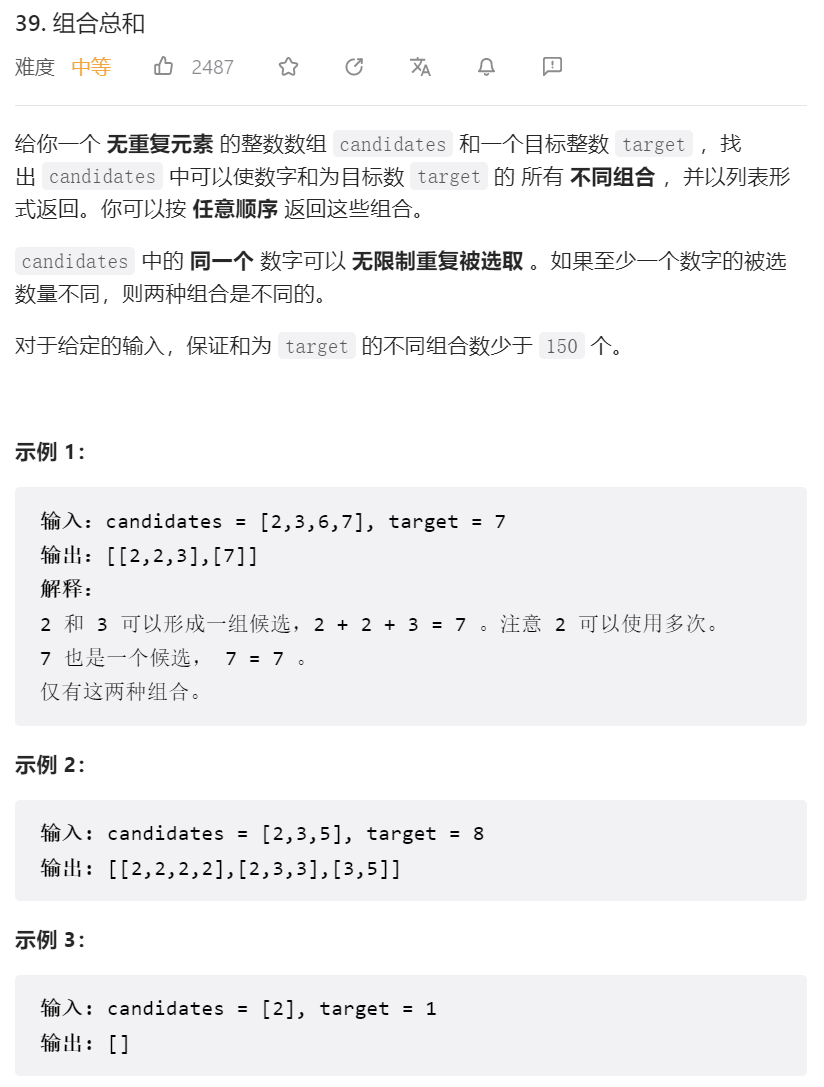
无重复元素,每个元素可以无限次选取
方法一:
剪枝:
1
2
if (target < candidates[i])break ;
可重复选取,所以backtracking传入的是当前下标i
1 backtracking(candidates, target - candidates[i], i);
剪枝的条件是把数组排序
1 Arrays.sort(candidates);
1
2
3
4
5
6
7
8
9
10
11
12
13
14
15
16
17
18
19
20
21
22
23
24
List<List<Integer>> res = new LinkedList <>();new LinkedList <>();public List<List<Integer>> combinationSum (int [] candidates, int target) {0 );return res;private void backtracking (int [] candidates, int target, int start) {if (target < 0 )return ;if (target == 0 ) {new LinkedList <>(path));return ;for (int i = start; i < candidates.length; ++i) {if (target < candidates[i])break ;
方法二:
1
2
3
4
5
6
7
8
9
10
11
12
13
14
15
16
17
18
19
20
21
22
23
class Solution {new LinkedList <>();new LinkedList <>();public List<List<Integer>> combinationSum (int [] candidates, int target) {0 );return res;private void backtracking (int [] candidates, int target, int start) {if (target < 0 || start == candidates.length)return ;if (target == 0 ) {new LinkedList <>(path));return ;1 );
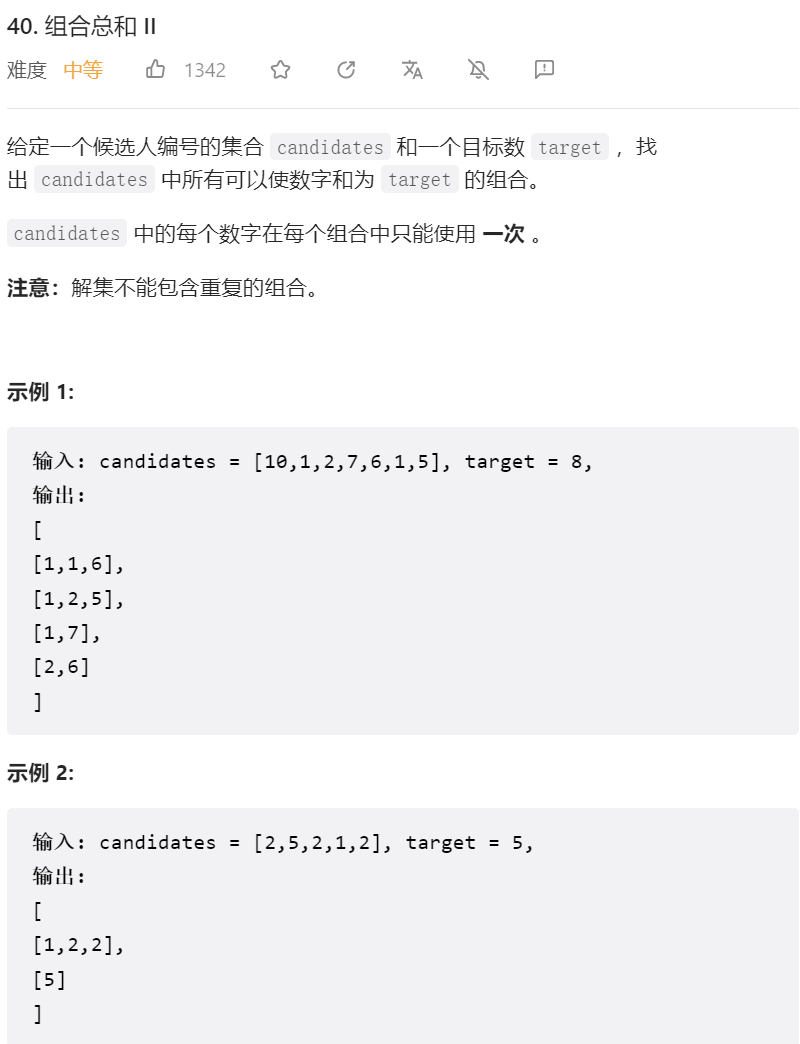
数组内有重复元素,每个元素只能使用一次,解集不能包含重复组合
方法一:
剪枝
1
2
if (candidates[i] > target)break ;
去重
1
2
if (i > start && candidates[i] == candidates[i - 1 ])continue ;
1
2
3
4
5
6
7
8
9
10
11
12
13
14
15
16
17
18
19
20
21
22
23
24
25
26
class Solution {new LinkedList <>();new LinkedList <>();public List<List<Integer>> combinationSum2 (int [] candidates, int target) {0 );return res;private void backtracking (int [] candidates, int target, int start) {if (target == 0 ) {new LinkedList <>(path));return ;for (int i = start; i < candidates.length; ++i) {if (candidates[i] > target)break ;if (i > start && candidates[i] == candidates[i - 1 ])continue ;1 );
1
2
3
4
5
6
7
8
9
10
11
12
13
14
15
16
17
18
19
20
class Solution {new LinkedList <>();new LinkedList <>();public List<List<Integer>> subsets (int [] nums) {0 );return res;private void backtracking (int [] nums, int start) {if (start == nums.length) {new LinkedList <>(path));return ;1 );1 );
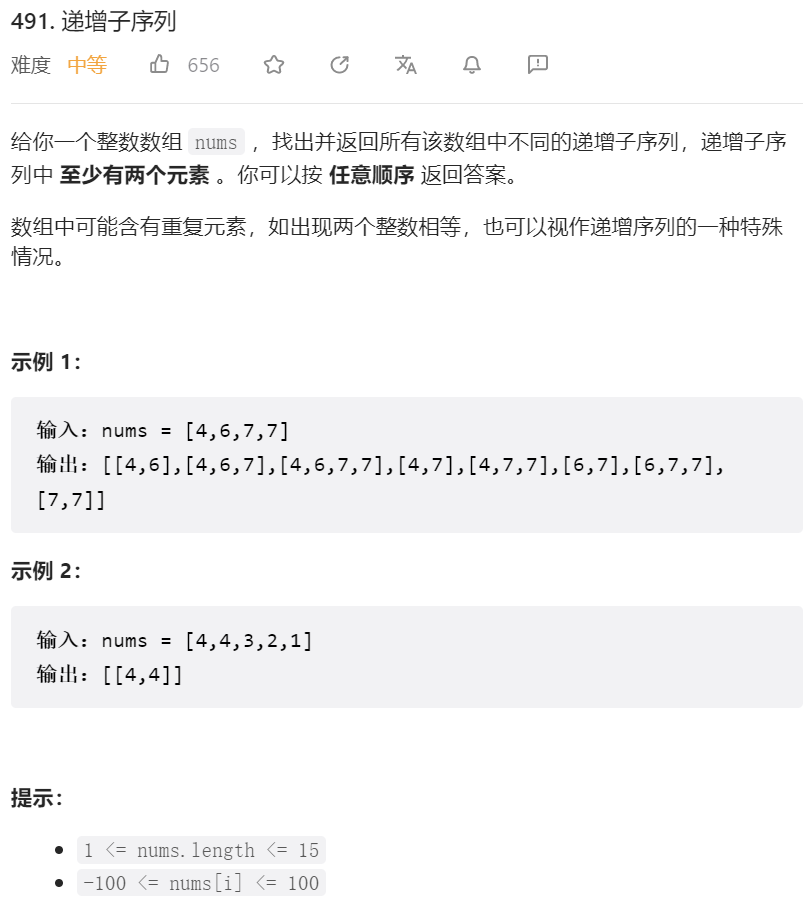
方法一:顺序DFS
注意:
HashSet的位置!!!每进入一层递归,就会在for循环前创建一个HashSet,这样可以保证树层去重,并且树枝不会去重 peekLast()! 不是peek()
1
2
3
4
5
6
7
8
9
10
11
12
13
14
15
16
17
18
19
20
21
22
23
class Solution {Integer >> res = new LinkedList<>();Integer > path = new LinkedList<>();public List<List<Integer >> findSubsequences(int [] nums) {0 );return res;public void backtracking(int [] nums, int start ) {if (path .size() >= 2 )add (new LinkedList(path ));Set <Integer > set = new HashSet<>();for (int i = start ; i < nums.length; ++i) {if ((!path .isEmpty() && nums[i] < path .peekLast()))continue ;if (set .contains(nums[i]))continue ;set .add (nums[i]);path .add (nums[i]);1 );path .pollLast();
把树形结构画出来就懂了
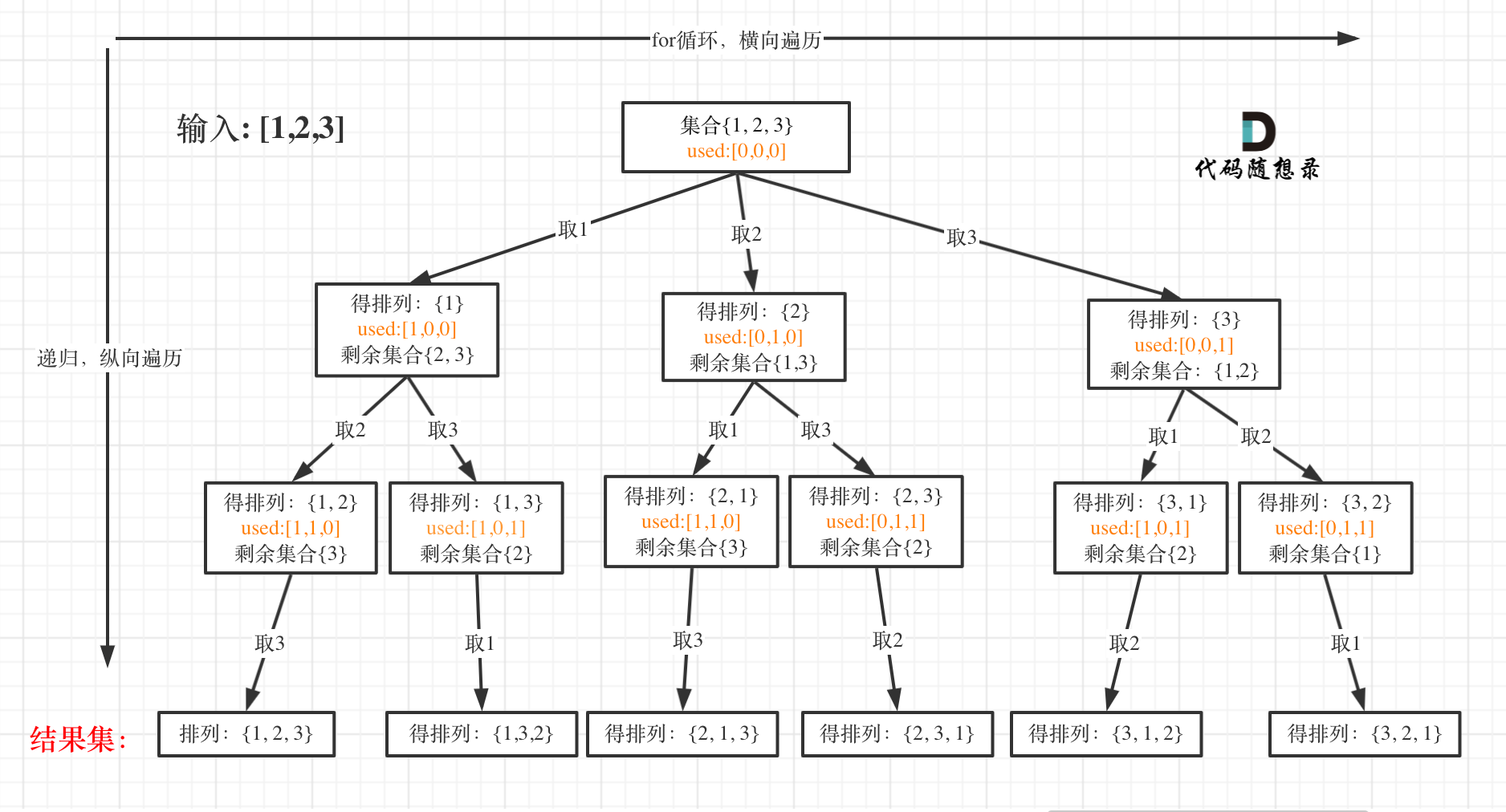
for (int i = 0; i < nums.length; ++i) { if (used[i]) continue;与 for (int i = 0; i < nums.length && !used[i]; ++i) 的区别
这两个循环的区别在于循环终止条件的判断逻辑。
第一个循环: 1 2 3 4 5 for (int i = 0 ; i < nums.length; ++i) {if (used[i])continue ;
nums 的所有元素,但在每次迭代中,如果当前元素已经被标记为 used[i],则会使用 continue 跳过后续的代码逻辑,直接进入下一次迭代。
第二个循环: 1 2 3 for (int i = 0 ; i < nums.length && !used[i]; ++i) {
nums 的所有元素,但在每次迭代中,会先检查终止条件 i < nums.length && !used[i]。只有当两个条件都满足时,才会执行循环体中的代码逻辑。如果其中任何一个条件不满足,循环就会终止。
1 2 3 4 5 6 7 8 9 10 11 12 13 14 15 16 17 18 19 20 21 22 23 24 25 26 27 28 class Solution {new LinkedList <>();boolean [] used;public List<List<Integer>> permute (int [] nums) {new ArrayDeque <>(nums.length);new boolean [nums.length];0 );return res;private void backtracking (int [] nums, int start) {if (path.size() == nums.length) {new ArrayList <>(path));return ;for (int i = 0 ; i < nums.length; ++i) {if (used[i])continue ;true ;1 );false ;
为了去重,需要先将数组排序 树层去重,树枝不需要去重 上一个相同的数如果used[i - 1] == false,那么说明已经被遍历过,并且将used数组赋值回false,这个时候就不需要遍历当前nums[i]了;如果used[i - 1] == true,那么说明是在同一路径上
1 2 if (i > 0 && nums[i] == nums[i - 1 ] && !used[i - 1 ])continue ;
1 2 3 4 5 6 7 8 9 10 11 12 13 14 15 16 17 18 19 20 21 22 23 24 25 26 27 28 29 30 31 class Solution {new LinkedList <>();boolean [] used;public List<List<Integer>> permuteUnique (int [] nums) {new ArrayDeque <>(nums.length);new boolean [nums.length];0 );return res;private void backtracking (int [] nums, int start) {if (path.size() == nums.length) {new ArrayList <>(path));return ;for (int i = 0 ; i < nums.length; ++i) {if (used[i])continue ;if (i > 0 && nums[i] == nums[i - 1 ] && !used[i - 1 ])continue ;true ;1 );false ;
优质题解
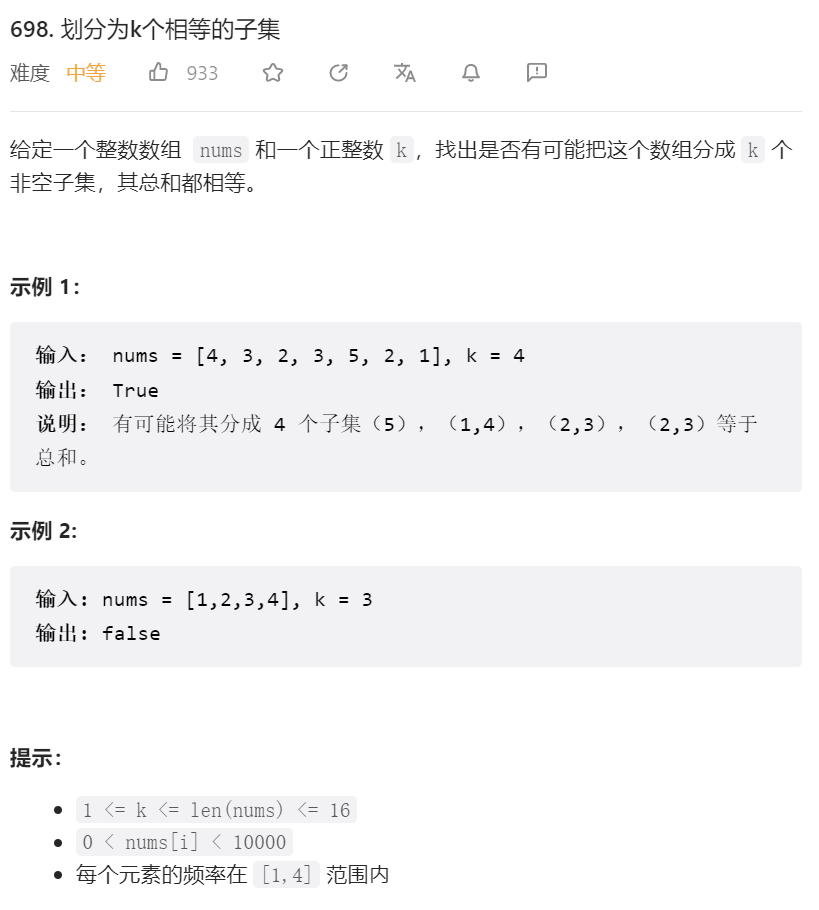
1 2 3 4 5 6 7 8 9 10 11 12 13 14 15 16 17 18 19 20 21 22 23 24 25 26 27 28 29 30 31 32 33 34 35 36 37 38 39 40 class Solution {new LinkedList <>();new LinkedList <>();int [] bucket;public boolean canPartitionKSubsets (int [] nums, int k) {int sum = Arrays.stream(nums).sum();if (sum % k != 0 )return false ;int target = sum / k;new int [k];int l = 0 , r = nums.length - 1 ;while (l < r) {int temp = nums[l];return backtracking(nums, k, target, 0 );private boolean backtracking (int [] nums, int k, int target, int index) {if (index == nums.length)return true ;for (int i = 0 ; i < k; ++i) {if (i > 0 && bucket[i - 1 ] == bucket[i])continue ;if (nums[index] + bucket[i] > target)continue ;if (backtracking(nums, k, target, index + 1 ))return true ;return false ;
方法一:回溯
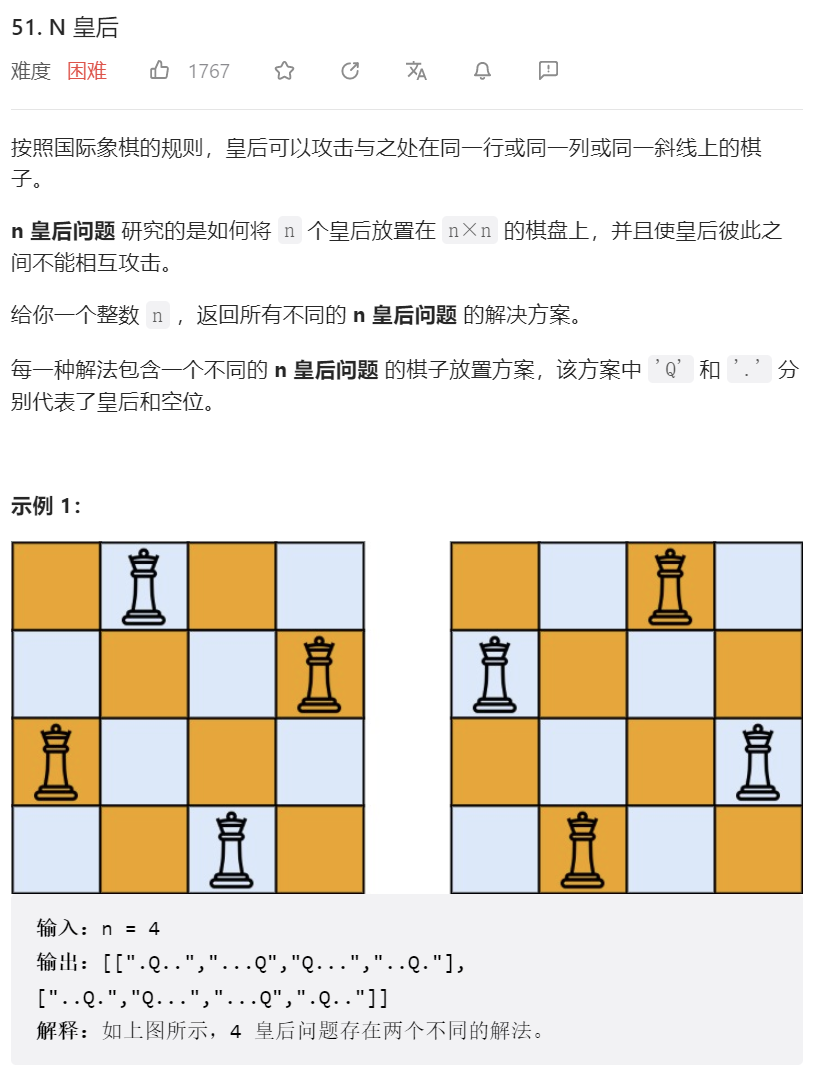
可以通过(c == colum[i] || r + c == i + colum[i] || r - c == i - colum[i])来判断是否同列,同对角线
1 2 3 4 5 6 7 8 9 10 11 12 13 14 15 16 17 18 19 20 21 22 23 24 25 26 27 28 29 30 31 32 33 34 35 36 37 38 39 40 41 42 43 44 45 46 47 48 49 50 51 class Solution {public List<List<String>> solveNQueens (int n) {this .n = n;new int [n]; 0 );return res;public void dfs (int index) {if (index == n) { return ;for (int i = 0 ; i < n; ++i) { if (isValid(index, i)) {1 );public boolean isValid (int r, int c) {for (int i = 0 ; i < r; ++i) {if (c == colum[i] || r + c == i + colum[i] || r - c == i - colum[i])return false ;return true ;public List<String> build () {new ArrayList <>();StringBuilder sb = new StringBuilder ();for (int x : colum) {for (int i = 0 ; i < x; ++i)'.' );'Q' );for (int i = 0 ; i < n - x - 1 ; ++i)'.' );new StringBuilder ();return s;new ArrayList <>();new LinkedList <>();int [] colum;int n;
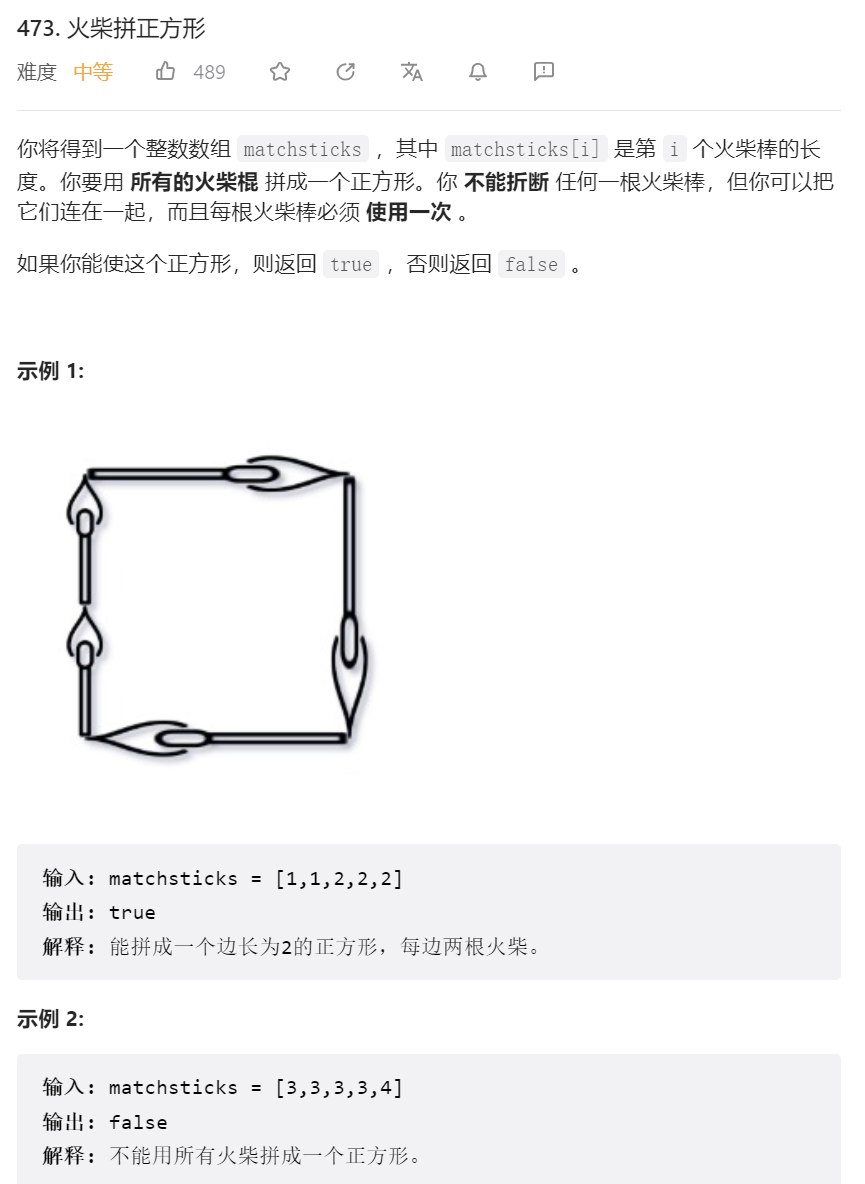
与698. 划分为k个相等的子集 一道题
方法一:回溯
1 2 3 4 5 6 7 8 9 10 11 12 13 14 15 16 17 18 19 20 21 22 23 24 25 26 27 28 29 30 31 32 33 34 35 36 37 class Solution {new LinkedList <>();new LinkedList <>();int [] bucket = new int [4 ];public boolean makesquare (int [] matchsticks) {int sum = Arrays.stream(matchsticks).sum();if (sum % 4 != 0 )return false ;int target = sum / 4 , l = 0 , r = matchsticks.length - 1 ;while (l < r) {int temp = matchsticks[l];return backtracking(matchsticks, 0 , target);private boolean backtracking (int [] matchsticks, int index, int target) {if (index == matchsticks.length)return true ;for (int i = 0 ; i < 4 ; ++i) {if (i > 0 && bucket[i - 1 ] == bucket[i])continue ;if (matchsticks[index] + bucket[i] > target)continue ;if (backtracking(matchsticks, index + 1 , target))return true ;return false ;
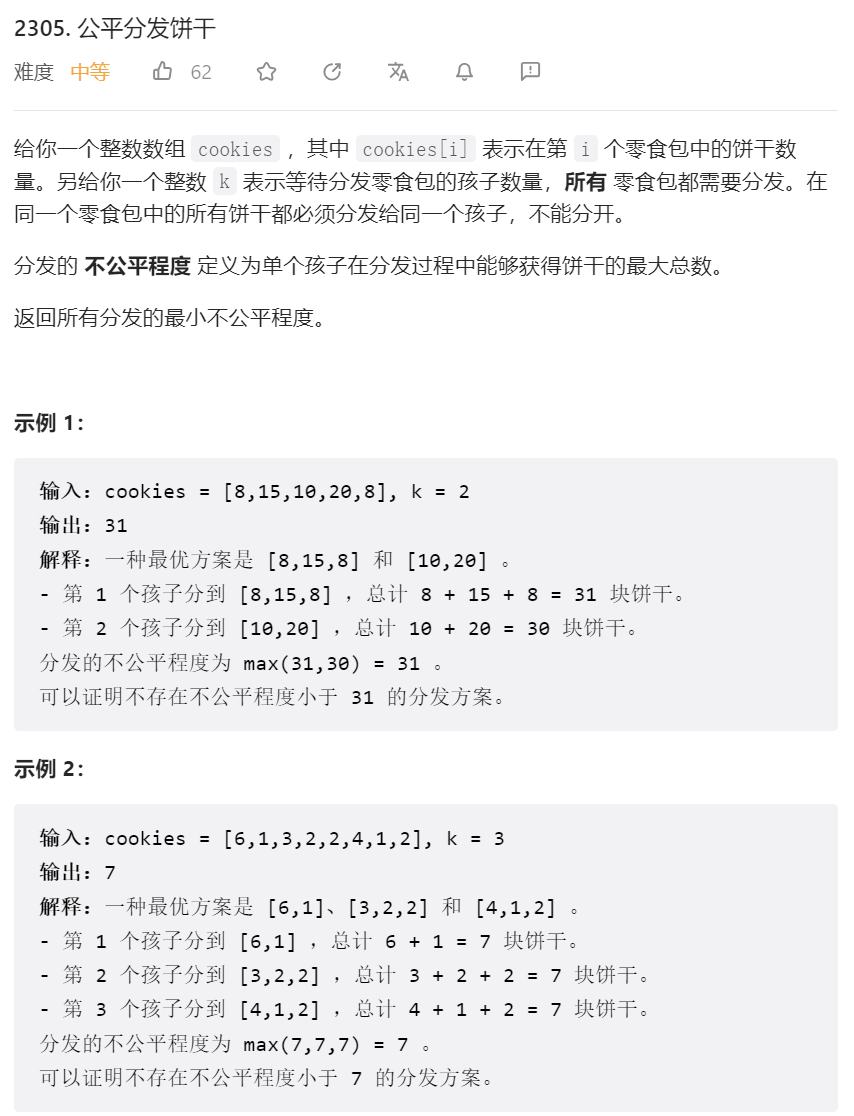
方法一:回溯
1 2 3 4 5 6 7 8 9 10 11 12 13 14 15 16 17 18 19 20 21 22 23 24 25 26 27 28 class Solution {int res = Integer.MAX_VALUE;int [] bucket;public int distributeCookies (int [] cookies, int k) {new int [k];0 );return res;private void backtracking (int [] cookies, int k, int index) {if (index == cookies.length) {int curAns = Integer.MIN_VALUE;for (int count : bucket){return ;for (int i = 0 ; i < k; ++i) {if (i > 0 && bucket[i - 1 ] == bucket[i])continue ;1 );
方法二:回溯 + 二分
求最小的最大值
用k个框(bucket)装一个数组,所有框统一尺寸,要求框的最小尺寸
left是数组的最大元素,right是数组元素之和,如果把框的尺寸设为left,那么大概率不能容纳所有数组元素:
left = mid + 1;如果把框的尺寸设为right,肯定能装下数组所有元素:right = mid - 1
只要check(cookies, mid, k)为true,说明mid刚刚好或者选大了,框的上界可以进一步缩小,
当最后一次满足check(cookies, mid, k)为true并向左滑动右区间,之后只会向右滑动左区间,
最后left = right + 1退出while循环,left就是最小的最大值
1 2 3 4 5 6 7 8 9 10 11 12 13 14 15 16 17 18 19 20 21 22 23 24 25 26 27 28 29 30 31 32 33 34 35 36 37 38 39 40 41 42 43 44 45 46 47 48 49 class Solution {int [] bucket;public int distributeCookies (int [] cookies, int k) {new int [k];int l = 0 , r = cookies.length - 1 , sum = 0 ;while (l < r) {int temp = cookies[l];if (cookies.length % 2 != 0 )2 ];0 ]; while (l <= r) {int mid = (l + r) >> 1 ;if (check(cookies, mid, k)) 1 ;else 1 ;return l;private boolean check (int [] cookies, int mid, int k) {new int [k];return backtracking(cookies, mid, k, 0 );private boolean backtracking (int [] cookies, int limit, int k, int index) {if (index == cookies.length)return true ; for (int i = 0 ; i < k; ++i) {if (i > 0 && bucket[i - 1 ] == bucket[i]) continue ;if (bucket[i] + cookies[index] > limit)continue ;if (backtracking(cookies, limit, k, index + 1 ))return true ; return false ;
与2305. 公平分发饼干 一模一样
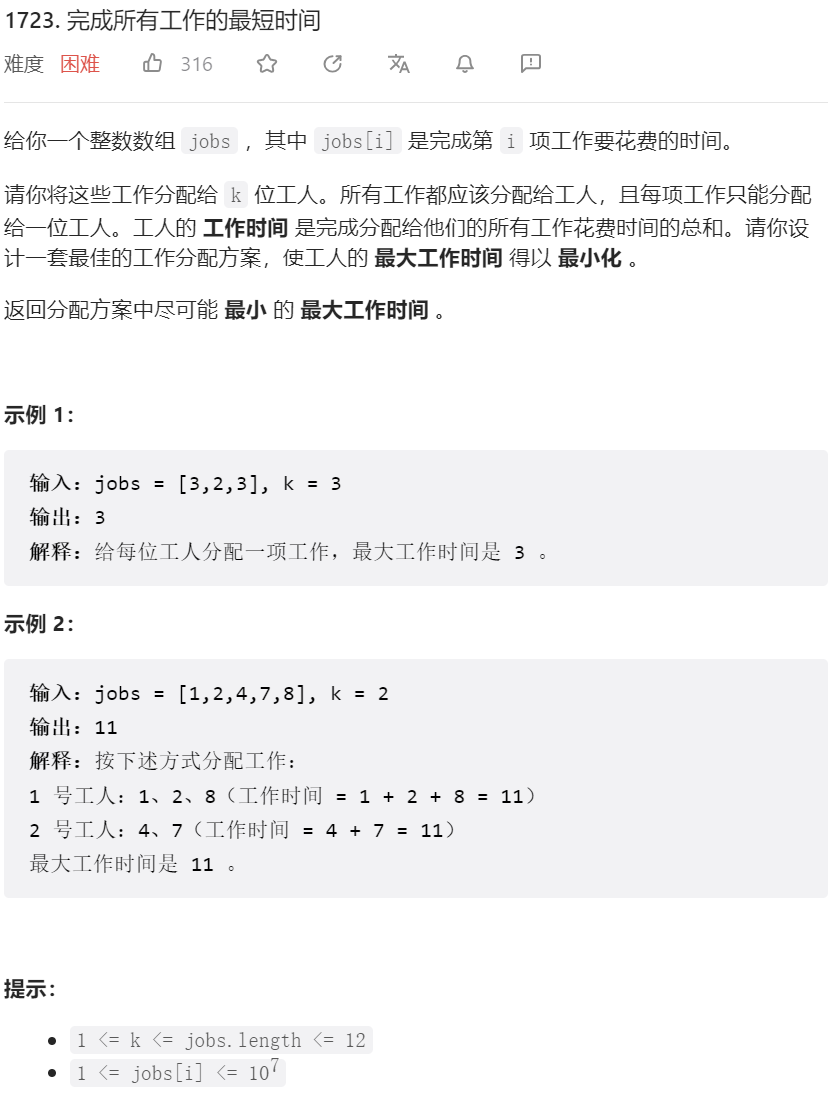
方法一:二分 + 回溯
这里的二分和之前做的二分不太一样
要求最小的最大值,我们用二分去测试,如果允许每个bucket的最大值为mid,是否能用k个bucket容纳下jobs的所有元素 l取jobs中最大的元素,r取jobs的和sum,比如每个bucket的最大值为sum,那么一个bucket就能容纳下jobs的所有元素,那么肯定是要取更小的bucket的最大值
1 2 3 4 5 6 7 8 9 10 11 12 13 14 15 16 17 18 19 20 21 22 23 24 25 26 27 28 29 30 31 32 33 34 35 36 37 38 39 40 41 42 43 44 45 46 47 class Solution {int [] bucket;public int minimumTimeRequired (int [] jobs, int k) {new int [k];int l = 0 , r = jobs.length - 1 ;while (l < r) {int temp = jobs[l];0 ];while (l <= r) {int mid = (l + r) >> 1 ;if (check(jobs, mid, k)) 1 ;else 1 ;return l;private boolean check (int [] jobs, int limit, int k) {new int [k];return backtracking(jobs, limit, k, 0 );private boolean backtracking (int [] jobs, int limit, int k, int index) {if (index == jobs.length)return true ;for (int i = 0 ; i < k; ++i) {if (i > 0 && bucket[i - 1 ] == bucket[i])continue ;if (jobs[index] + bucket[i] > limit)continue ;if (backtracking(jobs, limit, k, index + 1 ))return true ;return false ;
优化求sum部分
1 2 3 4 5 6 7 8 9 10 11 12 13 14 15 16 17 18 19 20 21 22 23 24 25 26 27 28 29 30 31 32 33 34 35 36 37 38 39 40 41 42 43 44 45 46 47 48 49 50 class Solution {int [] bucket;public int minimumTimeRequired (int [] jobs, int k) {new int [k];int l = 0 , r = jobs.length - 1 , sum = 0 ;while (l < r) {int temp = jobs[l];if (jobs.length % 2 != 0 )2 ];0 ]; while (l <= r) {int mid = (l + r) >> 1 ;if (check(jobs, mid, k)) 1 ;else 1 ;return l;private boolean check (int [] jobs, int limit, int k) {new int [k];return backtracking(jobs, limit, k, 0 );private boolean backtracking (int [] jobs, int limit, int k, int index) {if (index == jobs.length)return true ;for (int i = 0 ; i < k; ++i) {if (i > 0 && bucket[i - 1 ] == bucket[i])continue ;if (jobs[index] + bucket[i] > limit)continue ;if (backtracking(jobs, limit, k, index + 1 ))return true ;return false ;
二刷
省略check,每次在dfs前重新初始化bucket数组
1
2
3
4
5
6
7
8
9
10
11
12
13
14
15
16
17
18
19
20
21
22
23
24
25
26
27
28
29
30
31
32
33
34
35
36
37
38
39
40
41
42
43
44
45
46
public int minimumTimeRequired (int [] jobs, int k) {new int [k];int l = 0 , r = jobs.length - 1 , sum = 0 ;while (l < r) {int temp = jobs[l];if (jobs.length % 2 == 1 )2 ];0 ];while (l <= r) {int mid = (l + r) >> 1 ;if (dfs(jobs, k, mid, 0 ))1 ;else 1 ;return l;int [] bucket;private boolean dfs (int [] jobs, int k, int target, int index) {if (index == jobs.length) {new int [k];return true ;for (int i = 0 ; i < k; ++i) {if (i > 0 && bucket[i - 1 ] == bucket[i])continue ;if (bucket[i] + jobs[index] > target)continue ;if (dfs(jobs, k, target,index + 1 ))return true ;return false ;