LeetCode Solutions
Dynamic Programming
debug
1
2
3
4
5
6
7
private static void printDp (int [] dp, int i) {": " );for (int maxValue : dp){" " );
方法一:DP
1
2
3
4
5
6
7
8
9
10
11
12
class Solution {public int fib (int n) {if (n == 0 )return 0 ;int [] dp = new int [n + 1 ];1 ] = 1 ;for (int i = 2 ; i <= n; ++i) {2 ] + dp[i - 1 ];return dp[n];
方法二:DP + 滚动数组
1
2
3
4
5
6
7
8
9
10
11
12
class Solution {public int fib (int n) {if (n == 0 )return 0 ;int [] dp = new int [3 ];1 ] = 1 ;for (int i = 2 ; i <= n; ++i) {3 ] = dp[(i - 2 ) % 3 ] + dp[(i - 1 ) % 3 ];return dp[n % 3 ];
方法一:DP + 滚动数组
1
2
3
4
5
6
7
8
9
10
11
12
13
14
15
class Solution {public int climbStairs (int n) {int [] dp = new int [3 ];0 ] = 1 ;1 ] = 1 ;for (int i = 2 ; i <= n; ++i) {3 ] = dp[(i - 1 ) % 3 ] + dp[(i - 2 ) % 3 ];return dp[n % 3 ];
注意:最后一个阶梯之后才是楼顶
image-20230512125550663
方法一:DP + 滚动数组
1
2
3
4
5
6
7
8
9
10
11
12
13
14
15
class Solution {public int minCostClimbingStairs (int [] cost) {int n = cost.length;int [] dp = new int [3 ];0 ] = 0 ;1 ] = 0 ;for (int i = 2 ; i <= n; ++i) {3 ] = Math.min(dp[(i - 2 ) % 3 ] + cost[i - 2 ], dp[(i - 1 ) % 3 ] + cost[i - 1 ]);return dp[n % 3 ];
剑指Offer 95
最优子结构:求最长 公共子序列,求问题最优解,适合使用dp解决。
重叠子问题:求第一个字符串中位置0~\(i\) 构成的子序列与第二个字符串中0~\(j\) 构成的子序列的最大公共子序列\(f(i,j)\) ,需要多次使用\(f(i-1, j-1), f(i-1,j),f(i,j-1)\) ,拥有重叠子问题
状态转移方程: \[
f(i,j) =
\begin{cases}
f(i-1,j-1)+1, & ch[i]==ch[j] \\
max(f(i-1,j),f(i,j-1)), & else \\
\end{cases}
\]
边界条件:dp[0][:] == 0, dp[:][] == 0
令两个字符串长度分别为\(m,n\) ,
时间复杂度 :双重for循环,\(O(mn)\)
空间复杂度 :需要建立大小为(m+1)(n+1)的数组,因此空间复杂度为\(O(mn)\)
1
2
3
4
5
6
7
8
9
10
11
12
13
14
15
16
17
class Solution {public int longestCommonSubsequence (String text1, String text2) {int m = text1.length(), n = text2.length();int [][] dp = new int [m + 1 ][n + 1 ];for (int i = 1 ; i <= m; ++i) {for (int j = 1 ; j <= n; ++j) {if (text1.charAt(i - 1 ) == text2.charAt(j - 1 )) {1 ][j - 1 ] + 1 ;else {1 ][j], dp[i][j - 1 ]);return dp[m][n];
如何优化空间复杂度?
分析 :只要在数组中找到任意数等于数组累加和的一半,该数组就是等和子集,可抽象为经典0-1背包问题。
dp[i][j]:从编号0-i的物品中任选物品(可以都不选),容量为j的背包能否正好装满
递归公式:dp[i][j] = dp[i-1][j] || j >= num[i] : dp[i-1][j-nums[i]] : false
初始化:
当j==0时,即背包容量为0,不管有多少物品,只要什么都不选就能使背包总重量为0,所以f(i,0)=true
当i==0 && j!= 0时,即物品数量为0,怎样都不能放满容量大于0的背包,所以f(0,i)=false
遍历顺序:先遍历物品再嵌套从头到尾遍历容量
打印dp数组验证与手写稿是否一致
空间复杂度优化 :由于求第i行dp数组只需要用到第i-1行dp数组的信息,所以可以使用一维滑动dp数组代替二维dp数组。
从 stones数组中选择,凑成总和不超过 \(sum/2\) 的最大价值
1
2
3
4
5
6
7
8
9
10
11
12
13
14
class Solution {public int lastStoneWeightII (int [] stones) {int sum = Arrays.stream(stones).sum();int target = sum / 2 ;int [] dp = new int [target + 1 ];for (int i = 0 ; i < stones.length; ++i) {for (int j = target; j >= stones[i]; --j) {return sum - dp[target] * 2 ;
背包问题中,weight里的数据不一定要升序!比如weights=[4,1,3]
方法一:DP
1
2
3
4
5
6
7
8
9
10
11
12
13
14
15
16
17
18
19
20
21
22
23
24
25
class Solution {public int findMaxForm (String[] strs, int m, int n) {int [][][] dp = new int [strs.length + 1 ][m + 1 ][n + 1 ];for (int k = 1 ; k <= strs.length; ++k) {String str = strs[k - 1 ];int num0 = 0 , num1 = 0 ;for (int x = 0 ; x < str.length(); ++x) {if (str.charAt(x) == '0' )else for (int i = 0 ; i <= m; ++i) {for (int j = 0 ; j <= n; ++j) {if (i < num0 || j < num1)1 ][i][j];else 1 ][i][j], dp[k - 1 ][i - num0][j - num1] + 1 );return dp[strs.length][m][n];
方法二:DP+滚动数组
1
2
3
4
5
6
7
8
9
10
11
12
13
14
15
16
17
18
19
20
21
22
class Solution {public int findMaxForm (String[] strs, int m, int n) {int [][] dp = new int [m + 1 ][n + 1 ];for (int k = 1 ; k <= strs.length; ++k) {String str = strs[k - 1 ];int num0 = 0 , num1 = 0 ;for (int x = 0 ; x < str.length(); ++x) {if (str.charAt(x) == '0' )else for (int i = m; i >= num0; --i) {for (int j = n; j >= num1; --j) {1 );return dp[m][n];
经典完全背包问题,解题步骤如下:
dp[j]:背包容量为j时,放满背包的组合方法数
状态转移公式:dp[j] = dp[j] + dp[j - coins[i]]
初始化dp[0]:背包容量为0时,有一种方法放满背包(什么都不放)
遍历顺序:求组合数,先便利物品,再遍历容量
遍历dp数组
关于组合和排列的理解 :先遍历物品后遍历背包是这样,比如,外层循环固定coins[1],在内层循环遍历背包时,随着背包不断增加,coins[1]可以重复被添加进来,而由于外层循环固定了,因此coins[2]只能在下一次外层循环添加进不同大小的背包中,这么看的话,coins[i + 1]只能在coins[i]之后了;如果先遍历背包后遍历物品,那么外层循环先固定背包大小j,然后在大小为j的背包中循环遍历添加物品,然后在下次外层循环背包大小变为j+1,此时仍要执行内层循环遍历添加物品,也就会出现在上一轮外层循环中添加coins[2]的基础上还能再添加coins[1]的情况,那么就有了coins[1]在coins[2]之后的情况了(逆序)。
如果求组合数就是外层for循环遍历物品,内层for遍历背包。
如果求排列数就是外层for遍历背包,内层for循环遍历物品。
先举个例子,nums = [1, 2, 3],target = 35.
假设用1,2,3拼凑出35的总组合个数为y。我们可以考虑三种情况:
(1)有效组合的末尾数字为1,这类组合的个数为 x1。我们把所有该类组合的末尾1去掉,那么不难发现,我们找到了一个子问题,x1即为在[1,2,3]中凑出35 - 1 = 34的总组合个数。因为我如果得到了和为34的所有组合,我只要在所有组合的最后面,拼接一个1,就得到了和为35且最后一个数字为1的组合个数了。
(2)有效组合的末尾数字为2,这类组合的个数为 x2。我们把所有该类组合的末尾2去掉,那么不难发现,我们找到了一个子问题,x2即为在[1,2,3]中凑出35 - 2 = 33的总组合个数。因为我如果得到了和为33的所有组合,我只要在所有组合的最后面,拼接一个2,就得到了和为35且最后一个数字为2的组合个数了。
(3)有效组合的末尾数字为3,这类组合的个数为 x3。我们把所有该类组合的末尾3去掉,那么不难发现,我们找到了一个子问题,x3即为在[1,2,3]中凑出35 - 3 = 32的总组合个数。因为我如果得到了和为32的所有组合,我只要在所有组合的最后面,拼接一个3,就得到了和为35且最后一个数字为3的组合个数了。
这样就简单了,y = x1 + x2 + x3。而x1,x2,x3又可以用同样的办法从子问题得到。状态转移方程get!
全排列问题,转化为完全背包问题
dp[j]:在背包容量为j时,放满背包的排列数
状态转移公式:dp[j] = dp[j] + dp[j - nums[i]]
初始化dp[0]:在背包容量为0时,放满背包的排列数量为1(什么都不放)
遍历顺序,排列问题,先遍历背包容量(物品可以逆序放入dp[j - nums[i]]),再遍历物品
打印dp数组
完全背包 + 全排列问题,可以重复选择放入物品1与物品2,求放满容量为n的背包的排列数
dp[j]:在背包容量为j时,放满背包的排列数
状态转移公式:dp[j] = dp[j] + dp[j - nums[i]]
初始化dp[0]:在背包容量为0时,放满背包的排列数量为1(什么都不放)
遍历顺序,排列问题,先遍历背包容量(物品可以逆序放入dp[j - nums[i]]),再遍历物品
打印dp数组
完全背包问题
dp[j]:背包容量为j时,凑满背包容量所需的最少硬币数
状态转移公式:dp[j] = min(dp[j], dp[j - coins[i]] + 1)
初始化dp[0]:背包容量为0时,凑满背包容量所需的最少硬币数时0,其他初始化为Integer.MAX_VALUE
遍历顺序,无所谓
打印dp数组
1
2
3
4
5
6
7
8
9
10
11
12
13
14
15
16
17
class Solution {public int coinChange (int [] coins, int amount) {int [] dp = new int [amount + 1 ];0 ] = 0 ;for (int i = 0 ; i < coins.length; ++i) {for (int j = coins[i]; j <= amount; ++j) {if (dp[j - coins[i]] != Integer.MAX_VALUE)1 );return dp[amount] == Integer.MAX_VALUE ? -1 : dp[amount];
dp[j]:装满容量为j的背包,至少要放多少个物品
状态转移公式:dp[j] = min(dp[j], dp[j - weights[i]] + 1)
初始化dp[0]:装满容量为0的背包,至少放0个物品;其他设为Integet.MAX_VALUE
遍历顺序:无所谓
打印dp数组
1
2
3
4
5
6
7
8
9
10
11
12
13
14
15
16
17
18
19
20
21
22
23
24
25
26
27
28
29
30
31
32
33
34
35
36
class Solution {public int numSquares (int n) {int max_weight = (int )(Math.sqrt(n)); int [] weights = new int [max_weight];for (int i = 1 ; i <= max_weight; i++)1 ] = i*i; int [] dp = new int [n + 1 ];for (int i = 1 ; i <= n; i++) {for (int i = 0 ; i < weights.length; i++) {for (int j = weights[i]; j <= n; j++) {if (dp[j - weights[i]] != Integer.MAX_VALUE)1 );return dp[n];private static void printDp (int [] dp, int i) {": " );for (int maxValue : dp){" " );
背包问题 + 排列 (“leetcode”由“leet”与“code”组成但不能反过来由“code”与“leet”组成 )的变种,建议不要完全抽象成背包问题,便于理解
dp[j]:长度为j的字符串,可以被字典中的单词拆分 。
状态转移公式:if([j, i] 这个区间的子串出现在字典里 && dp[j]是true) 那么 dp[i] = true, 其中j<i。
初始化dp[0]:dp[i]依赖于前面的dp[j],所以dp[0]要初始化为true,不然全为false
遍历顺序:先遍历背包容量,再嵌套遍历物品
打印dp数组
dp[j]:偷窃从标号为0到j的房屋所能获得的最大价值
状态转移公式:dp[j] = max(dp[j - 1], dp[j - 2] + nums[j])
初始化:dp[0] = nums[0], dp[1] = max(nums[0], nums[1])
遍历顺序:单序列问题,dp[i] 是根据dp[i - 2] 和 dp[i - 1] 推导出来的,那么一定是从前到后遍历!
遍历dp数组
优化空间复杂度
根据状态转移公式dp[j] = max(dp[j - 1], dp[j - 2] + nums[j]),dp[j]只需要dp[j-1]以及dp[j-2]两个变量即可,可以把数组大小压缩到2。
dp[j]:背包容量为j时,是否能用物品装满
状态转移方程:dp[j] = dp[j] || dp[j - nums[i]]
初始化:背包容量为0时,不把物品装进去即可装满,dp[0] = true
遍历顺序:一维滑动数组,零一背包,先遍历物品后遍历背包容量
方法一:HashMap
f:偷当前房屋能获得的最大价值;g:不偷当前房屋能获得的最大价值
偷当前房屋f(cur) = cur.val + g(cur.left) + g(cur.right)
不偷当前房屋g(cur) = max(f(cur.left), g(cur.left)) + max(f(cur.right), g(cur.right))
方法二:Morris + HashMap
当作是练习题了!!
注意事项: 在访问的时候,此时需要cur.right,而这个时候已经是逆序过的,cur.right实际上指向的是自己的父节点,所以再用一个hashmap存储cur真正的右节点(或者再逆序一遍)。
1
2
3
4
5
6
7
8
9
10
11
12
13
14
15
16
17
18
19
20
21
22
23
24
25
26
27
28
29
30
31
32
33
34
35
36
37
38
39
40
41
42
43
44
45
46
47
48
49
50
51
52
53
54
55
56
57
58
59
class Solution {new HashMap <>();new HashMap <>();new HashMap <>();public int rob (TreeNode root) {TreeNode cur = root, mostRight = null ;while (cur != null ) {if (mostRight != null ) {while (mostRight.right != null && mostRight.right != cur)if (mostRight.right == null ) {continue ;else { null ;return Math.max(f.getOrDefault(root, 0 ), g.getOrDefault(root, 0 ));private void visit (TreeNode cur) {TreeNode tail = reverse(cur);while (cur != null ) {0 ) + g.getOrDefault(right.get(cur), 0 ));int maxLeft = Math.max(f.getOrDefault(cur.left, 0 ), g.getOrDefault(cur.left, 0 ));int maxRight = Math.max(f.getOrDefault(right.get(cur), 0 ), g.getOrDefault(right.get(cur), 0 ));if (cur.right != null ) private TreeNode reverse (TreeNode cur) {TreeNode pre = null ;while (cur != null ) {TreeNode next = cur.right;return pre;
你根本没在dp!
方法一:暴力迭代
超时咯
image-20230330094627247
方法二:贪心
从前往后遍历,使用minPrice记录最小值,使用maxProfit记录最大收益
方法三:DP
DP数组的定义十分重要!
1
2
3
4
5
6
7
8
9
10
11
12
13
14
15
16
17
18
19
class Solution {public int maxProfit (int [] prices) {int len = prices.length;if (len == 0 || prices == null )return 0 ;int [][] dp = new int [2 ][len];0 ][0 ] = -prices[0 ];for (int j = 1 ; j < len; ++j) {0 ][j] = Math.max(dp[0 ][j - 1 ], -prices[j]);1 ][j] = Math.max(dp[1 ][j - 1 ], prices[j] + dp[0 ][j - 1 ]); return dp[1 ][len - 1 ];
1
2
3
4
5
6
7
8
9
10
11
12
13
14
15
16
17
class Solution {public int maxProfit (int [] prices) {int len = prices.length;int [][] dp = new int [2 ][len];0 ][0 ] = -prices[0 ];for (int j = 1 ; j < len; ++j) {0 ][j] = Math.max(dp[0 ][j - 1 ], dp[1 ][j - 1 ] - prices[j]);1 ][j] = Math.max(dp[1 ][j - 1 ], dp[0 ][j - 1 ] + prices[j]);return dp[1 ][len - 1 ];
1
2
3
4
5
6
7
8
9
10
11
12
13
class Solution {public int numTrees (int n) {int [] dp = new int [n + 1 ];0 ] = 1 ;1 ] = 1 ;for (int i = 2 ; i <= n; ++i) {for (int j = 1 ; j <= i; ++j) {1 ] * dp[i - j];return dp[n];
优化空间..
1
2
3
4
5
6
7
8
9
10
11
12
13
14
15
16
17
18
19
20
21
22
23
24
25
26
27
28
29
30
31
32
class Solution {new HashMap <>();new HashMap <>();new LinkedList <>();public int longestZigZag (TreeNode root) {new TreeNode []{root, null });while (!queue.isEmpty()) {0 ], 0 );0 ], 0 );if (sonFather[1 ] != null ) {if (sonFather[1 ].left == sonFather[0 ])0 ], g.get(sonFather[1 ]) + 1 );if (sonFather[1 ].right == sonFather[0 ])0 ], f.get(sonFather[1 ]) + 1 );if (sonFather[0 ].left != null ) new TreeNode []{sonFather[0 ].left, sonFather[0 ]});if (sonFather[0 ].right != null ) new TreeNode []{sonFather[0 ].right, sonFather[0 ]});int max = Integer.MIN_VALUE;for (TreeNode node : f.keySet()) {return max;
dp[i]:以nums[i]结尾的最长递增子序列的长度
从前往后,在i的左开区间进行比较所有的j(j < i),如果nums[j]<nums[i],那么dp[i] = max(dp[i], dp[j] + 1)
初始化:令dp数组所有元素为1,最短序列是本身
遍历顺序:第二层从前往后,从后往前都可以,只要把i之前的元素全部遍历了就行
要注意的是,要输出的答案不是dp[dp.length-1],而是dp数组中的最大值,比如序列为01234512,输出的是结果是dp[5];所以可以用一个全局变量记录dp数组中的最大值
时间复杂度:\(O(n^2)\)
空间复杂度:\(O(n)\)
1
2
3
4
5
6
7
8
9
10
11
12
13
14
15
16
17
18
19
class Solution {public int lengthOfLIS (int [] nums) {int n = nums.length;if (n == 1 )return 1 ;int [] dp = new int [n];1 );int maxLenOfSubsequence = 0 ;for (int i = 1 ; i < n; ++i) {for (int j = 0 ; j < i; ++j) {if (nums[i] > nums[j]) {1 );return maxLenOfSubsequence;
方法一:DP
dp[i]:以nums[i]结尾的最长连续递增子序列的长度
当当前数字nums[i]大于nums[i-1],令dp[i] = dp[i - 1] + 1
初始化:令dp数组所有元素为1,最短序列是本身
时间复杂度:\(O(n)\)
空间复杂度:\(O(n)\)
1
2
3
4
5
6
7
8
9
10
11
12
13
14
15
16
17
18
19
20
class Solution {public int findLengthOfLCIS (int [] nums) {int n = nums.length;if (n == 1 )return 1 ;int [] dp = new int [n];1 );int maxLength = 0 ;for (int i = 1 ; i < n; ++i) {if (nums[i] > nums[i - 1 ]) {1 ] + 1 ;return maxLength;
方法二:DP + 滑动数组
注意:当nums[i] <= nums[i - 1]时,需要把dp[i%2]重置为1
1
2
3
4
5
6
7
8
9
10
11
12
13
14
15
16
17
18
19
20
class Solution {public int findLengthOfLCIS (int [] nums) {int n = nums.length;if (n == 1 )return 1 ;int [] dp = new int [2 ];1 );int maxLength = 0 ;for (int i = 1 ; i < n; ++i) {if (nums[i] > nums[i - 1 ]) {2 ] = dp[(i - 1 ) % 2 ] + 1 ;else {2 ] = 1 ;2 ]);return maxLength;
方法一:暴力
时间复杂度:\(O(m^2n)\)
空间复杂度:\(O(1)\)
1
2
3
4
5
6
7
8
9
10
11
12
13
14
15
16
17
18
class Solution {public int findLength (int [] nums1, int [] nums2) {int res = 0 ;for (int i = 0 ; i < nums1.length; ++i) {for (int j = 0 ; j < nums2.length; ++j) {int count1 = i, count2 = j;int counter = 0 ;while (count1 < nums1.length && count2 < nums2.length && nums1[count1] == nums2[count2]) {return res;
方法二:DP
dp[i][j]:以nums1[i - 1]结尾与以nums2[j - 1]结尾时的最长重复子数组
状态转移公式:当nums1[i - 1] == nums2[j - 1]时,dp[i][j] = dp[i - 1][j - 1] + 1
初始化:m为nums1的长度,n为nums2的长度,初始化(m + 1) * (n + 1)的二维数组,第一行第一列初始化为0,因为任一数组为空,就不会有重复子数组
注意事项:输出结果是dp数组中的最大值,因为最长的重复子数组不一定是在两数组的结尾处,可以在循环内比较
时间复杂度:\(O(mn)\)
空间复杂度:\(O(mn)\)
1
2
3
4
5
6
7
8
9
10
11
12
13
14
15
16
class Solution {public int findLength (int [] nums1, int [] nums2) {int m = nums1.length, n = nums2.length;int [][] dp = new int [m + 1 ][n + 1 ];int result = 0 ;for (int i = 1 ; i <= m; ++i) {for (int j = 1 ; j <= n; ++j) {if (nums1[i - 1 ] == nums2[j - 1 ]) {1 ][j - 1 ] + 1 ;return result;
滚动数组缩减空间复杂度
dp数组为第二个数组的长度加一
不相等时要把dp[j]赋0,不然之后会出错
此时遍历第二个数组的时候,就要从后向前遍历,这样避免重复覆盖 。
比如nums1 = [1, 2, 3, 1],nums2 = [1,6,8,1,3,1,2,3]
i = 1时候,dp数组为[1,0,0,1,0,1,0,0]
i = 2时候,dp数组为[0,0,0,0,0,0,1,0]
i = 3时候,dp数组为[0,0,0,0,1,0,0,2]
i=3时,如果第二层for循环j从前往后遍历,那么dp倒数第二个位置会因为3!=2,被赋0,进而导致dp最后一个位置是1而不是2
1
2
3
4
5
6
7
8
9
10
11
12
13
14
15
16
17
18
class Solution {public int findLength (int [] nums1, int [] nums2) {int [] dp = new int [nums2.length + 1 ];int res = 0 ;for (int i = 1 ; i <= nums1.length; ++i) {for (int j = nums2.length; j > 0 ; --j) {if (nums1[i - 1 ] == nums2[j - 1 ]) {1 ] + 1 ;else {0 ;return res;
方法三:滑动窗口
方法一:DP O(mn)
1
2
3
4
5
6
7
8
9
10
11
12
13
14
15
16
17
18
19
class Solution {public int uniquePaths (int m, int n) {int [][] dp = new int [m][n];for (int i = 0 ; i < m; ++i) {0 ] = 1 ;for (int j = 0 ; j < n; ++j) {0 ][j] = 1 ;for (int i = 1 ; i < m; ++i) {for (int j = 1 ; j < n; ++j) {1 ][j] + dp[i][j - 1 ];return dp[m - 1 ][n - 1 ];
方法二:DP+滚动数组 O(n) 2行
1
2
3
4
5
6
7
8
9
10
11
12
13
14
15
16
17
18
19
class Solution {public int uniquePaths (int m, int n) {int [][] dp = new int [2 ][n];for (int i = 0 ; i < 2 ; ++i) {0 ] = 1 ;for (int j = 0 ; j < n; ++j) {0 ][j] = 1 ;for (int i = 1 ; i < m; ++i) {for (int j = 1 ; j < n; ++j) {2 ][j] = dp[(i - 1 ) % 2 ][j] + dp[i % 2 ][j - 1 ];return dp[(m - 1 ) % 2 ][n - 1 ];
方法三:DP+滚动数组 O(n) 1行
1
2
3
4
5
6
7
8
9
10
11
12
13
14
15
16
class Solution {public int uniquePaths (int m, int n) {int [] dp = new int [n];1 );for (int i = 1 ; i < m; ++i) {for (int j = 1 ; j < n; ++j) {1 ];return dp[n - 1 ];
方法一:DP
1
2
3
4
5
6
7
8
9
10
11
12
13
14
15
16
17
18
19
20
21
22
23
24
25
class Solution {public int uniquePathsWithObstacles (int [][] obstacleGrid) {int m = obstacleGrid.length, n = obstacleGrid[0 ].length;int [][] dp = new int [m][n];for (int i = 0 ; i < m; ++i) {if (obstacleGrid[i][0 ] == 1 ) {break ;0 ] = 1 ;for (int j = 0 ; j < n; ++j) {if (obstacleGrid[0 ][j] == 1 )break ;0 ][j] = 1 ;for (int i = 1 ; i < m; ++i) {for (int j = 1 ; j < n; ++j) {if (obstacleGrid[i][j] == 1 )continue ;1 ][j] + dp[i][j - 1 ];return dp[m - 1 ][n - 1 ];
方法一:DP
image-20230515170354808
1
2
3
4
5
6
7
8
9
10
11
12
13
14
15
class Solution {public int integerBreak (int n) {int [] dp = new int [n + 1 ];1 ] = 1 ;for (int i = 2 ; i <= n; ++i) {for (int j = 1 ; j < i; ++j) {int k = i - j;return dp[n];
方法一:DP
1
2
3
4
5
6
7
8
9
10
11
12
13
14
15
16
17
18
19
class Solution {public int findTargetSumWays (int [] nums, int target) {int sum = Arrays.stream(nums).sum();int diff = sum - target;if (diff % 2 == 1 || diff < 0 )return 0 ;2 ;int [] dp = new int [target + 1 ];0 ] = 1 ;for (int i = 0 ; i < nums.length; ++i) {for (int j = target; j >= nums[i]; --j) {return dp[target];
树形DP
左神shi'p
树形DP题目
没有上司的舞会
337. 打家劫舍 III
96. 不同的二叉搜索树
1372. 二叉树中的最长交错路径
Binary Tree
方法一:递归
假设树上一共有n 个节点。
时间复杂度 :遍历了整棵树,\(O(n)\)
空间复杂度 :和递归使用的栈大小相关,递归层数不超过n(一叉树),\(O(n)\)
1
2
3
4
5
6
7
8
9
10
11
12
13
14
class Solution {public List<Integer> preorderTraversal (TreeNode root) {new LinkedList <>();return result;public void dfs (TreeNode root, List<Integer> result) {if (root == null )return ;
方法二:非递归
假设树上一共有n 个节点。
时间复杂度 :遍历了整棵树,\(O(n)\)
空间复杂度 :和递归使用的栈大小相关,递归层数不超过n(一叉树),\(O(n)\)
1
2
3
4
5
6
7
8
9
10
11
12
13
14
15
16
17
class Solution {public List<Integer> preorderTraversal (TreeNode root) {new LinkedList <>();new Stack <>();TreeNode cur = root;while (cur != null || !stack.isEmpty()) {while (cur != null ) {return result;
方法三:Morris前序遍历
morris遍历利用树的大量空闲指针,实现空间开销的极限缩减。
时间复杂度 :\(O(n)\) ,其中n是二叉树的节点数。没有左子树的节点只被访问一次,有左子树的节点被访问两次
空间复杂度 :\(O(1)\) ,只操作已存在的指针(树的空闲指针),因此只需要常数的额外空间
1
2
3
4
5
6
7
8
9
10
11
12
13
14
15
16
17
18
19
20
21
22
23
24
25
26
27
class Solution {public List<Integer> preorderTraversal (TreeNode root) {new LinkedList <>();TreeNode cur = root, mostRight = null ;while (cur != null ) {if (mostRight != null ) {while (mostRight.right != null && mostRight.right != cur) if (mostRight.right == null ) {continue ;else { null ;else { return result;
方法一:递归
时间复杂度 :\(O(n)\) ,其中n为树的节点数
空间复杂度 :\(O(n)\) ,和递归使用的栈大小相关,递归层数不超过n(一叉树)
1
2
3
4
5
6
7
8
9
10
11
12
13
14
15
class Solution {public List<Integer> inorderTraversal (TreeNode root) {new LinkedList <>();return result;public void dfs (TreeNode root, List<Integer> result) {if (root != null ) {
方法二:非递归
时间复杂度 :\(O(n)\) ,其中n为树的节点数
空间复杂度 :\(O(n)\) ,和递归使用的栈大小相关,递归层数不超过n(一叉树)
1
2
3
4
5
6
7
8
9
10
11
12
13
14
15
16
17
class Solution {public List<Integer> inorderTraversal (TreeNode root) {new LinkedList <>();new Stack <>();TreeNode cur = root;while (cur != null || !stack.isEmpty()) {while (cur != null ) {return res;
方法三:Morris中序遍历
morris遍历利用树的大量空闲指针,实现空间开销的极限缩减。
时间复杂度 :\(O(n)\) ,其中n是二叉树的节点数。没有左子树的节点只被访问一次,有左子树的节点被访问两次
空间复杂度 :\(O(1)\) ,只操作已存在的指针(树的空闲指针),因此只需要常数的额外空间
1
2
3
4
5
6
7
8
9
10
11
12
13
14
15
16
17
18
19
20
21
22
23
24
class Solution {public List<Integer> inorderTraversal (TreeNode root) {new LinkedList <>();TreeNode cur = root, mostRight = null ;while (cur != null ) {if (mostRight != null ) {while (mostRight.right != null && mostRight.right != cur)if (mostRight.right == null ) {continue ;else { null ;return res;
方法一:递归
方法二:非递归
1
2
3
4
5
6
7
8
9
10
11
12
13
14
15
16
17
18
19
20
21
22
23
24
class Solution {public List<Integer> postorderTraversal (TreeNode root) {new LinkedList <>();new Stack <>();TreeNode cur = root, pre = null ;while (cur != null || !stack.isEmpty()) {while (cur != null ) {if (cur.right != null && cur.right != pre) {else {null ;return res;
方法三:Morris后序遍历
时间复杂度 :\(O(n)\) ,其中n为树的节点数
空间复杂度 :\(O(n)\) ,和递归使用的栈大小相关,递归层数不超过n(一叉树)
如果可以到达一个节点两次(有左子树),第二次逆序打印左子树上的右边界
最后走出循环后,逆序打印根节点的右边界
1
2
3
4
5
6
7
8
9
10
11
12
13
14
15
16
17
18
19
20
21
22
23
24
25
26
27
28
29
30
31
32
33
34
35
36
37
38
39
40
41
42
43
44
class Solution {public List<Integer> postorderTraversal (TreeNode root) {new LinkedList <>();TreeNode cur = root, mostRight = null ;while (cur != null ) {if (mostRight != null ) {while (mostRight.right != null && mostRight.right != cur)if (mostRight.right == null ) {continue ;else { null ;return res;private void visit (TreeNode cur, List<Integer> res) {TreeNode tail = reverse(cur);while (cur != null ) {private TreeNode reverse (TreeNode cur) {TreeNode pre = null ;while (cur != null ) {TreeNode next = cur.right;return pre;
借助队列实现,关键在于通过queue.size来判断下一层的节点数!
Queue.offer(null)的话,size为1!
这道题目背后有一个让程序员心酸的故事,听说 Homebrew的作者Max Howell,就是因为没在白板上写出翻转二叉树,最后被Google拒绝了。(真假不做判断,权当一个乐子哈)
要求:左右子树交换位置
方法一:bfs层级遍历
时间复杂度 :所有节点都需要入队,出队一次,所以是\(O(n)\)
空间复杂度 :在最坏的情况下,给定的树是满二叉树,所有叶节点(\(n/2 + 1\) )都要入队,所以是\(O(n)\)
1
2
3
4
5
6
7
8
9
10
11
12
13
14
15
16
17
18
19
20
21
22
23
class Solution {public TreeNode invertTree (TreeNode root) {if (root == null )return root;new LinkedList <>();while (!queue.isEmpty()) {if (cur.left != null )if (cur.right != null )return root;private void reverse (TreeNode cur) {TreeNode temp = cur.left;
方法二:dfs
1
2
3
4
5
6
7
8
9
10
11
12
13
14
15
16
17
18
19
class Solution {public TreeNode invertTree (TreeNode root) {return root;private void dfs (TreeNode root) {if (root == null )return ;private void reverse (TreeNode root) {TreeNode temp = root.left;
方法一:拷贝+翻转+判断(高情商:刷一道,解三道!低情商:只会笨方法?还是看看远方的复杂度吧)
方法二:BFS
假设树上一共有n 个节点。
时间复杂度 :遍历了整棵树,\(O(n)\)
空间复杂度 :和使用的队列大小相关,在最坏的情况下,给定的树是满二叉树,所有叶节点(\(n/2 + 1\) )都要入队,所以是\(O(n)\)
注意: 如果p,q都为空,continue!而不是return truel!!!
1
2
3
4
5
6
7
8
9
10
11
12
13
14
15
16
17
18
19
20
21
22
23
class Solution {public boolean isSymmetric (TreeNode root) {new LinkedList <>();while (!queue.isEmpty()) {if (p == null && q == null )continue ;if (p == null || q == null )return false ;if (p.val != q.val) return false ;return true ;
方法三:DFS
假设树上一共有n 个节点。
时间复杂度 :遍历了整棵树,\(O(n)\)
空间复杂度 :和递归使用的栈大小相关,递归层数不超过n(一叉树),\(O(n)\)
1
2
3
4
5
6
7
8
9
10
11
12
class Solution {public boolean isSymmetric (TreeNode root) {return dfs(root.left, root.right);private boolean dfs (TreeNode left, TreeNode right) {if (left == null && right == null )return true ;if (left == null || right == null )return false ;return (left.val == right.val) && dfs(left.left, right.right) && dfs(left.right, right.left);
对称二叉树 方法一中用到了这个笨方法,顺手做了吧。
方法一:DFS
假设树上一共有\(n\) 个节点
时间复杂度 :遍历了整棵树,\(O(n)\)
空间复杂度 :和递归使用的栈大小相关,递归层数不超过n,\(O(n)\)
方法二:BFS
只是和对称二叉树 BFS解法中的入队顺序改变一点。
假设树上一共有n 个节点。
时间复杂度 :遍历了整棵树,\(O(n)\)
空间复杂度 :和使用的队列大小相关,在最坏的情况下,给定的树是满二叉树,所有叶节点(\(n/2 + 1\) )都要入队,所以是\(O(n)\)
方法一:BFS
时间复杂度 :遍历整棵树,\(O(n)\) 空间复杂度 :和使用的队列大小相关,在最坏情况下,给定的二叉树是满二叉树,\(n/2 + 1\) 个叶节点要入队,所以是\(O(n)\)
方法二:DFS
假设树上一共有\(n\) 个节点
时间复杂度 :遍历了整棵树,\(O(n)\)
空间复杂度 :和递归使用的栈大小相关,递归层数不超过n,\(O(n)\)
同上题二叉树的最大深度 ,只是在遍历子节点的时候不同。
1
2
3
4
for (int i = 0 ; i < cur.children.size(); i++) {if (cur.children.get(i) != null )
最小深度是从根节点到最近叶子节点的最短路径上的节点数量
方法一:DFS
首先递归左子树和右子树
如果左子树为空,那么返回右子树的高度 + 1;如果右子树为空, 那么返回左子树的高度 + 1
如果左右子树都不为空,那么返回他们最小高度 + 1
1
2
3
4
5
6
7
8
9
10
11
12
13
class Solution {public int minDepth (TreeNode root) {if (root == null )return 0 ;int leftDepth = minDepth(root.left);int rightDepth = minDepth(root.right);if (root.left == null )return rightDepth + 1 ;if (root.right == null )return leftDepth + 1 ;return Math.min(leftDepth, rightDepth) + 1 ;
方法二:BFS
通过队列的size知道这是第几层,上一层加入队列节点的个数就是队列的size,在得到size的同时,将记录最小深度的变量minDepth加一 遍历到第一个叶子节点的当前层数就是二叉树的最小深度 时间复杂度 :遍历整棵树,\(O(n)\) 空间复杂度 :和使用的队列大小相关,在最坏情况下,给定的二叉树是满二叉树,\(n/2 + 1\) 个叶节点要入队,所以是\(O(n)\)
1
2
3
4
5
6
7
8
9
10
11
12
13
14
15
16
17
18
19
20
21
22
23
24
class Solution {public int minDepth (TreeNode root) {if (root == null )return 0 ;new LinkedList <>();int minDepth = 0 ;while (!queue.isEmpty()) {int size = queue.size();while (size-- > 0 ) {if (cur.left == null && cur.right == null )return minDepth;if (cur.left != null ) if (cur.right != null )return minDepth;
方法一:BFS
在每层开始遍历时,记录节点个数的变量加上队列里元素个数
方法二:DFS
边界:如果是空节点,返回0
递归左子树和右子树+1(当前节点)
1
2
3
4
5
6
7
8
9
10
class Solution {public int countNodes (TreeNode root) {return dfs(root);public int dfs (TreeNode root) {if (root == null )return 0 ;return 1 + dfs(root.left) + dfs(root.right);
方法一:先序DFS
终止条件:如果root为空,返回true
首先求当前节点左右子树高度是否<=1,再判断递归左子树和右子树
时间复杂度:\(O(n^2)\)
空间复杂度:\(O(n)\)
1
2
3
4
5
6
7
8
9
10
11
12
class Solution {public boolean isBalanced (TreeNode root) {if (root == null )return true ;return Math.abs(height(root.left) - height(root.right)) <= 1 && isBalanced(root.left) && isBalanced(root.right);private int height (TreeNode root) {if (root == null )return 0 ;return Math.max(height(root.left), height(root.right)) + 1 ;
方法二:后序DFS:warning:
只需遍历所有节点一次
时间复杂度\(O(n)\)
空间复杂度\((n)\)
1
2
3
4
5
6
7
8
9
10
11
12
13
14
15
16
17
class Solution {public boolean isBalanced (TreeNode root) {return height(root) >= 0 ;public int height (TreeNode root) {if (root == null ) {return 0 ;int leftHeight = height(root.left);int rightHeight = height(root.right);if (leftHeight == -1 || rightHeight == -1 || Math.abs(leftHeight - rightHeight) > 1 ) {return -1 ;else {return Math.max(leftHeight, rightHeight) + 1 ;
方法一:BFS
1
2
3
4
5
6
7
8
9
10
11
12
13
14
15
16
17
18
19
20
21
22
23
24
25
26
class Solution {public List<String> binaryTreePaths (TreeNode root) {new LinkedList <>();new LinkedList <>();String path = "" ;while (!queue.isEmpty()) {if (cur.left == null && cur.right == null ) {if (cur.left != null ) {"->" + String.valueOf(cur.left.val));if (cur.right != null ) {"->" + String.valueOf(cur.right.val));return result;
方法二:DFS
1
2
3
4
5
6
7
8
9
10
11
12
13
14
15
16
17
18
19
20
class Solution {new LinkedList <>();public List<String> binaryTreePaths (TreeNode root) {"" );return result;public void dfs (TreeNode root, String path) {if (root == null )return ;if (root.left == null && root.right == null ) {else {"->" ;
:warning:方法一:DFS
1
2
3
4
5
6
7
8
9
10
11
12
13
14
15
16
17
18
19
20
21
22
class Solution {public int sumOfLeftLeaves (TreeNode root) {if (root.left == null && root.right == null )return 0 ;return dfs(root);private int dfs (TreeNode root) {if (root == null )return 0 ;int sum = 0 ;if (root.left != null ) {if (root.right != null ) {return sum;private boolean isLeaf (TreeNode root) {return root.left == null && root.right == null ;
:warning:方法一:DFS
1
2
3
4
5
6
7
8
9
10
11
12
13
14
15
16
17
18
19
class Solution {int curHeight = 0 ;int curValue = 0 ;public int findBottomLeftValue (TreeNode root) {0 );return curValue;private void dfs (TreeNode root, int height) {if (root == null )return ;if (height > curHeight) {
方法二:BFS
从右往左层次遍历,最后一个访问的节点就是树左下角的值!
1
2
3
4
5
6
7
8
9
10
11
12
13
14
15
16
17
18
19
class Solution {public int findBottomLeftValue (TreeNode root) {int res = 0 ;new LinkedList <>();while (!queue.isEmpty()) {if (cur.right != null ) {if (cur.left != null ) {return res;
方法一:BFS
初始化一个Object类型队列,用于存放节点与节点的值,首先把根节点和根节点的值offer进队列
开始while循环,循环的执行条件是队列不为空
首先按顺序取出节点和节点的值,注意这里需要强转
判断当前节点是否为根节点且节点的值是否为目标值,如果满足,直接return true
如果左子树不为空,先将左子树节点offer进队列,再将左子树的值加上poll出的当前节点的值offer进队列
如果右子树不为空,先将右子树节点offer进队列,再将右子树的值加上poll出的当前节点的值offer进队列
如果有这么一条路径,那么在while循环中就会return true,不会执行到这;如果没有满足条件的路径,则返回false
1
2
3
4
5
6
7
8
9
10
11
12
13
14
15
16
17
18
19
20
21
22
23
24
25
26
class Solution {public boolean hasPathSum (TreeNode root, int targetSum) {if (root == null )return false ;new LinkedList <>();while (!queue.isEmpty()) {int val = (int )queue.poll();if (cur.left == null && cur.right == null && val == targetSum) {return true ;if (cur.left != null ) {if (cur.right != null ) {return false ;
|:warning::warning:方法二:DFS
1
2
3
4
5
6
7
8
9
class Solution {public boolean hasPathSum (TreeNode root, int targetSum) {if (root == null )return false ;if (root.left == null && root.right == null ) return targetSum == root.val;return hasPathSum(root.left, targetSum - root.val) || hasPathSum(root.right, targetSum - root.val);
方法一:BFS
使用队列存放当前节点和累加节点值
使用HashMap记录每个节点的父节点
当节点满足是叶节点且累加值等于targetSum时,通过HashMap,从该叶子节点遍历到根节点记录到list中,最后把list反转
1
2
3
4
5
6
7
8
9
10
11
12
13
14
15
16
17
18
19
20
21
22
23
24
25
26
27
28
29
30
31
32
33
34
35
36
37
38
39
class Solution {public List<List<Integer>> pathSum (TreeNode root, int targetSum) {new LinkedList <>();if (root == null ) return res;new LinkedList <>();new HashMap <>();while (!queue.isEmpty()) {int val = (Integer)queue.poll();if (cur.left == null && cur.right == null && val == targetSum) {if (cur.left != null ) {if (cur.right != null ) {return res;private List<Integer> getPath (TreeNode node, Map<TreeNode, TreeNode> sonFather) {new LinkedList <>();while (node != null ) {return path;
:warning:方法二:DFS
使用双端队列,每次dfs将当前节点值放入双端队列队尾,并让targetSum减去当前节点元素
如果当前节点是叶子节点且targetSum等于0,那么说明这条路径满足条件,将path加入结果
每次dfs完左右,再将双端队列最后一个元素移除!!!
1
2
3
4
5
6
7
8
9
10
11
12
13
14
15
16
17
18
19
20
class Solution {new LinkedList <>();new LinkedList <>();public List<List<Integer>> pathSum (TreeNode root, int targetSum) {return res;private void dfs (TreeNode root, int targetSum) {if (root == null ) return ;if (root.left == null && root.right == null && targetSum == 0 ) {new LinkedList <>(path));
:star:方法三:回溯(其实方法二也是回溯)
递归终止条件是:节点为空
1 2 3 4 5 6 7 8 9 10 11 12 13 14 15 16 17 18 19 20 21 22 23 24 25 26 27 28 29 30 31 32 33 34 35 36 class Solution {new LinkedList <>();new LinkedList <>();public List<List<Integer>> pathSum (TreeNode root, int targetSum) {if (root == null )return res;return res;private void dfs (TreeNode root, int targetSum) {if (root == null )return ;if (root.left == null && root.right == null && targetSum == root.val) {new LinkedList (path));
草稿构造一棵二叉树,写出中序和后序序列
确定好边界条件:左闭右闭
后序序列最后一个元素是根,通过HashMap找到根节点下标
根节点左边的长度为lenOfLeft,那么先序序列和后序序列的前lenOfLeft为根节点的左子树
1
2
3
4
5
6
7
8
9
10
11
12
13
14
15
16
17
18
19
20
21
22
23
24
25
26
27
28
class Solution {new HashMap <>();public TreeNode buildTree (int [] inorder, int [] postorder) {if (postorder == null )return null ;for (int i = 0 ; i < inorder.length; ++i) {return dfs(inorder, 0 , inorder.length - 1 , postorder, 0 , postorder.length - 1 );private TreeNode dfs (int [] inorder, int inStart, int inEnd, int [] postorder, int postStart, int postEnd) {if (inStart > inEnd || postStart > postEnd) return null ;int rootValue = postorder[postEnd];int rootIdx = map.get(rootValue);TreeNode root = new TreeNode (rootValue);int lenOfLeft = rootIdx - inStart;1 , postorder, postStart, postStart + lenOfLeft - 1 );1 , inEnd, postorder, postStart + lenOfLeft, postEnd - 1 );return root;
注意:int lenOfLeft = rootIdx - inStart; !!!!!!!!
1
2
3
4
5
6
7
8
9
10
11
12
13
14
15
16
17
18
19
20
21
22
23
class Solution {new HashMap <>();public TreeNode buildTree (int [] preorder, int [] inorder) {int length = inorder.length;for (int i = 0 ; i < length; ++i)return dfs(inorder, 0 , length, preorder, 0 , length);private TreeNode dfs (int [] inorder, int inStart, int inEnd, int [] preorder, int preStart, int preEnd) {if (inStart >= inEnd || preStart >= preEnd)return null ;int rootVal = preorder[preStart];int rootIdx = map.get(rootVal);int lenOfLeft = rootIdx - inStart;TreeNode root = new TreeNode (rootVal);1 , preStart + 1 + lenOfLeft);1 , inEnd, preorder, preStart + 1 + lenOfLeft, preEnd);return root;
方法一:DFS
思路同106. 从中序与后序遍历序列构造二叉树
1
2
3
4
5
6
7
8
9
10
11
12
13
14
15
16
17
18
19
20
21
class Solution {public TreeNode constructMaximumBinaryTree (int [] nums) {return dfs(0 , nums.length, nums);private TreeNode dfs (int start, int end, int [] nums) {if (start >= end)return null ;int index = start;int maxValue = nums[start];for (int i = start; i < end; ++i) {if (maxValue < nums[i]) {TreeNode root = new TreeNode (maxValue);1 , end, nums);return root;
解题思路 :当树1当前节点的左子树或右子树为空,而树2当前节点左子树或右子树不为空时:使用parentQueue存储树1树2的当前节点parent1,parent2,在遍历到下一层时,使用parent1来指向parent2的左子树或者右子树。
Debug :如果cur1左子树为空,cur2左子树不为空,将cur1,cur2加入trashQueue;同理右子树。如果cur1左右子树都为空,cur2左右子树都不为空,将cur1,cur2加入parentQueue两次!!不然之后poll的时候空指针!!
:warning:方法二:DFS
1
2
3
4
5
6
7
8
9
10
11
12
class Solution {public TreeNode mergeTrees (TreeNode root1, TreeNode root2) {if (root1 == null )return root2;if (root2 == null )return root1;return root1;
方法一:DFS
1
2
3
4
5
6
7
8
9
10
11
12
13
14
15
16
17
class Solution {public TreeNode searchBST (TreeNode root, int val) {TreeNode cur = root;while (cur != null ) {if (cur.val == val) {return cur;else if (cur.val < val) {else {return null ;
方法一:中序遍历
中序遍历二叉搜索树应该是升序的,只需要一个记录上一个节点的值的遍历preVal,并与当前节点比较,如果当前节点的值小于等于 preVal(cur.val应该严格>preVal不能等于),则返回false;否则,遍历完所有节点返回true。
假设树有n个节点
时间复杂度 :遍历所有节点,\(O(n)\)
空间复杂度 :和使用的栈相关,在最坏情况(每个节点都只有一个子节点)下,树的高度为n,都需要压栈,所以为\(O(n)\)
1
2
3
4
5
6
7
8
9
10
11
12
13
14
15
16
17
18
19
20
21
class Solution {public boolean isValidBST (TreeNode root) {if (root == null )return true ;long preVal = Long.MIN_VALUE;TreeNode cur = root;new Stack <>();while (cur != null || !stack.isEmpty()) {while (cur != null ) {if (cur.val <= preVal)return false ;return true ;
:war:方法二:递归
1
2
3
4
5
6
7
8
9
10
11
12
13
14
15
16
17
class Solution {public boolean isValidBST (TreeNode root) {if (root == null )return true ;return dfs(TreeNode root, long .MIN_VALUE, long .MAX_VALUE)public boolean dfs (TreeNode root, long pre, long post) {if (root == null )return true ;if (root.val <= pre || root.val >= post)return false ;return dfs(root.left, pre, root.val) && dfs(root.right, root.val, post);
方法三:Morris中序遍历
Morris遍历利用叶子节点的左右空指针,实现空间开销的极限缩减。
morris遍历的实现原则
记作当前节点为cur。
如果cur无左孩子,cur向右移动(cur=cur.right)
如果cur有左孩子,找到cur左子树上最右的节点,记为mostright
如果mostright的right指针指向空,让其指向cur,cur向左移动(cur=cur.left)
如果mostright的right指针指向cur,让其指向空,cur向右移动(cur=cur.right)
实现以上的原则,即实现了morris遍历。
morris遍历的实质
建立一种机制,对于没有左子树的节点只到达一次,对于有左子树的节点会到达两次
Morris中序遍历
如果可以到达一个节点两次(有左子树),第二次访问
如果可以到达一个节点一次(无左子树),直接访问
举个例子
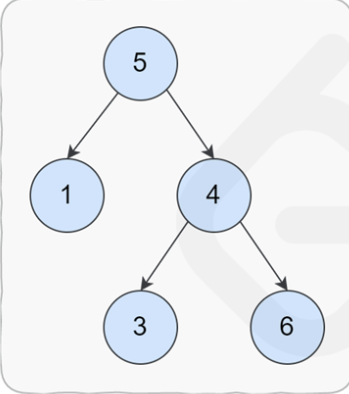
从根节点5开始遍历,令cur = 根节点5,找到mostRight为节点1
节点1的右子树为空,将节点1的右子树指向节点5,并让cur移动到左子树(节点1)
开始遍历节点1,由于节点一无左子树,直接访问,比较节点一与preValue(初始化为最小值),
1 < Long.MIN_VALUE,将节点1的val赋值给preValue
将cur(1)移动到右子树,此时cur为之前访问过的根节点5,继续找到cur(5)左子树的最右节点1,发现节点1的右子树为当前节点cur(5),将节点1的右子树还原为空
此时是第二次到达节点5,比较节点5与preValue(1),并将5赋值给preValue,cur向右子树移动,此时cur到达节点4
找到cur(4)左子树的最右节点3,将节点3的右子树指向cur(4),cur向左子树移动,此时cur到达节点3
由于节点3无左子树,直接比较节点3与preValue(5)的值,3<5,返回false。
可以发现中序遍历的顺序是:15346
Morris中序遍历到达的节点顺序是:515 4346 ,其中5和4有左子树,在到底5和4的第二次时作比较。
1
2
3
4
5
6
7
8
9
10
11
12
13
14
15
16
17
18
19
20
21
22
23
24
25
26
class Solution {public boolean isValidBST (TreeNode root) {TreeNode cur = root, mostRight = null ;long preValue = Long.MIN_VALUE;while (cur != null ) {if (mostRight != null ) {while (mostRight.right != null && mostRight.right != cur) if (mostRight.right == null ) {continue ;else if (mostRight.right == cur) {null ;if (cur.val <= preValue) return false ;return true ;
时间复杂度 :遍历所有节点,\(O(n)\)
空间复杂度 :Morris遍历利用叶子节点的左右空指针,实现空间开销的极限缩减,\(O(1)\)
方法一:中序遍历
使用中序遍历二叉搜索树得到的结果是升序的。
:star::warning:方法二:双指针
双指针的思想真的很重要!!!
初始化全局变量:pre节点初始化为空;diff存储相邻节点差值,初始化为整型最大值
中序遍历过程:第一次遍历,pre是空的,还没遇到第二个节点也就没有相邻节点之间的差值;
把当前节点(root)赋给pre,那么下一个root就是中序遍历顺序pre的下一个节点
1
2
3
4
5
6
7
8
9
10
11
12
13
14
15
16
17
class Solution {int diff = Integer.MAX_VALUE;public int getMinimumDifference (TreeNode root) {return diff;private void dfs (TreeNode root) {if (root == null )return ;if (pre != null )
老样子,中序遍历
遍历的过程
1
2
3
4
5
6
7
8
9
10
11
12
13
14
15
16
17
if (preVal == cur.val) {else {1 ;if (!modes.contains(cur.val) && counter == maxCounter) {if (counter > maxCounter) {
方法一:用HashMap存储所有父节点,用HashSet标记是否访问过;从p开始向上遍历,并标记访问过的父节点,再从q开始向上遍历,如果当前节点被访问过,那么这个节点就是最近公共祖先。
注意:对于p,先设置visisted,再向上移;对于q,先判断当前节点是不是已经被visited,再向上移。 如果p,q任意一者先向上移再操作,都会导致在,p或q是最近公共节点时,返回的却是p或q的父节点
1 2 3 4 5 6 7 8 9 10 11 12 13 14 15 16 17 18 19 20 21 22 23 24 25 26 27 28 29 30 31 32 33 34 35 36 37 38 39 class Solution {public TreeNode lowestCommonAncestor (TreeNode root, TreeNode p, TreeNode q) {new HashMap <>();new HashSet <>();while (p != null ) {while (q != null ) {if (visited.contains(q)) {return q;return root;public void dfs (TreeNode root, Map<TreeNode, TreeNode> map) {if (root == null )return ;if (root.left != null ) {if (root.right != null ) {
:warning:方法二:DFS
题解
可以不判断非p,q的叶节点
1
2
3
4
5
6
7
8
9
10
11
12
13
14
15
16
class Solution {public TreeNode lowestCommonAncestor (TreeNode root, TreeNode p, TreeNode q) {return dfs(root, p, q);public TreeNode dfs (TreeNode root, TreeNode p, TreeNode q) {if (root == null || root == p || root == q)return root;TreeNode left = dfs(root.left, p, q);TreeNode right = dfs(root.right, p, q);if (left == null )return right;if (right == null ) return left;return root;
递归:考虑三种情况
p,q是root:return root
p,q在root两侧,(p.val < root.val && q.val > root.val) || (p.val > root.val && q.val < root.val), return root
p,q在root同一侧 (p.val < root && q.val < root.val) || (p.val > root.val && q.val > root.val)
p.val < root && q.val < root.val: return dfs(left, p, q)
p.val > root.val && q.val > root.val: return dfs(right, p, q)
方法一:DFS
1
2
3
4
5
6
7
8
9
10
11
class Solution {public TreeNode lowestCommonAncestor (TreeNode root, TreeNode p, TreeNode q) {if (root == null )return null ;if (root.val > p.val && root.val > q.val) return lowestCommonAncestor(root.left, p, q);if (root.val < p.val && root.val < q.val)return lowestCommonAncestor(root.right, p, q); return root;
要点是:如何记录要插入节点的父节点
方法一:栈
从根节点开始遍历,用栈存储每个遍历过的节点,大于向右小于向左;循环结束,判断插入最后一个被遍历的节点(栈中最顶层节点),判断大于小于,插入,结束。
遍历过程把所有元素放进栈,空节点跳出循环后,栈顶元素就是要插入节点的父节点
1
2
3
4
5
6
7
8
9
10
11
12
13
14
15
16
17
18
19
20
21
22
23
24
25
26
class Solution {public TreeNode insertIntoBST (TreeNode root, int val) {if (root == null )return new TreeNode (val);TreeNode cur = root;new Stack <>();while (cur != null ) {if (val < cur.val) {else {TreeNode newNode = new TreeNode (val);if (cur.val > val) {else {return root;
方法二:双指针
用pre指针指向上一个节点,有两个要注意的地方
初始化pre指针时,不能初始化为null,如果根节点没有左子树,而要插入的节点小于根节点,要插入的节点会成为根节点的左子树 ,这种情况判断一次就会跳出while循环,此时pre还是null,所以要把pre初始化为根节点
在while循环中,用pre=cur记录cur的上一个节点,但是,最后cur等于空的时候,pre再记录cur就没有意义了,所以加上if (cur != null)判断条件
1
2
3
4
5
6
7
8
9
10
11
12
13
14
15
16
17
18
19
20
21
class Solution {public TreeNode insertIntoBST (TreeNode root, int val) {TreeNode res = new TreeNode (val);if (root == null )return res;TreeNode cur = root, pre = root;while (cur != null ) {if (cur.val > val)else if (cur.val < val)if (cur != null )if (val > pre.val)else return root;
方法三:DFS
当时想出来了,但是卡在怎么插入这个点上,其实这里已经用root.left或者root.right来接收 new TreeNode(val)了。 ==构造树==!!!
1
2
3
4
5
6
7
8
9
10
11
12
13
class Solution {public TreeNode insertIntoBST (TreeNode root, int val) {if (root == null ) {return new TreeNode (val);if (val < root.val) {else {return root;
解题思路 :
如果目标节点大于当前节点值,则去右子树中删除;
如果目标节点小于当前节点值,则去左子树中删除;
如果目标节点就是当前节点,分为以下三种情况:
其无左子:其右子顶替其位置,删除了该节点;
其无右子:其左子顶替其位置,删除了该节点;
其左右子节点都有:其左子树转移到其右子树的最左节点的左子树上,然后右子树顶替其位置,由此删除了该节点。
写了快100行,重构一下代码。。
方法一:迭代
1 2 3 4 5 6 7 8 9 10 11 12 13 14 15 16 17 18 19 20 21 22 23 24 25 26 27 28 29 30 31 32 33 34 35 36 37 38 39 40 41 42 43 44 45 46 47 48 49 50 51 52 53 54 55 56 57 58 59 60 61 62 63 64 65 66 67 68 69 70 71 72 73 class Solution {public TreeNode deleteNode (TreeNode root, int key) {if (root == null )return root;TreeNode cur = root, pre = root;while (cur != null ) {if (cur.val == key) {if (cur.left == null && cur.right == null ) { if (pre.val < key) null ;else null ;else {if (cur.left != null && cur.right != null ) {TreeNode left = cur.left, right = cur.right;while (cur.left != null ) if (pre.val < key) else else if (cur.left == null && cur.right != null ) {TreeNode right = cur.right;if (pre.val < key)else else if (cur.left != null && cur.right == null ) {TreeNode left = cur.left;if (pre.val < key)else break ;else if (cur.val < key) {else {if (root.val == key) {return root.left == null ? root.right : root.left; return root;
:star:方法二:DFS
注意代码注释部分是完全冗余的!
1
2
3
4
5
6
7
8
9
10
11
12
13
14
15
16
17
18
19
20
21
22
23
24
25
26
27
28
29
30
31
32
33
34
35
36
class Solution {public TreeNode deleteNode (TreeNode root, int key) {if (root == null )return root;if (key < root.val)else if (key > root.val)else { if (root.left == null && root.right == null ) {return null ;else if (root.left == null && root.right != null ) {return root.right;else if (root.left != null && root.right == null ) {return root.left;else {TreeNode cur = root.right;while (cur.left != null ) return root.right;return root;
借上一题的思路直接速通了
方法一:二分DFS[左闭右闭]
方法二:DFS[左闭右开)],开区间元素在record的数值要--,闭区间元素在record的位置要++,开区间元素和闭区间元素都为‘a’,所以s的下标1以‘b’开始的子串“ba”也是变位词!
1
2
3
4
5
6
7
8
9
10
11
12
13
14
15
16
17
18
19
20
21
22
23
24
25
26
27
28
29
class Solution {public List<Integer> findAnagrams (String s, String p) {new LinkedList <>();if (s.length() < p.length())return index;int [] record = new int [26 ];for (int i = 0 ; i < p.length(); ++i) {'a' ];'a' ];if (areZeros(record)) {0 );for (int i = p.length(); i < s.length(); ++i) {'a' ];'a' ];if (areZeros(record)) {1 );return index;private boolean areZeros (int [] record) {for (int element : record)if (element != 0 )return false ;return true ;
方法一:滑动窗口
1
2
3
4
5
6
7
8
9
10
11
12
13
14
15
16
17
18
class Solution {public int equalSubstring (String s, String t, int maxCost) {int n = s.length();int [] diff = new int [n];for (int i = 0 ; i < n; ++i) {int res = 0 , start = 0 , sum = 0 ;for (int end = 0 ; end < n; ++end) {while (maxCost < sum) {1 );return res;
String补充知识
String与char数组,StringBuilder之间相互转换
将String转换为char数组:
1
2
codeString str = "hello" ;char [] charArray = str.toCharArray();
将char数组转换为String:
1
2
codechar[] charArray = {'h' , 'e' , 'l' , 'l' , 'o' };String str = new String (charArray);
将String转换为StringBuilder:
1 2 3 4 5 6 codeString str = "hello" ;StringBuilder sb = new StringBuilder (str);StringBuilder sb = new StringBuilder ();
将StringBuilder转换为String:
1
2
3
codeStringBuilder sb = new StringBuilder ();"hello" );String str = sb.toString();
将char数组转换为StringBuilder:
1
2
3
codechar[] charArray = {'h' , 'e' , 'l' , 'l' , 'o' };StringBuilder sb = new StringBuilder ();
将StringBuilder转换为char数组:
1
2
3
codeStringBuilder sb = new StringBuilder ("hello" );char [] charArray = new char [sb.length()];0 , sb.length(), charArray, 0 );
需要注意的是,在将String转换为char数组或char时,如果字符串为空,或者字符串中的字符数量为0,则可能会导致越界异常或其他异常。因此,在进行这些转换操作时,需要进行有效性检查和异常处理。
单个字符char转换为String
在Java中,将单个字符(char)转换为字符串(String)有以下两种方法:
1.使用字符串连接符
您可以使用字符串连接符"+"来连接一个空字符串和单个字符,从而将其转换为字符串。例如:
1
2
arduinoCopy codechar c = 'a' ;String s = "" + c;
在上面的代码中,首先创建一个空字符串,然后使用字符串连接符将其与字符"c"连接起来,从而将字符"c"转换为字符串。现在,字符串s将包含字符"c"的字符串。
2.使用String.valueOf()方法
另一种将单个字符转换为字符串的方法是使用String类的valueOf()方法。例如:
1
2
arduinoCopy codechar c = 'a' ;String s = String .valueOf (c);
在上面的代码中,将字符"c"传递给valueOf()方法,并将返回的字符串分配给变量s。
无论使用哪种方法,您都可以将单个字符转换为字符串,从而可以对其进行各种字符串操作。
StringBuilder的append可以是char或者String
StringBuilder的append()方法可以接受char类型和String类型的参数。append()方法的作用是在StringBuilder对象的末尾追加指定的字符序列,这可以是char、String、StringBuilder或其他CharSequence实例。
以下是使用StringBuilder的append()方法追加char和String类型参数的示例代码:
追加char类型参数:
1
2
3
codeStringBuilder sb = new StringBuilder ();char c = 'a' ;
追加String类型参数:
1
2
3
codeStringBuilder sb = new StringBuilder ();String str = "hello" ;
需要注意的是,使用append()方法追加char类型参数时,会自动将char类型转换为String类型。因此,如果需要在StringBuilder中追加一个char类型的字符,可以直接使用append()方法,而不需要先将其转换为String类型。
KMP算法
生成next数组讲得很透彻
Array
方法一:左闭右开
区间:[left, right)
初始化:right = nums.length
while循环终止条件应为left < right(右开,right不能等于left)
当nums[mid] < target时,nums[0]~nums[mid]都小于target,此时有效的有边界是mid - 1,又因为右边界是开区间,所以另right = mid
时间复杂度:\(O(logn)\) ,由于每次查找都会将查找范围缩小一半,因此二分查找的时间复杂度是\(O(logn)\) ,其中 n 是数组的长度
空间复杂度:\(O(1)\)
1
2
3
4
5
6
7
8
9
10
11
12
13
14
15
16
class Solution {public int search (int [] nums, int target) {int left = 0 , right = nums.length;while (left < right) {int mid = left + ((right - left) >> 1 );if (nums[mid] == target)return mid;else if (nums[mid] < target)1 ;else return -1 ;
方法二:左闭右闭
区间:[left, right]
初始化:right = nums.length - 1
while循环终止条件应为left <= right
当nums[mid] < target时,nums[0]~nums[mid]都小于target,另right = mid - 1
时间复杂度:\(O(logn)\) ,由于每次查找都会将查找范围缩小一半,因此二分查找的时间复杂度是\(O(logn)\) ,其中 n 是数组的长度
空间复杂度:\(O(1)\)
1
2
3
4
5
6
7
8
9
10
11
12
13
14
15
class Solution {public int search (int [] nums, int target) {int left = 0 , right = nums.length - 1 ;while (left <= right) {int mid = right - ((right - left) >> 1 );if (nums[mid] > target) 1 ;else if (nums[mid] < target)1 ;else return mid;return -1 ;
方法一:暴力
每当发现一个数相等,那么从当前数组的下一个数开始,全部往前移一位。
注意 :因为移位后,下一个要访问的数组元素j会到当前i的位置,然后for循环结束i自增,会错过访j,所以移位后要--i。时间复杂度:\(O(n^2)\)
空间复杂度:\(O(1)\)
1
2
3
4
5
6
7
8
9
10
11
12
13
14
15
16
17
18
19
class Solution {public int removeElement (int [] nums, int val) {int newLen = nums.length;if (newLen == 0 )return 0 ;for (int i = 0 ; i < newLen; i++) {if (nums[i] == val) {for (int j = i + 1 ; j < newLen; j++) {1 ] = nums[j];return newLen;
方法二:双指针
初始化慢指针为0
for循环遍历快指针,当nums[fast] != val时,令nums[slow] = nums[fast],slow指针往后移。也就是说,如果快指针找到了val,那么慢指针停在val位置,之后快指针遍历到非val的位置时,将该非val数据覆盖到慢指针的指向数组位置的数据。
最后返回慢指针(慢指针大小代表新数组的大小)
时间复杂度:\(O(n)\)
空间复杂度:\(O(1)\)
1
2
3
4
5
6
7
8
9
10
11
12
class Solution {public int removeElement (int [] nums, int val) {int slow = 0 ;for (int fast = 0 ; fast < nums.length; ++fast) {if (nums[fast] != val) {return slow;
方法三:相向双指针
避免了需要保留的元素的重复赋值操作 。
初始化:left=0, right=nums.length-1,左闭右闭区间,所以while语句的执行条件是
left <= right(如果没有等于,left会少后移一次)
循环:当nums[left]不等于val时,left指针后移;当nums[left]等于val时,将nums[right]赋值给nums[left],right指针前移;如果赋值过来的元素恰好也等于val,可以继续把右指针 right指向的元素的值赋值过来,直到左指针指向的元素的值不等于 val为止。
时间复杂度:\(O(n)\)
空间复杂度:\(O(1)\)
1
2
3
4
5
6
7
8
9
10
11
12
13
14
15
16
class Solution {public int removeElement (int [] nums, int val) {int left = 0 , right = nums.length - 1 ;while (left <= right) {if (nums[left] == val) {else {return left;
双指针
left,right指针指向数组两端,将较大的平方数放入result数组里。
时间复杂度:\(O(n)\)
空间复杂度:\(O(n)\)
nums[++i]先执行自增操作还是数组寻址操作?
在Java中,表达式nums[++i]中的++i是先自增还是先寻址是有规定的。按照Java的运算符优先级规定,前置自增运算符++i的优先级高于数组下标运算符[],因此在执行这个表达式时,先进行++i自增运算,然后再进行数组下标运算,即先自增再寻址。
因此,nums[++i]相当于先将变量i自增1,然后使用自增后的i作为数组下标去访问nums数组中的元素。如果i的初始值为0,那么nums[++i]将访问nums[1]位置上的元素,而不是nums[0]。如果数组nums越界,将会抛出ArrayIndexOutOfBoundsException异常。
nums[i++]先执行自增操作还是数组寻址操作?
在这种情况下,nums[i++]实际上会先执行数组寻址操作,然后再对i进行自增操作。这是因为数组寻址操作的优先级比自增操作的优先级高。
具体来说,这个表达式会先使用i的当前值来计算nums数组中第i个元素的地址,然后将地址作为结果返回,接着才会将i的值加1。
int a = ++i 是先赋值还是先自增
这行代码会先自增变量 i 的值,然后将自增后的结果赋值给变量 a。所以,变量 a 的值等于自增后的变量 i 的值。这个过程中,变量 i 的值会被修改,而变量 a 的值则是这个修改后的值。
可以将这行代码拆分成两步:
i = i + 1; // 自增 i 的值
a = i; // 将自增后的 i 的值赋值给 a
所以,最终变量 a 的值等于自增后的变量 i 的值。
int a = i++ 是先赋值还是先自增
这行代码会先将变量 i 的值赋值给变量 a,然后再将变量 i 的值自增。所以,变量 a 的值等于变量 i 的值,而变量 i 的值会被自增。
可以将这行代码拆分成两步:
a = i; // 将 i 的值赋值给 a
i = i + 1; // 自增 i 的值
所以,最终变量 a 的值等于变量 i 的初始值,而变量 i 的值则是初始值加一。
while(--index) 先-- 后比较index>0
1
2
3
4
int index = 2 ;while (--index > 0 ) {
stdout
1
while(index--) 先比较 后--
1
2
3
4
int index = 2 ;while (index-- > 0 ) {
stdout
10
System.out.print(--index) 先-- 后打印
1
2
3
4
int index = 2 ;while (index > 0 ) {
stdout
10
滑动窗口
注意:为了确保有些案例,sum一直小于target,最后输出判断:如果
result == Integer.MAX_VALUE,就输出0。
result记录最小的长度
时间复杂度:\(O(n)\)
空间复杂度:\(O(1)\)
1
2
3
4
5
6
7
8
9
10
11
12
13
14
15
class Solution {public int minSubArrayLen (int target, int [] nums) {int counter = 0 , result = Integer.MAX_VALUE;int sum = 0 ;for (int i = 0 ; i < nums.length; ++i) {while (sum >= target) {return result == Integer.MAX_VALUE ? 0 : result;
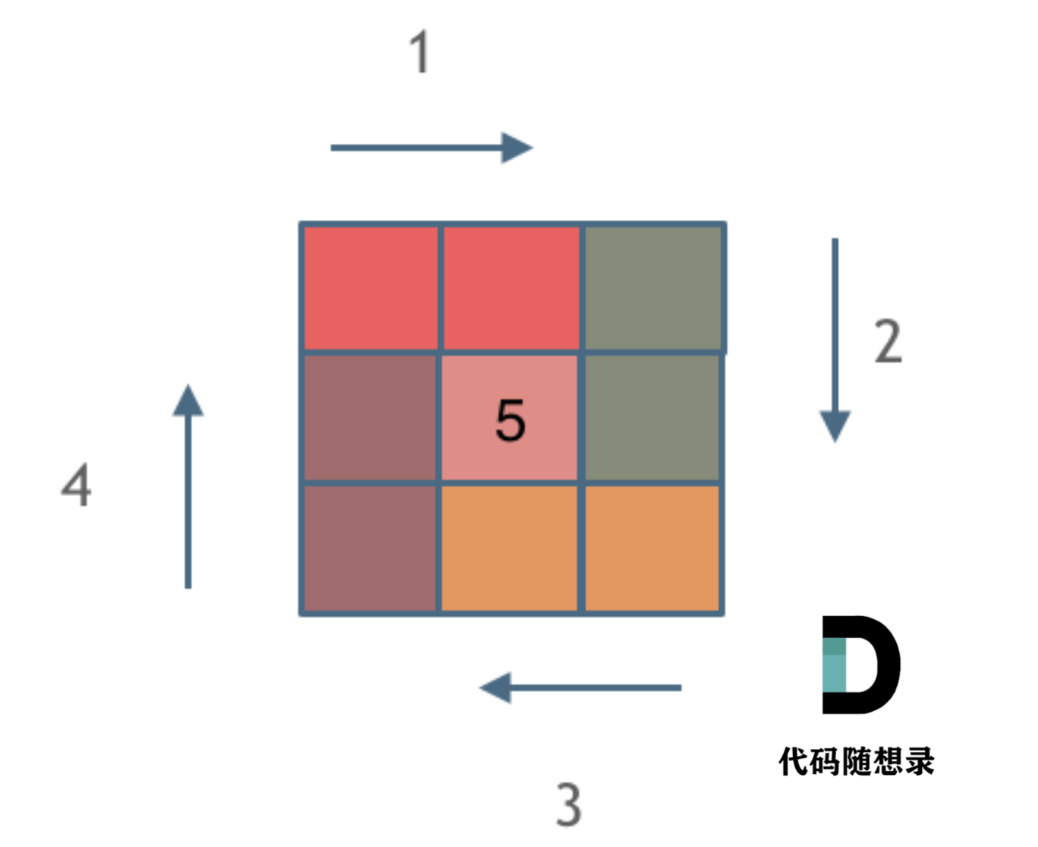
遍历顺序:从左到右(左闭右开),从上到下(上闭下开),从右到左(右闭左开),从下到上(下闭上开)
思路见代码注释部分
时间复杂度:\(O(n^2)\)
空间复杂度:\(O(1)\)
1
2
3
4
5
6
7
8
9
10
11
12
13
14
15
16
17
18
19
20
21
22
23
24
25
26
27
28
29
30
31
32
33
34
35
36
37
38
39
40
41
class Solution {public int [][] generateMatrix(int n) {int [][] matrix = new int [n][n];int traverseTime = n / 2 ;int i, j;int data = 1 ;for (int cur = 0 ; cur < traverseTime; ++cur) {for (j = cur; j < n - cur - 1 ; ++j) {for (i = cur; i < n - cur - 1 ; ++i) {for (; j > cur; --j) {for (; i > cur; --i) {if (n % 2 == 1 )return matrix;
方法一:暴力
1
2
3
4
5
6
7
8
9
10
11
12
13
14
15
16
17
18
19
20
class NumArray {private int [] nums;public NumArray (int [] nums) {this .nums = nums;public int sumRange (int left, int right) {int sum = 0 ;for (int i = left; i <= right; ++i) {return sum;
方法二:前缀和
建立一个长度为n+1的数组preSum
初始化preSum[0] = 0;
preSum[i]表示数组nums从下标0到下标i-1的和
image-20230511111212882
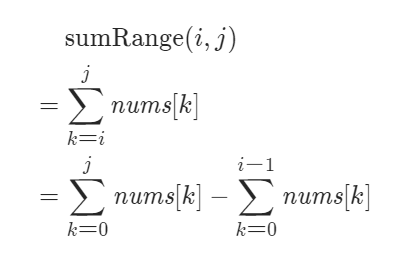
区间[left,right]的和为preSum[right + 1] - preSum[left];
preSum[right + 1]表示数组从下标0到right的和,preSum[left]表示数组从下标0到left-1的和
将前缀和数组preSum的长度设为n+1的目标是为了方便计算sumRange(left, right)时,不需要对left=0的情况做特殊处理
1
2
3
4
5
6
7
8
9
10
11
12
13
14
15
16
17
18
19
class NumArray {private int [] preSum;public NumArray (int [] nums) {new int [nums.length + 1 ];for (int i = 1 ; i < preSum.length; ++i) {1 ] + nums[i - 1 ];public int sumRange (int left, int right) {return preSum[right + 1 ] - preSum[left];
前缀和:前缀和数组为n,需要对left=0时做特殊处理
1
2
3
4
5
6
7
8
9
10
11
12
13
14
15
16
17
18
19
20
21
22
23
class NumArray {private int [] preSum;public NumArray (int [] nums) {new int [nums.length];0 ] = nums[0 ];for (int i = 1 ; i < preSum.length; ++i) {1 ] + nums[i];public int sumRange (int left, int right) {if (left == 0 ) {return preSum[right];return preSum[right] - preSum[left - 1 ];
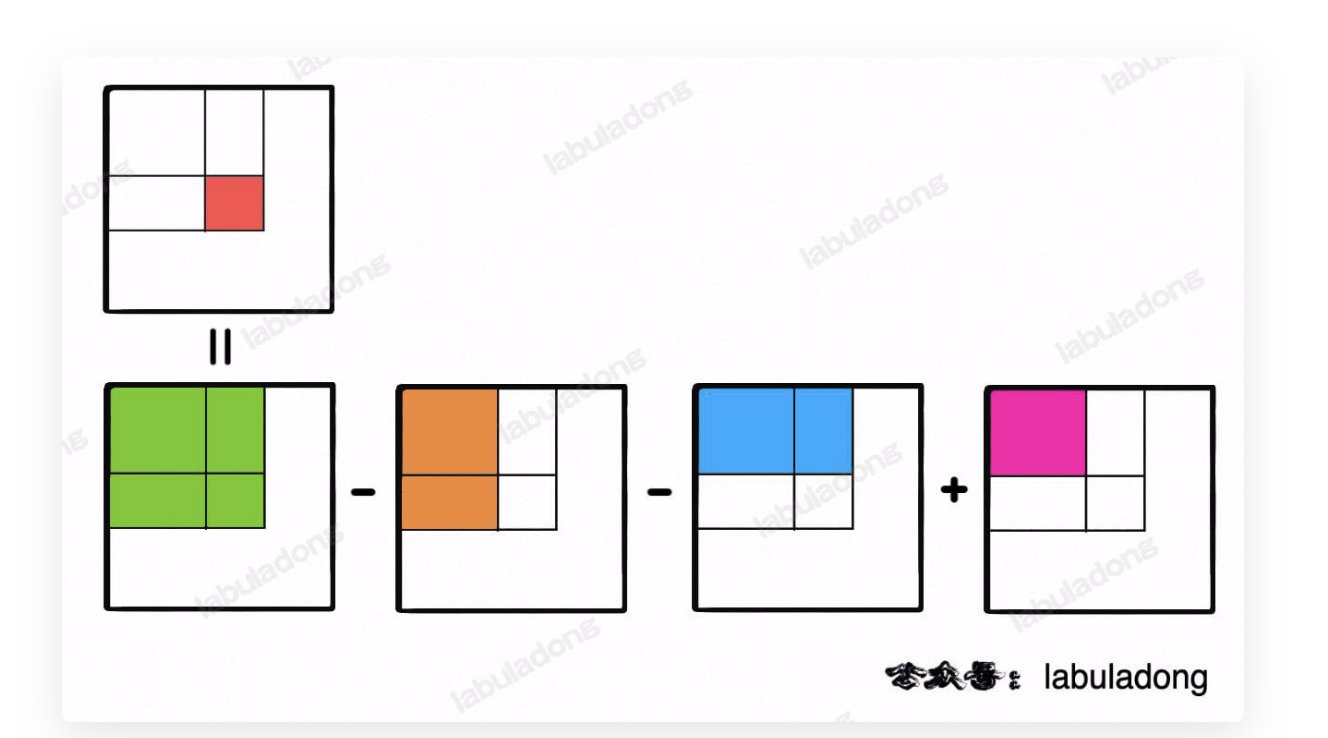
方法一:前缀和:warning:
需要重刷!
题解
image-20230511124326460
1
2
3
4
5
6
7
8
9
10
11
12
13
14
15
16
17
18
19
20
21
class NumMatrix {int [][] preSum;public NumMatrix (int [][] matrix) {new int [matrix.length + 1 ][matrix[0 ].length + 1 ];for (int i = 1 ; i <= matrix.length; ++i) {for (int j = 1 ; j <= matrix[0 ].length; ++j) {1 ][j - 1 ] + preSum[i - 1 ][j] + preSum[i][j - 1 ] - preSum[i - 1 ][j - 1 ];public int sumRegion (int row1, int col1, int row2, int col2) {return preSum[row2 + 1 ][col2 + 1 ] - preSum[row2 + 1 ][col1] - preSum[row1][col2 + 1 ] + preSum[row1][col1];
LinkedList
解题思路:在面对链表、树有关创建、删除操作,使用dummyHead!能省去不少边界判定的功夫。
初始化:dummyHead指向head,dummyHead赋值给pre,head赋值给cur
当cur的值等于所求val,pre指向cur的下一个节点
当cur的值不等于val,pre移动到cur,cur往后移一位
返回dummyHead的下一个节点。
注意事项:DummyHead + size
用笔模拟一下指针pre,cur,next的过程
时间复杂度:\(O(n^2)\)
空间复杂度:\(O(1)\)
注意要点:用纸和笔模拟一下指针pre,cur,next的过程,记得创建dummyHead
时间复杂度:\(O(n)\)
空间复杂度:\(O(1)\)
使用dummyHead,从dummyHead,找到倒数第N个节点的前一个节点node,需要走链表长度size - N步,即可把node指向下一个节点的下一个节点即可完成删除操作。
但是链表的长度是未知的,可以先遍历一遍链表的长度,求出size,再走size-N步完成删除操作。
也可以使用快慢指针,fast与slow的起始点都为dummyHead,fast先走N步,再让fast与slow一起右移,当fast走到最后一个节点时(fast.next == null时),slow右移了size - N步,到达倒数第N个节点的上一个节点,即可完成删除操作。
时间复杂度:\(O(n)\)
空间复杂度:\(O(1)\)
方法一:HashSet
用指针A,B分别指向两个链表头
开始循环,循环的终止条件为A,B都为空,每次循环先将A,B指向的节点放入HashSet,再向后移
当遍历到某个已经存入HashSet的节点时,这个节点就是相交节点;否则没有相交节点
时间复杂度:\(O(m + n)\) ,其中m,n分别为两个链表的长度
空间复杂度:\(O(m + n)\)
方法二:双指针
解题思路 :A,B分别指向headA,headB,如果有公共节点,设公共节点长度为c,链表A和B长度分别为a,b。向右遍历,如何为空,则指向另一个链表的头。如果两个链表相交,则A向右移动了a+c+b步,B向右移动了b+c+a时相交,返回A;如果两个链表不相交,则A向右移动了a+b步,B向右移动了b+a步,都为空,退出循环返回null。
用指针A,B分别指向两个链表头headA,headB
开始循环,循环的条件是A和B不都为空,如果A为空,则A指向headB,否则向后移;如果B为空,则B指向headA,否则向后移
开始循环,循环的终止条件为A,B都为空,每次循环先将A,B指向的节点放入HashSet,再向后移
当遍历到某个已经存入HashSet的节点时,这个节点就是相交节点;否则没有相交节点
时间复杂度:\(O(m + n)\) ,其中m,n分别为两个链表的长度
空间复杂度:\(O(m + n)\)
一个错误代码实例
1 2 3 4 5 6 7 8 9 10 11 12 13 14 public class Solution {public ListNode getIntersectionNode (ListNode headA, ListNode headB) {if (headA == null || headB == null )return null ;ListNode pA = headA, pB = headB;while (pA != null || pB != null ) {null ? headB : pA.next;null ? headA : pB.next;if (pA == pB)return pA;return null ;
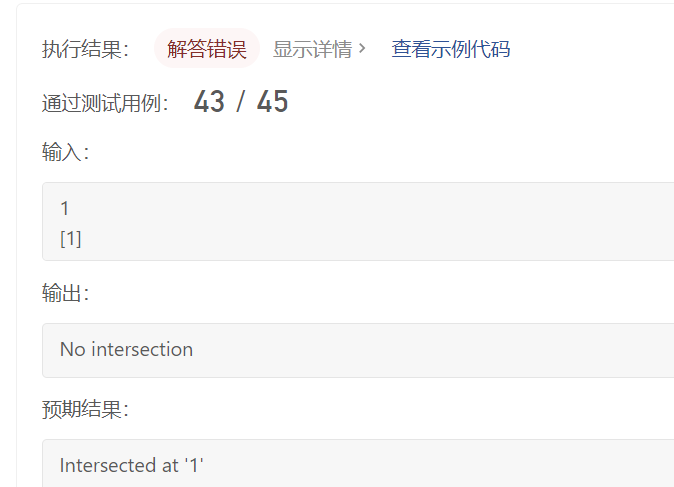
错误如下,当两个链表只有公共部分节点1时,上述代码没有先判断,先向右移,结果指向A,B都为空,返回空。
所以解决方案是把判断AB相等的语句放在指针移动上面
1 2 3 4 5 6 7 8 9 10 11 12 13 public class Solution {public ListNode getIntersectionNode (ListNode headA, ListNode headB) {if (headA == null || headB == null )return null ;ListNode pA = headA, pB = headB;while (pA != null || pB != null ) {if (pA == pB)return pA;null ? headB : pA.next;null ? headA : pB.next;return null ;
成功
优化
当A,B只有公共部分时,直接返回结果
当A,B有自己的部分也相交时
当A,B公共部分前面节点数量相同时,遍历到相交节点直接返回结果
当A,B公共部分前面节点数量不同时,遍历a+b+c步也会相交,返回结果
当A,B不相交时,遍历完a+ 1(null) + b + 1(null) 步后,A和B都为null,返回的A为null,表示不相交
1 2 3 4 5 6 7 8 9 10 11 12 public class Solution {public ListNode getIntersectionNode (ListNode headA, ListNode headB) {if (headA == null || headB == null )return null ;ListNode pA = headA, pB = headB;while (pA != pB) {null ? headB : pA.next;null ? headA : pB.next;return pA;
解题思路: 快慢指针,慢指针走一步,快指针走两步,如果有环,快指针总能在环中追上慢指针。当快指针和慢指针指向同一节点时,把快节点指向头节点,慢节点不动,快慢指针一起走,再次相遇时,指向的节点就是入环的第一个节点。
时间复杂度:\(O(m + n)\) ,其中m,n分别为两个链表的长度
空间复杂度:\(O(m + n)\)
1 2 3 4 5 6 7 8 9 10 11 12 13 14 15 16 17 18 19 20 public class Solution {public ListNode detectCycle (ListNode head) {if (head == null || head.next == null ) return null ;ListNode fast = head.next.next, slow = head.next;while (fast != null && fast.next != null ) {if (fast == slow) {while (fast != slow) {return fast;return null ;
方法一:翻转合并
1 2 3 4 5 6 7 8 9 10 11 12 13 14 15 16 17 18 19 20 21 22 23 24 25 26 27 28 29 30 31 32 33 34 35 36 37 38 39 40 41 42 class Solution {public void reorderList (ListNode head) {ListNode cur = head, fast = head.next;while (fast != null && fast.next != null ) {ListNode mid = cur;null ;while (fast != null ) {ListNode next1 = cur.next, next2 = fast.next;private ListNode reverse (ListNode cur) {ListNode pre = null , next = null ;while (cur != null ) {return pre;
方法一:翻转三次
1 2 3 4 5 6 7 8 9 10 11 12 13 14 15 16 17 18 19 20 21 22 23 24 25 26 27 28 29 30 31 32 33 34 35 36 37 38 39 40 41 42 43 44 45 46 47 48 49 50 51 52 53 class Solution {public ListNode addTwoNumbers (ListNode l1, ListNode l2) {ListNode res = addReversedList(l1, l2);return reverse(res);private ListNode addReversedList (ListNode l1, ListNode l2) {ListNode dummy = new ListNode (-1 );ListNode cur = dummy;int carry = 0 , sum = 0 ;while (l1 != null || l2 != null ) {null ? null : l1;null ? null : l2;null ? 0 : l1.val) + (l2 == null ? 0 : l2.val) + carry;10 ? 1 : 0 ;10 ? sum - 10 : sum;ListNode newNode = new ListNode (sum);null ? null : l1.next;null ? null : l2.next;if (carry == 1 ) {ListNode newNode = new ListNode (1 );return dummy.next;private ListNode reverse (ListNode cur) {ListNode pre = null , next = null ;while (cur != null ) {return pre;
方法二:翻转两次(最后一次不需要翻转)
1 2 3 4 5 6 7 8 9 10 11 12 13 14 15 16 17 18 19 20 21 22 23 24 25 26 27 28 29 30 31 32 33 34 35 36 37 38 39 40 41 42 43 44 45 46 47 48 49 50 51 52 53 54 55 56 class Solution {public ListNode addTwoNumbers (ListNode l1, ListNode l2) {ListNode res = addReversedList(l1, l2);return res;private ListNode addReversedList (ListNode l1, ListNode l2) {ListNode dummy = new ListNode (-1 );ListNode cur = dummy;int carry = 0 , sum = 0 ;while (l1 != null || l2 != null ) {null ? null : l1;null ? null : l2;null ? 0 : l1.val) + (l2 == null ? 0 : l2.val) + carry;10 ? 1 : 0 ;10 ? sum - 10 : sum;ListNode newNode = new ListNode (sum);null ? null : l1.next;null ? null : l2.next;if (carry == 1 ) {ListNode newNode = new ListNode (1 );return dummy.next;private ListNode reverse (ListNode cur) {ListNode pre = null , next = null ;while (cur != null ) {return pre;
Hash Table
方法一:双HashMap记录词频
判断s与t的长度,若不相等,则一定不是字母异位词
建立两个HashMap<Character, Integer>
遍历字符串,将每个字符存入map中,并将值+1
如果map1与map2的size不相等,则一定不是字母异位词
遍历map1(我遍历的是字符串),get字符串s,t的每一个字符出现了的次数,判断是否相同,如果不同,则一定不是字母异位词。
时间复杂度:\(O(n)\) ,其中n为第一个字符串的长度
空间复杂度:\(O(1)\)
1 2 3 4 5 6 7 8 9 10 11 12 13 14 15 16 17 18 19 20 21 22 23 class Solution {public boolean isAnagram (String s, String t) {int len = s.length();if (len != t.length())return false ; new HashMap <>(), map2 = new HashMap <>();for (int i = 0 ; i < len; ++i) {char sChar = s.charAt(i);char tChar = t.charAt(i);0 ) + 1 );0 ) + 1 );for (int i = 0 ; i < len; ++i) {int sSize = map1.get(s.charAt(i));int tSize = map2.getOrDefault(s.charAt(i), 0 );if (sSize != tSize) {return false ;return true ;
方法二:数组
数组其实就是一个简单哈希表 ,而且这道题目中字符串只有小写字符,那么就可以定义一个数组,来记录字符串s里字符出现的次数。定一个数组record,大小为26 ,初始化为0,因为字符a到字符z的ASCII也是26个连续的数值。
遍历第一个字符串s时,只需要将s.charAt(i) - ‘a’所在的元素+1,这样统计了字符串s中每个字符出现的次数。
同样,遍历第二个字符串t时,只需要将t.charAt(i) - ‘a’所在的元素-1。
如果record全部元素为0,那么s和t是字母异位词;否则不是。
时间复杂度:\(O(n)\) ,其中n为第一个字符串的长度
空间复杂度:\(O(1)\) ,只使用了常数大小的辅助数组。
1 2 3 4 5 6 7 8 9 10 11 12 13 14 15 class Solution {public boolean isAnagram (String s, String t) {if (s.length() != t.length())return false ;int [] record = new int [26 ];for (int i = 0 ; i < s.length(); ++i) {'a' ];'a' ];for (int i = 0 ; i < 26 ; ++i) if (record[i] != 0 )return false ;return true ;
解题思路:双HashSet
首先使用一个HashSet命名为set,记录第一个数组中不包含重复的所有元素
再用一个HashSet命名为intersection,遍历第二个数组,如果第二个数组中的元素在set中,则加入intersection中
最后将intersection转换为数组,并返回
1 2 3 4 5 6 7 8 9 10 11 12 13 14 15 16 17 class Solution {public int [] intersection(int [] nums1, int [] nums2) {new HashSet <>();new HashSet <>();for (int i = 0 ; i < nums1.length; ++i)for (int i = 0 ; i < nums2.length; ++i) if (set.contains(nums2[i]))int [] result = new int [intersection.size()];int i = 0 ;for (int element : intersection) {return result;
求和的过程中,sum会重复出现,用HashSet记录每一次求和,如果有重复,那么必定不是快乐数。
注意: sum += (n % 10) * (n % 10);+=的优先级高于%。
1 2 3 4 5 6 7 8 9 10 11 12 13 14 15 16 17 18 19 class Solution {public boolean isHappy (int n) {new HashSet <>();while (n != 1 && !set.contains(n)) {return n == 1 ;private int getSum (int n) {int sum = 0 ;while (n > 0 ) {10 ) * (n % 10 );10 ;return sum;
方法一:暴力
注意初始化int数组:new int[]{i, j};
时间复杂度:\(O(n^2)\) ,其中n为第一个字符串的长度
空间复杂度:\(O(1)\) ,只使用了常数大小的辅助数组。
1 2 3 4 5 6 7 8 9 10 11 12 13 class Solution {public int [] twoSum(int [] nums, int target) {int [] result = new int [2 ];for (int i = 0 ; i < nums.length - 1 ; ++i) {for (int j = i + 1 ; j < nums.length; ++j) {if (nums[i] + nums[j] == target) {return new int []{i, j};return result;
方法二:HashMap
解题思路 :
建立一个HashMap,key为数组的值,value为数组索引
遍历一遍,每次遍历判断哈希表中是否存在key为target-nums[i],如果有,则这个key对应的value与i即为所求
时间复杂度:\(O(n)\)
空间复杂度:\(O(n)\)
1 2 3 4 5 6 7 8 9 10 11 class Solution {public int [] twoSum(int [] nums, int target) {new HashMap <>();for (int i = 0 ; i < nums.length; ++i) {if (map.containsKey(target - nums[i])) return new int []{map.get(target - nums[i]), i};return new int [2 ];
解题思路:
用HashMap用两层循环记录前两个数组每个元素之和为key,和出现的次数为value
再两次循环后两个数组,如果map.containsKey(- i - j),那么- i - j与当前i + j之和为0,即为本题所求,则把result加上和为- i - j的数量
时间复杂度:\(O(n^2)\) ,两层循环
空间复杂度:\(O(n^2)\) ,在最坏情况下,前两个数组的元素各不相同,map占n * n
1 2 3 4 5 6 7 8 9 10 11 12 13 14 15 16 17 18 19 class Solution {public int fourSumCount (int [] nums1, int [] nums2, int [] nums3, int [] nums4) {new HashMap <>();int result = 0 ;int n = nums1.length;for (int i = 0 ; i < n; ++i) {for (int j = 0 ; j < n; ++j) {0 ) + 1 );for (int i : nums3) {for (int j : nums4) {if (map.containsKey(- i - j))return result;
解题思路:字母表
如果ransomNote的长度大于magazine的长度,直接返回false
新建一个长度为26的字母表,以及一个HashMap,key为字母-‘a’,value为字母出现的次数,将magazine中的每个字符put进map
遍历ransomNote的所有字符i,如果map中key为字符i的value大于0,那么把这个value减一;如果map中key为字符i的value小于等于0,说明magazine不存在字符i或者字符i的个数小于ransomNote中字符i的个数,那么 ransomNote 能不能由 magazine 里面的字符构成,返回false
时间复杂度:\(O(n)\) ,两层循环
空间复杂度:\(O(1)\) ,只需要常数大小的辅助空间
1 2 3 4 5 6 7 8 9 10 11 12 13 14 15 16 17 18 19 20 21 22 class Solution {public boolean canConstruct (String ransomNote, String magazine) {if (ransomNote.length() > magazine.length())return false ;char [] record = new char [26 ];new HashMap <>();for (int i = 0 ; i < magazine.length(); ++i) {int index = magazine.charAt(i) - 'a' ;0 ) + 1 );for (int i = 0 ; i < ransomNote.length(); ++i) {int index = ransomNote.charAt(i) - 'a' ;if (map.getOrDefault(index, 0 ) > 0 ) {1 );else return false ;return true ;
题目要求:
nums[i],nums[j],nums[k]中i,j,k各不相同
输出的nums[i],nums[j],nums[k]不能重复,如果结果集合中有{1,2,3}了,就不能再加入一个{1,2,3}
不能有重复的三元组,但三元组内的元素是可以重复的! {0,0,0},{-1,-1,2}是允许的
方法一:暴力
注意 :{1,2,3}和{3, 2, 1}是不同的元素!
1 2 3 4 set.add(Arrays.asList(1 , 2 , 3 ));3 , 1 , 2 ));1 , 2 , 3 ]3 , 1 , 2 ]
找到符合的元素先排序,如何hashset中不存在再加入list中。
1 2 3 4 5 6 7 8 9 10 11 12 13 14 15 16 17 18 19 20 21 class Solution {public List<List<Integer>> threeSum (int [] nums) {new HashSet <>();new LinkedList <>();for (int i = 0 ; i < nums.length - 2 ; ++i) {for (int j = i + 1 ; j <nums.length - 1 ; ++j) {for (int k = j + 1 ; k < nums.length; ++k) {if (nums[i] + nums[j] + nums[k] == 0 ) {if (!set.contains(temp)) {return list;
超时
方法二:排序 + 双指针
去重思路 边界判断 时间复杂度:\(O(n^2)\) ,两层循环
空间复杂度:\(O(1)\)
1 2 3 4 5 6 7 8 9 10 11 12 13 14 15 16 17 18 19 20 21 22 23 24 25 26 27 28 29 30 31 32 33 34 35 36 37 38 39 40 41 class Solution {public List<List<Integer>> threeSum (int [] nums) {new LinkedList <>();for (int i = 0 ; i < nums.length - 2 ; ++i) {if (nums[i] > 0 )break ;if (i > 0 && nums[i] == nums[i - 1 ]) continue ;int left = i + 1 , right = nums.length - 1 ;while (left < right) {int sum = nums[i] + nums[left] + nums[right];if (sum < 0 )else if (sum > 0 )else { while (right > left && nums[right] == nums[right - 1 ])while (right > left && nums[left] == nums[left + 1 ])return result;
注意事项 :nums[i]的范围,如果4个数都等于\(10^9\) ,
那么将大于\(2^{31} - 1= 2147483648 < 2.15 * 10^9\) (int最大的正数),所以要用long记录四数之和
在三数之和的基础上,再增加一层循环,
区间为[nums[i], nums[left], nums[right], nums[j]]
时间复杂度:\(O(n^3)\) ,三层循环
空间复杂度:\(O(n)\) ,排序使用了额外的数组存储数组nums的副本
剪枝
第一层循环中,如果最小的四数之和大于target,那么后面的数更大,break
1 2 3 \\ 第一层循环if ((long ) nums[i] + nums[i + 1 ] + nums[i + 2 ] + nums[i + 1 ] > target)break ;
第二层循环中,如果最大的四数之和小于target,那么前面的数更小,break
1 2 3 \\ 第二层循环if ((long ) nums[i] + nums[j] + nums[j - 1 ] + nums[j - 2 ] < target)break ;
完整代码如下
1 2 3 4 5 6 7 8 9 10 11 12 13 14 15 16 17 18 19 20 21 22 23 24 25 26 27 28 29 30 31 32 33 34 35 36 37 38 39 40 41 42 43 44 45 46 class Solution {public List<List<Integer>> fourSum (int [] nums, int target) {new LinkedList <>();int length = nums.length;if (length < 4 )return result;for (int i = 0 ; i < length - 3 ; ++i) {if (i > 0 && nums[i] == nums[i - 1 ])continue ;if ((long ) nums[i] + nums[i + 1 ] + nums[i + 2 ] + nums[i + 1 ] > target)break ;for (int j = length - 1 ; j > 2 ; --j) {if (j < length - 1 && nums[j] == nums[j + 1 ])continue ;if ((long ) nums[i] + nums[j] + nums[j - 1 ] + nums[j - 2 ] < target)break ;int left = i + 1 , right = j - 1 ;while (left < right) {long sum = (long ) nums[i] + nums[left] + nums[right] + nums[j];if (sum < target)else if (sum > target)else { while (left < right && nums[left] == nums[left + 1 ])while (left < right && nums[right] == nums[right - 1 ])return result;
1 2 3 4 5 6 7 8 9 10 11 12 13 14 15 16 17 18 19 20 21 22 23 24 25 26 27 28 29 30 31 32 33 34 35 36 37 38 39 40 41 42 43 44 45 46 class RandomizedSet {public RandomizedSet () {new LinkedList <>();new HashMap <>();public boolean insert (int val) {if (map.containsKey(val))return false ;1 );return true ;public boolean remove (int val) {if (!map.containsKey(val))return false ;int index = map.get(val);int lastVal = list.get(list.size() - 1 );1 );return true ;public int getRandom () {Random random = new Random ();return list.get(random.nextInt(list.size()));
1 2 3 4 5 6 7 8 9 10 11 12 13 14 15 16 17 18 19 20 21 22 23 24 25 26 27 28 29 30 31 32 33 34 35 36 37 38 39 40 41 42 43 44 45 46 47 48 49 50 51 52 53 54 55 56 57 58 59 60 61 62 63 64 65 66 67 68 69 70 71 72 73 74 75 76 77 78 class LRUCache {class ListNode {int key;int val;public ListNode (int key, int val) {this .val = val;this .key = key;private int capacity;public LRUCache (int capacity) {this .capacity = capacity;new ListNode (-1 , -1 );new ListNode (-1 , -1 );new HashMap <>();public int get (int key) {if (!map.containsKey(key))return -1 ;return map.get(key).val;public void put (int key, int value) {if (map.containsKey(key)) {ListNode node = map.get(key);else { ListNode node = new ListNode (key, value);if (this .capacity != map.size()) { else { ListNode toDelete = head.next;public void moveToTail (int key) {ListNode node = map.get(key);if (node.next == tail)return ;public void delete (ListNode node) {public void insertAtTail (ListNode node) {
Stack and Queue
解题思路 :使用两个栈,inStack,outStack来实现队列。
push:直接将元素push进inStack
pop:如果outStack不为空,则弹出outStack顶部元素;如果outStack为空,则将inStack中的元素全部弹入inStack,再弹出outStack顶部元素
1 2 3 4 5 6 7 8 9 10 11 12 13 14 15 16 17 18 19 20 21 22 23 24 25 26 27 28 29 30 31 32 33 34 35 36 37 38 39 40 41 42 43 44 45 46 47 48 class MyQueue {private Stack<Integer> inStack;private Stack<Integer> outStack;public MyQueue () {new Stack <>();new Stack <>();public void push (int x) {public int pop () {if (outStack.isEmpty()) {return outStack.pop();public int peek () {if (outStack.isEmpty()) return outStack.peek();public boolean empty () {return inStack.isEmpty() && outStack.isEmpty();public void pushIntoOut () {while (!inStack.isEmpty()) {
方法一:单队列
push:直接将元素加入queue
pop():首先将队列元素移除并重新加入queue.size() - 1次,这样底部的元素就在队列首部了,poll出来即可
peek():首先将队列元素移除并重新加入queue.size() - 1次,这样底部的元素就在队列首部了,先用result接收queue.peek(),再将这个元素移除并重新加入,最后返回result ,peek()操作是不能改变内部数据的!!
1 2 3 4 5 6 7 8 9 10 11 12 13 14 15 16 17 18 19 20 21 22 23 24 25 26 27 28 29 30 31 32 33 34 class MyStack {private Queue<Integer> queue;public MyStack () {new LinkedList <>();public void push (int x) {public int pop () {return queue.poll();public int top () {int result = queue.peek();return result;public boolean empty () {return queue.isEmpty();public void catchBottom () {for (int i = 0 ; i < queue.size() - 1 ; ++i) {
优化 在面对大量需要查看顶部元素业务的时候,每次都要重新出队入队n次,不如在push的时候就排好序,
1 2 3 4 5 6 7 8 9 10 11 12 public void push (int x) {for (int i = 0 ; i < queue.size() - 1 ; ++i) {public int pop () {return queue.poll();public int top () {return queue.peek();
方法二:双队列
push:先在辅助队列supportQueue中加入目标数据,再将主队列queue中的数据全部弹出并加入到supportQueue中,这个时候supportQueue就是先进后出的排列顺序,最后将queue和support交换
1 2 3 4 5 6 7 8 9 10 11 12 13 14 15 16 17 18 19 20 21 22 23 24 25 26 27 28 29 30 31 class MyStack {public MyStack () {new LinkedList <>();new LinkedList <>();public void push (int x) {while (!queue.isEmpty()) {public int pop () {return queue.poll();public int top () {return queue.peek();public boolean empty () {return queue.isEmpty();
方法一:HashMap + Stack
注意事项: 如果是左括号,直接push进栈
如果是右括号,如果栈为空那么匹配不了;如果右括号和栈顶部的左括号不匹配,也不满足
最后如果栈空,则是有效的括号;否则不是
1 2 3 4 5 6 7 8 9 10 11 12 13 14 15 16 17 18 19 20 class Solution {public boolean isValid (String s) {new HashMap <>();'{' , '}' );'(' , ')' );'[' , ']' );new Stack <>();for (int i = 0 ; i < s.length(); ++i) {char c = s.charAt(i);if (map.containsKey(c))else { if (stack.isEmpty() || map.get(stack.pop()) != c) {return false ;return stack.isEmpty();
方法一:StringBuilder
如果当前字符和前一个字符相等,则删除当前字符;否则加入当前字符
1 2 3 4 5 6 7 8 9 10 11 12 13 14 15 16 17 18 class Solution {public String removeDuplicates (String s) {StringBuilder sb = new StringBuilder ();int index = -1 ;for (int i = 0 ; i < s.length(); ++i) {char c = s.charAt(i);if (sb.length() == 0 || c != sb.charAt(index)) {else {return sb.toString();
解题思路 : 遇到数字则入栈;遇到算符则取出栈顶两个数字进行计算,并将结果压入栈中
1 2 3 4 5 6 7 8 9 10 11 12 13 14 15 16 17 18 19 20 21 22 23 24 25 26 27 28 29 30 31 32 class Solution {public int evalRPN (String[] tokens) {new Stack <>();for (int i = 0 ; i < tokens.length; ++i) {String token = tokens[i];if (isNumber(token)) else {int b = stack.pop(), a = stack.pop();switch (token) {case "+" :break ;case "-" :break ;case "*" :break ;case "/" :break ;default :return stack.pop();public boolean isNumber (String s) {return !(s.equals("+" ) || s.equals("-" ) || s.equals("*" ) || s.equals("/" ));
注意事项 :
在Java中,==和.equals()都是用于比较两个对象是否相等的操作符。但是它们之间存在着不同的用法和含义。
==用于比较两个对象的引用是否相等,也就是判断这两个对象是否是同一个对象。当比较两个基本数据类型的值时,它们的值相等时返回true;当比较两个引用类型的对象时,如果它们所指向的内存地址相同,也就是它们是同一个对象时,返回true;否则返回false。
.equals()方法用于比较两个对象的内容是否相等。默认情况下,.equals()方法比较的是两个对象的引用是否相等,也就是使用==比较,但是我们可以通过重写.equals()方法来自定义比较规则,比如根据对象的属性值来比较是否相等。
对于字符串类型的变量来说,==和.equals()方法的区别如下:
==比较的是字符串对象的引用是否相等,也就是它们是否指向同一个内存地址。.equals()方法比较的是字符串对象的内容是否相等,也就是它们包含的字符序列是否相同。
因为Java中字符串是一个特殊的对象类型,为了方便字符串的比较操作,Java中提供了一种特殊的机制,也就是"字符串常量池",它可以缓存字符串对象,使得多个字符串对象可以共享同一个对象,也就是它们的引用相等。在这种情况下,==操作符会返回true。但是在其他情况下,如果不是使用相同的字符串字面量来创建字符串对象,==操作符会返回false,此时需要使用.equals()方法来进行字符串的内容比较。
方法一:暴力(超时)
时间复杂度:\(O(kn)\)
空间复杂度:\(O(n)\) ,存储结果的数组
1 2 3 4 5 6 7 8 9 10 11 12 13 14 15 16 17 class Solution {public int [] maxSlidingWindow(int [] nums, int k) {int n = nums.length;int [] result = new int [n - k + 1 ];if (k > n)return result;for (int i = 0 ; i < result.length; ++i) {int max = Integer.MIN_VALUE;for (int j = i; j < i + k; ++j) {return result;
方法二:单调队列
1 2 3 4 5 6 7 8 9 10 11 12 13 14 15 16 17 18 19 20 21 22 23 24 25 26 class Solution {public int [] maxSlidingWindow(int [] nums, int k) {int n = nums.length - k + 1 ;new LinkedList <>();for (int i = 0 ; i < k; ++i) {while (!deque.isEmpty() && nums[i] > nums[deque.peekLast()]) {int [] result = new int [n];0 ] = nums[deque.peekFirst()];for (int i = k; i < nums.length; ++i) {while (!deque.isEmpty() && nums[i] > nums[deque.peekLast()]) {if (deque.peekFirst() <= i - k) {1 ] = nums[deque.peekFirst()];return result;
1 2 3 4 5 6 7 8 9 10 11 12 13 14 15 16 17 18 19 20 21 22 23 24 25 26 27 28 29 30 class Solution {public int [] topKFrequent(int [] nums, int k) {new HashMap <>();for (int i = 0 ; i < nums.length; ++i) {0 ) + 1 );int []> queue = new PriorityQueue <>(new Comparator <int []>() {public int compare (int [] m, int [] n) {return m[1 ] - n[1 ];for (Map.Entry<Integer, Integer> entry: map.entrySet()) {int num = entry.getKey(), count = entry.getValue();if (queue.size() == k) {if (count > queue.peek()[1 ]) {new int []{num, count});else {new int []{num, count});int [] result = new int [k];for (int i = 0 ; i < k; ++i) {0 ];return result;
优先级队列(大根堆、小根堆)
Java中可以使用PriorityQueue类来创建优先级队列,它实现了一个基于优先级堆的无界优先级队列。
要创建一个大根堆,需要使用Comparator.reverseOrder()方法来创建一个反转自然顺序的比较器,示例如下:
1 2 3 4 5 PriorityQueue<Integer> maxHeap = new PriorityQueue <>(Comparator.reverseOrder());5 );1 );10 );
要创建一个小根堆,只需要使用默认的比较器即可,示例如下:
1 2 3 4 5 PriorityQueue<Integer> minHeap = new PriorityQueue <>();5 );1 );10 );
在上述示例中,我们首先创建了一个空的优先级队列,然后使用add()方法向其中添加元素,使用poll()方法从队列中取出元素并删除。由于大根堆和小根堆的比较器不同,它们会按照不同的顺序取出元素。
除了示例中用到的add()和poll()方法之外,PriorityQueue类还提供了一些其他常用的方法,下面对一些常用方法进行补充说明:
offer(E e): 添加元素到队列中,如果队列已满则抛出异常。
1 2 arduinoCopy codePriorityQueue<Integer > queue = new PriorityQueue<>();queue .offer(1 );
peek(): 获取但不删除队列的头部元素,如果队列为空则返回null。
1 2 3 4 arduinoCopy codePriorityQueue<Integer > queue = new PriorityQueue<>();queue .offer(1 );queue .offer(2 );queue .peek());
remove(Object o): 从队列中删除指定的元素,如果队列中不存在该元素则返回false。
1 2 3 4 5 6 7 arduinoCopy codePriorityQueue<Integer > queue = new PriorityQueue<>();queue .offer(1 );queue .offer(2 );queue .offer(3 );queue .remove(2 )); queue .remove(4 )); queue );
size(): 返回队列中元素的数量。
1 2 3 4 5 arduinoCopy codePriorityQueue<Integer > queue = new PriorityQueue<>();queue .offer(1 );queue .offer(2 );queue .offer(3 );queue .size());
clear(): 删除队列中的所有元素。
1 2 3 4 5 6 arduinoCopy codePriorityQueue<Integer > queue = new PriorityQueue<>();queue .offer(1 );queue .offer(2 );queue .offer(3 );queue .clear();queue );
还有一些其他的方法,如toArray()、contains()、addAll()等,可以参考Java官方文档进行学习。
Greedy
方法一:从小胃口开始喂小饼干
先把两个数组都升序排序,从左往右遍历
如果孩子满足度小于等于饼干满足度,那么++res,并让两个指针都往后移动一位
如果孩子满足度大于饼干满足度,使饼干的指针向后移动一位
直到任意一个指针超出数组范围为止
1 2 3 4 5 6 7 8 9 10 11 12 13 14 15 16 17 18 19 class Solution {public int findContentChildren (int [] children, int [] cookies) {int res = 0 ;int i = 0 , j = 0 ;while (i < children.length && j < cookies.length) {if (children[i] <= cookies[j]) {else {return res;
方法二:从大胃口开始喂大饼干
1 2 3 4 5 6 7 8 9 10 11 12 13 14 15 16 17 18 19 class Solution {public int findContentChildren (int [] children, int [] cookies) {int res = 0 ;int i = children.length - 1 , j = cookies.length - 1 ;while (i >= 0 && j >= 0 ) {if (children[i] <= cookies[j]) {else {return res;
方法一:排序+删除连续重复元素+dp(不推荐)
1 2 3 4 5 6 7 8 9 10 11 12 13 14 15 16 17 18 19 20 21 22 23 24 25 26 27 28 29 30 31 32 33 34 35 36 37 38 39 class Solution {public int wiggleMaxLength (int [] nums) {int n = nums.length;if (n == 1 )return 1 ;new LinkedList <>();0 ]);for (int i = 1 ; i < n; ++i) {if (nums[i] != nums[i - 1 ])new Integer [0 ]);if (dummy.length == 1 )return 1 ;if (dummy.length == 2 )return 2 ;int [] dp = new int [dummy.length];0 ] = 1 ;1 ] = 2 ;int res = 1 ;for (int i = 2 ; i < dummy.length; ++i) {if ((dummy[i] - dummy[i - 1 ]) * (dummy[i - 1 ] - dummy[i - 2 ]) < 0 ) {1 ] + 1 ;else if ((dummy[i] - dummy[i - 1 ]) * (dummy[i - 1 ] - dummy[i - 2 ]) > 0 ) {1 ];return res;
方法二:贪心
1 2 3 4 5 6 7 8 9 10 11 12 13 14 class Solution {public int wiggleMaxLength (int [] nums) {int preDiff = 0 , postDiff = 0 ;int result = 1 ;for (int i = 0 ; i < nums.length - 1 ; ++i) {1 ] - nums[i];if ((preDiff <= 0 && postDiff > 0 ) || (preDiff >= 0 && postDiff < 0 )) {return result;
方法三:DP
1 2 3 4 5 6 7 8 9 10 11 12 13 14 15 16 17 18 19 20 21 22 23 24 25 class Solution {public int wiggleMaxLength (int [] nums) {int n = nums.length;if (n < 2 )return n;int [] up = new int [n], down = new int [n];0 ] = 1 ;0 ] = 1 ;for (int i = 1 ; i < n; ++i) {if (nums[i] > nums[i - 1 ]) {1 ], down[i - 1 ] + 1 );1 ];else if (nums[i] < nums[i - 1 ]) {1 ];1 ], up[i - 1 ] + 1 );else {1 ];1 ];return Math.max(up[n - 1 ], down[n - 1 ]);
方法一:DP
dp[i]:以nums[i]结尾的子数组的最大数组和
状态转移方程:
当dp[i - 1] >= 0 时候,dp[i] = dp[i - 1] + nums[i]
当dp[i - 1] < 0时候, dp[i] = nums[i]
初始化:dp[0] = nums[0]
时间复杂度:\(O(n)\)
空间复杂度:\(O(n)\)
1 2 3 4 5 6 7 8 9 10 11 12 13 14 15 16 17 18 19 20 21 22 class Solution {public int maxSubArray (int [] nums) {int n = nums.length;if (n == 1 )return nums[0 ];int [] dp = new int [n];0 ] = nums[0 ];int res = dp[0 ];for (int i = 1 ; i < n; ++i) {if (dp[i - 1 ] >= 0 ) {1 ] + nums[i];else { return res;
方法二:优化空间的DP
由于dp[i]只依赖dp[i - 1],所以可以用一个长度为2的数组记录dp
1 2 3 4 5 6 7 8 9 10 11 12 13 14 15 16 17 18 19 20 21 class Solution {public int maxSubArray (int [] nums) {int n = nums.length;if (n == 1 )return nums[0 ];int [] dp = new int [2 ];0 ] = nums[0 ];int res = nums[0 ];for (int i = 1 ; i < n; ++i) {if (dp[(i - 1 ) % 2 ] >= 0 ) {2 ] = dp[(i - 1 ) % 2 ] + nums[i];else { 2 ] = nums[i];2 ]);return res;
贪心
首先把记录结果的result初始化为最小值,以及count=0
遍历数组,count加上当前元素,如果count大于result,讲count值赋给result
如果count等于负数了,令count等于0,从下一个数开始重新计算
1 2 3 4 5 6 7 8 9 10 11 12 13 14 class Solution {public int maxSubArray (int [] nums) {int result = Integer.MIN_VALUE;int count = 0 ;for (int i = 0 ; i < nums.length; ++i) {if (count > result) if (count < 0 )0 ;return result;
只要下一天股票价格高于当天,那么就买入当前股票并在下一天卖出
1 2 3 4 5 6 7 8 9 10 11 12 class Solution {public int maxProfit (int [] prices) {int res = 0 ;for (int i = 0 ; i < prices.length - 1 ; ++i) {int diff = prices[i + 1 ] - prices[i];if (diff > 0 ) {return res;
方法一:贪心
初始化一个available数组,available[i]表示是否可以到底数组元素i
如果当前节点是可到达的,令i=0前往后遍历,把available数组从i+1开始,后nums[i]个元素都赋true
初始化:第一个元素是肯定能到达的,初始化为true
时间复杂度:\(O(n^2)\) ,最坏情况下,所有节点都刚好能到达数组倒数第二个元素,且倒数第二个元素的值为0,如[n - 2, n - 3, ..., 1, 0, 1],需要遍历\(\frac{(n-1)(n-2)}{2}\) 次
空间复杂度:\(O(n)\)
1 2 3 4 5 6 7 8 9 10 11 12 13 14 15 16 17 class Solution {public boolean canJump (int [] nums) {int n = nums.length;boolean [] available = new boolean [n];0 ] = true ;for (int i = 0 ; i < n - 1 ; ++i) {if (available[i]) {for (int j = i + 1 ; j < nums[i] + i + 1 ; ++j) {if (j == n - 1 )return true ;true ;return available[n - 1 ];
方法二:贪心(优化空间复杂度)
不必要用一个boolean数组来表示是否可以到达当前数组元素,可以用一个整数rightmost来判断
1 2 3 4 5 6 7 8 9 10 11 12 13 14 class Solution {public boolean canJump (int [] nums) {int n = nums.length;int rightmost = 0 ;for (int i = 0 ; i < n; ++i) {if (i <= rightmost) {if (rightmost >= n - 1 )return true ;return false ;
方法一:dp
1 2 3 4 5 6 7 8 9 10 11 12 13 14 15 16 17 class Solution {public int jump (int [] nums) {int n = nums.length;int [] dp = new int [n];0 ] = 0 ;for (int i = 0 ; i < n - 1 ; ++i) {for (int j = i + 1 ; j < i + 1 + nums[i]; ++j) {1 );if (j == n - 1 )break ;return dp[n - 1 ];
方法二:贪心
1 2 3 4 5 6 7 8 9 10 11 12 13 14 15 class Solution {public int jump (int [] nums) {int result = 0 ;int n = nums.length;int maxDistance = 0 , end = 0 ;for (int i = 0 ; i < n - 1 ; ++i) {if (i == end) {return result;
先创建一个小根堆,把数组所有元素都放进去
取反小根堆堆顶元素再放回小根堆,循环k次
时间复杂度:\(O(n)\)
空间复杂度:\(O(n)\)
如果小根堆堆顶是负数\(x\) ,那么一定是最小的负数,取反后会是比较大的正数\(-x\) ;
如果小根堆堆顶是正数\(x\) ,那么是最小的正数,取反后是负数\(-x\) ,由于此时只有这一个负数,所以\(-x\) 是最小值,再放入堆顶,再取反又是最小的正数,循环到k为0为止。
1 2 3 4 5 6 7 8 9 10 11 12 13 14 15 16 17 18 19 class Solution {public int largestSumAfterKNegations (int [] nums, int k) {new PriorityQueue <>();for (int n : nums)while (!queue.isEmpty() && k > 0 ) {int cur = queue.poll();1 * cur);int sum = 0 ;while (!queue.isEmpty()) {return sum;
方法二:优化方法一
先创建一个小根堆,把数组所有元素都放进去
首先小根堆弹出的元素\(x\) 如果是负数,就取反(最小的负数取反是比较大的正数),再放回小根堆
小根堆弹出的元素\(x\) 如果是是正数:此时\(k\) 值如果能被2整除,那么重复取反堆顶元素\(x\) ,最终\(x\) 不变,直接将\(x\) 加入堆中;如果\(k\) 值如果不能被2整除,那么将-x加入堆中
1 2 3 4 5 6 7 8 9 10 11 12 13 14 15 16 17 18 19 20 21 22 23 24 25 26 27 class Solution {public int largestSumAfterKNegations (int [] nums, int k) {new PriorityQueue <>();for (int n : nums)while (!queue.isEmpty() && k > 0 ) {int cur = queue.poll();if (cur < 0 ) {1 * cur);else { int negPart = k % 2 == 0 ? 1 : -1 ;break ;int sum = 0 ;while (!queue.isEmpty()) {return sum;
方法三:贪心(二刷)
首先将数组升序排序
进入for循环,注意循环的条件有两个,i < nums.length || k > 0
当k==0时,说明已经翻转了k次,不需要继续执行程序了,break即可
if (i == nums.length)留到最后讲解
如果,nums[i] <= 0,直接翻转即可;如果nums[i] > 0,那么说明此时数组里已经没有负数了,那么需要找到最小的正数,并且将剩余需要翻转的次数都对这个数使用:最小的正数只可能是当前的数或者前一个位置的数,比如数组[-5, -4, -3, 2, 3, 5],需要翻转四次,翻转四次后数组为[5, 4, 3, 2, 3, 5],即负数部分翻转后是降序。如果k能被2整除,那么翻转k次后这个数还是保持不变;如果不能被2整除,翻转一次即可。最后break退出for循环
如果i == nums.length,但是k的次数还没用完,这种情况只可能是数组元素全为负的情况,如果有一个正数,k都会在
if (nums[i] >= 0 && i > 0) 语句下被消化。这种情况下,一定是最后一个数最小,如果k不能被2整除,就nums[i - 1]翻转即可。比如数组为[-4, -3, -2],需要翻转4次,翻转3次后数组为
[4, 3, 2],此时i == nums.length,翻转2即可
1 2 3 4 5 6 7 8 9 10 11 12 13 14 15 16 17 18 19 20 21 class Solution {public int largestSumAfterKNegations (int [] nums, int k) {for (int i = 0 ; i < nums.length || k > 0 ; ++i) {if (k == 0 )break ;if (i == nums.length)if (nums[i] >= 0 && i > 0 ) {1 ] ? i - 1 : i;if (k % 2 == 1 ) {1 ;break ;1 ;return Arrays.stream(nums).sum();
方法一:贪心
首先如果总油量减去总消耗大于等于零那么一定可以跑完一圈
1 2 3 4 5 6 7 8 9 10 11 12 13 14 15 16 class Solution {public int canCompleteCircuit (int [] gas, int [] cost) {int curSum = 0 ;int totalSum = 0 ;int index = 0 ;for (int i = 0 ; i < gas.length; i++) {if (curSum < 0 ) {1 ) % gas.length ; 0 ;return (totalSum < 0 ) ? -1 : index;
方法二:最小累计值的下一站
1 2 3 4 5 6 7 8 9 10 11 12 13 14 15 class Solution {public int canCompleteCircuit (int [] gas, int [] cost) {int rest = 0 ;int minDiff = Integer.MAX_VALUE;int minIndex = 0 ;for (int i = 0 ; i < gas.length; ++i) {if (rest < minDiff) {return rest < 0 ? -1 : (minIndex + 1 ) % gas.length;
先从左往右,再从右往左
1 2 3 4 5 6 7 8 9 10 11 12 13 14 15 16 class Solution {public int candy (int [] ratings) {int [] candy = new int [ratings.length];1 );for (int i = 1 ; i < candy.length; ++i) {if (ratings[i] > ratings[i - 1 ]) 1 ];for (int i = candy.length - 1 ; i > 0 ; --i) {if (ratings[i - 1 ] > ratings[i]) {1 ] = Math.max(candy[i - 1 ], candy[i] + 1 );return Arrays.stream(candy).sum();
1 2 3 4 5 6 7 8 9 10 11 12 13 14 15 16 17 18 19 20 21 22 23 24 25 26 27 28 29 30 31 32 33 34 class Solution {public boolean lemonadeChange (int [] bills) {if (bills[0 ] != 5 )return false ;int five = 0 , ten = 0 ;for (int i = 0 ; i < bills.length; ++i) {if (bills[i] == 5 ) {else if (bills[i] == 10 ) {if (five > 0 ) {else {return false ;else {if (five > 0 && ten > 0 ) {else if (five >= 3 ) {3 ;else {return false ;return true ;
1 2 3 4 5 6 7 8 9 10 11 12 13 14 15 16 17 18 19 20 class Solution {public int [][] reconstructQueue(int [][] people) {new Comparator <int []>() {public int compare (int [] person1, int [] person2) {if (person1[0 ] != person2[0 ]) {return person2[0 ] - person1[0 ];else {return person1[1 ] - person2[1 ];int []> list = new LinkedList <>();for (int [] person : people) {1 ], person);return list.toArray(new int [list.size()][]);
注意事项 :
compare方法用return p1[0] - p2[0]会越界!
从左往右遍历,如果左边气球的右边界大于等于右边气球的左边界,那么可以一箭双球,此时有可能有第三个气球和前面两个气球有重合,但是把第一个气球的右边界设置为重合气球右边界的最小值
1 2 3 4 5 6 7 8 9 10 11 12 13 14 15 16 17 18 19 20 class Solution {public int findMinArrowShots (int [][] points) {new Comparator <int []>() {public int compare (int [] point1, int [] point2) {return Integer.compare(point1[0 ], point2[0 ]);int arrow = 1 ;for (int i = 0 , j = 1 ; j < points.length; ++j) {if (points[i][1 ] >= points[j][0 ]) {1 ] = Math.min(points[i][1 ], points[j][1 ]);else {return arrow;
方法一:
比较器按以下方法来,不然容易出错!!
1 2 3 4 5 6 7 8 9 10 Arrays.sort(intervals, new Comparator <int []>() {public int compare (int [] p1, int [] p2) {if (p1[0 ] == p2[0 ]) {return Integer.compare(p1[1 ], p2[1 ]);else {return Integer.compare(p1[0 ], p2[0 ]);
先定义比较器,如果p1, p2第一个元素不相等,则按照第一个元素升序排序;如果第一个元素相等,则按照第二个元素升序排序
双指针从前往后遍历,初始i=0,j=1
当intervals[i]与intervals[j]的第一个元素相等,那么必定要移除其中一个,由于比较器的排序,intervals[j]的区间更大,那么选择移除intervals[j],答案只需要返回最少移除了多少个数,所以将表示删除元素个数的变量erase加一,让j后移即可
当intervals[i]与intervals[j]的第一个元素不相等时候,分两种情况讨论
如果intervals[i]的第二个元素 > intervals[j]的第一个元素,此时区间重合,删除第二个元素即可,将表示删除元素个数的变量erase加一;如果此时intervals[i]的第二个元素 > intervals[j]的第二个元素,说明intervals[i]包含 intervals[j],那么此时必定删除 intervals[i],将i指向j表示删除 intervals[i]这个元素
如果intervals[i]的第二个元素 <= intervals[j]的第一个元素,那么i与j之间的元素都不重复,将i移动到j的位置
1 2 3 4 5 6 7 8 9 10 11 12 13 14 15 16 17 18 19 20 21 22 23 24 25 26 27 28 29 30 31 32 class Solution {public int eraseOverlapIntervals (int [][] intervals) {new Comparator <int []>() {public int compare (int [] p1, int [] p2) {if (p1[0 ] == p2[0 ]) {return Integer.compare(p1[1 ], p2[1 ]);else {return Integer.compare(p1[0 ], p2[0 ]);int erase = 0 , n = intervals.length;for (int i = 0 , j = 1 ; j < n; ++j) {if (intervals[i][0 ] == intervals[j][0 ]) {else {if (intervals[i][1 ] > intervals[j][0 ]) {if (intervals[i][1 ] >= intervals[j][1 ]) {else { return erase;
方法二:右边界取最小的
1 2 3 4 5 6 7 8 9 10 11 12 13 14 15 16 17 18 19 20 21 class Solution {public int eraseOverlapIntervals (int [][] intervals) {return Integer.compare(a[0 ],b[0 ]);int count = 0 ;for (int i = 1 ;i < intervals.length;i++){if (intervals[i][0 ] < intervals[i-1 ][1 ]){1 ] = Math.min(intervals[i - 1 ][1 ], intervals[i][1 ]);for (int [] is : intervals) {for (int i : is) {"," );return count;
二刷:左边界升序排序
1 2 3 4 5 6 7 8 9 10 11 12 13 14 15 16 17 18 19 20 21 22 23 class Solution {public int eraseOverlapIntervals (int [][] intervals) {new Comparator <int []>() {public int compare (int [] a, int [] b) {if (a[0 ] == b[0 ])return Integer.compare(a[1 ], b[1 ]);else return Integer.compare(a[0 ], b[0 ]);int res = 0 ;for (int i = 0 , j = 1 ; j < intervals.length; ++j) {if (intervals[i][1 ] > intervals[j][0 ]) {1 ] = Math.min(intervals[i][1 ], intervals[j][1 ]);else {return res;
方法一:贪心
首先创建一个长度为26的整型数组,统计每次字符出现的最远位置
遍历字符串,不断更新右边界的值
当当前下标i与右边界相等时,那么就将right-i+1记录
1 2 3 4 5 6 7 8 9 10 11 12 13 14 15 16 17 18 class Solution {public List<Integer> partitionLabels (String s) {int [] ch = new int [26 ];for (int i = 0 ; i < s.length(); ++i) {'a' ] = i;new LinkedList <>();int left = 0 , right = -1 ;for (int i = 0 ; i < s.length(); ++i) {'a' ]);if (i == right) {1 );1 ;return res;
方法一:
遍历数组,如果后一个元素的左边界大于等于前一个元素的右边界,那么修改后一个元素的左边界为两元素左边界最小的值,修改后一个元素的右边界为两元素右边界最大的值
如果后一个元素左边界大于前一个元素的右边界,直接把前一个元素加入结果list中
最后再把最后一个元素(修改过)加入结果list中
1 2 3 4 5 6 7 8 9 10 11 12 13 14 15 16 17 18 19 20 21 22 class Solution {public int [][] merge(int [][] intervals) {int n = intervals.length;new Comparator <int []>() {public int compare (int [] p1, int [] p2) {return Integer.compare(p1[0 ], p2[0 ]);int []> res = new LinkedList <>();for (int i = 0 ; i < n - 1 ; ++i) {if (intervals[i + 1 ][0 ] <= intervals[i][1 ]) {1 ][0 ] = Math.min(intervals[i + 1 ][0 ], intervals[i][0 ]);1 ][1 ] = Math.max(intervals[i + 1 ][1 ], intervals[i][1 ]); else {new int []{intervals[i][0 ], intervals[i][1 ]});new int []{intervals[n - 1 ][0 ], intervals[n - 1 ][1 ]});return res.toArray(new int [res.size()][]);
方法二:射气球的思路
首先将数组按照左边界升序排序
当intervals[i][1] >= intervals[j][0],那么这两个元素一定是要合并的,因为是intervals数组是按照左边界升序排序的,那么合并区间[a, b]的a一定是intervals[i][0],将intervals[i][1]赋值为intervals[i][1]与intervals[j][1]的最大值
当intervals[i][1] < intervals[j][0],那么这个两个区间是不重合的,先把上一个重合区间加入结果集,再把j赋值给i,进行下一轮循环
当j == intervals.length - 1时候,
如果intervals[i][1] >= intervals[j][0],那么会将intervals[i][1]取intervals[i][1]与intervals[j][1]的最大值
如果intervals[i][1] < intervals[j][0],那么会将之前的重合区间存入结果集,并将j赋值给i
所以出循环,只需要把intervals[i]加入结果集就好!
1 2 3 4 5 6 7 8 9 10 11 12 13 14 15 16 17 18 19 20 21 22 23 24 25 class Solution {public int [][] merge(int [][] intervals) {new Comparator <int []>() {public int compare (int [] a, int [] b) {if (a[0 ] == b[0 ])return Integer.compare(a[1 ], b[1 ]);else return Integer.compare(a[0 ], b[0 ]);int []> res = new LinkedList <>();int i = 0 ;for (int j = 1 ; j < intervals.length; ++j) {if (intervals[i][1 ] >= intervals[j][0 ]) {1 ] = Math.max(intervals[i][1 ], intervals[j][1 ]);else { new int []{intervals[i][0 ], intervals[i][1 ]});new int []{intervals[i][0 ], intervals[i][1 ]});return res.toArray(new int [res.size()][]);
从后往前遍历,如果有后一个数大于前一个数,那么就用flag记录后一个数的位置,循环结束后,从flag开始,把后面的数全部赋值‘9’ 注意边界!!!
1 2 3 4 5 6 7 8 9 10 11 12 13 14 15 16 17 class Solution {public int monotoneIncreasingDigits (int n) {String str = String.valueOf(n);char [] ch = str.toCharArray();int flag = ch.length;for (int i = ch.length - 1 ; i > 0 ; --i) {if (ch[i - 1 ] > ch[i]) {1 ];for (int i = flag; i < ch.length; ++i) {'9' ;return Integer.parseInt(String.valueOf(ch));
方法一:贪心
1 2 3 4 5 6 7 8 9 10 11 12 13 14 15 16 17 18 19 20 21 22 23 24 25 26 27 28 29 30 31 32 class Solution {int result = 0 ;public int minCameraCover (TreeNode root) {if (dfs(root) == 404 )return result;private int dfs (TreeNode root) {if (root == null )return 200 ;int leftState = dfs(root.left);int rightState = dfs(root.right);if (leftState == 200 && rightState == 200 )return 404 ;if (leftState == 404 || rightState == 404 ) {return 201 ;if (leftState == 201 || rightState == 201 ) return 200 ;return 666 ;
BackTracing
开始回溯前要知道的
详细讲解
image.png
注意 如果递归终止条件是这个,那么结果回事全空
1 2 3 4 if (depth == len) {return ;
执行 main 方法以后输出如下:
1 [[], [], [], [], [], []]
变量 path 所指向的列表 在深度优先遍历的过程中只有一份 ,深度优先遍历完成以后,回到了根结点,成为空列表。
在 Java 中,参数传递是 值传递 ,对象类型变量在传参的过程中,复制的是变量的地址。这些地址被添加到 res 变量,但实际上指向的是同一块内存地址,因此我们会看到 6 个空的列表对象。解决的方法很简单,在 res.add(path); 这里做一次拷贝即可。
修改的部分:
1 2 3 4 if (depth == len) {new ArrayList <>(path));return ;
算法模板
1 2 3 4 5 6 7 8 9 10 11 12 void backtracking (参数) if (终止条件) {return ;for (选择:本层集合中元素(树中节点孩子的数量就是集合的大小)) {backtracking (路径,选择列表);
方法一:回溯
由于已知结果要存放的数组大小为k,所以res使用ArrayList
List没有removeLast方法,但是LinkedList中有!
1 2 3 4 5 6 7 8 9 10 11 12 13 14 15 16 17 18 19 20 class Solution {new ArrayList <>();new LinkedList <>();public List<List<Integer>> combine (int n, int k) {1 );return res;private void backtracing (int n, int k, int start) {if (path.size() == k) {new LinkedList <>(path));return ;for (int i = start; i <= n; ++i) {1 );
方法二:方法一+剪枝
for循环横向遍历时候,i的执行条件为i <= n - (k - path.size()) + 1
例如,当i = 2,path里已经有1,需要组合k=3个元素,n为4,那么 4 - (3 - 1) + 1 = 3,说明i最多等于3,组成path[1, 3, 4],如果此时i = 4,那么就不能组成3个元素,只能组成[1,4]
1 2 3 4 5 6 7 8 9 10 11 12 13 14 15 16 17 18 19 20 class Solution {new ArrayList <>();new LinkedList <>();public List<List<Integer>> combine (int n, int k) {1 );return res;private void backtracing (int n, int k, int start) {if (path.size() == k) {new LinkedList <>(path));return ;for (int i = start; i <= n - (k - path.size()) + 1 ; ++i) {1 );
方法二:选或不选
防止底层扩容
1 Deque<Integer> path = new ArrayDeque <>(k);
若n=3,k=2,即从[1,2,3]中选两个数,如果当前什么都没选(k=2),n - k + 1= 2,说明至少要从2开始,才能满足选两个数这个要求
1 2 3 int bound = n - k + 1 ;if (start > bound)return ;
代码如下
1 2 3 4 5 6 7 8 9 10 11 12 13 14 15 16 17 18 19 20 21 22 23 24 class Solution {new LinkedList <>();public List<List<Integer>> combine (int n, int k) {new ArrayDeque <>(k);1 );return res;private void backtracking (Deque<Integer> path, int n, int k, int start) {if (k == 0 ) {new LinkedList <>(path));return ;int bound = n - k + 1 ;if (start > bound)return ;1 );1 , start + 1 );
方法一:回溯+剪枝
i那里的剪枝可以这么理解,假设从i开始取,则从i到n一共有n-i+1个元素,而当前还需要k-path.size()个元素,所以必须满足n-i+1>=k-path.size(),移项就可以得到i<=n+1-(k-path.size())
1 2 3 4 5 6 7 8 9 10 11 12 13 14 15 16 17 18 19 class Solution {new LinkedList <>();public List<List<Integer>> combinationSum3 (int k, int n) {1 , new ArrayDeque <>(k));return res;private void backtracking (int k, int n, int start, Deque<Integer> path) {if (path.size() == k) {if (n == 0 )new LinkedList <>(path));return ;for (int i = start; i <= 9 - (k - path.size()) + 1 ; ++i) {1 , path);
方法二:选或不选
注意:int bound = 9 - k + 1;而不是9 - (k - path.size()) + 1 ,因为这里的递归终止条件是k==0,==k的语义是还剩多少元素没选!!!==
1 2 3 4 5 6 7 8 9 10 11 12 13 14 15 16 17 18 19 20 21 class Solution {new LinkedList <>();public List<List<Integer>> combinationSum3 (int k, int n) {1 , new ArrayDeque <>(k));return res;private void backtracking (int k, int n, int start, Deque<Integer> path) {if (k == 0 ) {if (n == 0 )new LinkedList <>(path));return ;int bound = 9 - k + 1 ;if (start > bound)return ;1 , path);1 , n - start, start + 1 , path);
注意边界条件!
1 2 3 4 5 6 7 8 9 10 11 12 13 14 15 16 17 18 19 20 21 22 23 24 class Solution {new LinkedList <>();StringBuilder path = new StringBuilder ();"" , "" , "abc" , "def" , "ghi" , "jkl" , "mno" , "pqrs" , "tuv" , "wxyz" };public List<String> letterCombinations (String digits) {if (digits == null || digits.length() == 0 )return res;0 );return res;private void backtracing (String digits, int start) {if (path.length() == digits.length()) {new String (path));return ;char num = digits.charAt(start);String str = alphabet[num - '0' ];for (int i = 0 ; i < str.length(); ++i) {1 );1 );
与前面两题不同的是,可以选取相同元素;以及组合不能重复,如[3,5]与[5,3]是同一个组合
同一个 数字可以 无限制重复被选取
解析
方法一:回溯
去重:遇到这一类相同元素不计算顺序的问题,我们在搜索的时候就需要 按某种顺序搜索 。具体的做法是:每一次搜索的时候设置 下一轮搜索的起点 begin,请看下图。
img
1 2 3 4 5 6 7 8 9 10 11 12 13 14 15 16 17 18 19 20 21 class Solution {new LinkedList <>();new LinkedList <>();public List<List<Integer>> combinationSum (int [] candidates, int target) {0 );return res;private void backtracing (int [] candidates, int target, int start) {if (target < 0 )return ;if (target == 0 ) {new LinkedList <>(path));return ;for (int i = start; i < candidates.length; ++i) {
方法二:回溯+剪枝
注意:
是i不是start!!!
回溯前要排序!!!
1 2 3 4 5 6 7 8 9 10 11 12 13 14 15 16 17 18 19 20 21 22 23 24 class Solution {new LinkedList <>();new LinkedList <>();public List<List<Integer>> combinationSum (int [] candidates, int target) {0 );return res;private void backtracing (int [] candidates, int target, int start) {if (target == 0 ) {new LinkedList <>(path));return ;for (int i = start; i < candidates.length; ++i) {if (target - candidates[i] < 0 )break ;
树层去重,树枝不需要去重
去重和39题(上一题)以及三数之和差不多
方法一:
注意:if判断条件是i > start, 不是i > 0
1 2 3 4 5 6 7 8 9 10 11 12 13 14 15 16 17 18 19 20 21 22 23 24 25 这个避免重复当思想是在是太重要了。1 / \ 2 2 这种情况不会发生 但是却允许了不同层级之间的重复即: / \5 5 2 1 / 2 这种情况确是允许的 / 2 1 == cur 是用于判定当前元素是否和之前元素相同的语句。这个语句就能砍掉例1 。2 出现的时候,他就和前一个2 相同了。2 呢?begin 来避免这种情况,你发现例1 中的两个2 是处在同一个层级上的,2 的两个2 是处在不同层级上的。for 循环中,所有被遍历到的数都是属于一个层级的。我们要让一个层级中,2 ,那么就放过第一个出现重复的2 ,但不放过后面出现的2 。2 的特点就是 cur == begin . 第二个出现的2 特点是cur > begin .
1 2 3 4 5 6 7 8 9 10 11 12 13 14 15 16 17 18 19 20 21 22 23 24 25 26 class Solution {new LinkedList <>();new LinkedList <>();public List<List<Integer>> combinationSum2 (int [] candidates, int target) {0 );return res;private void backtracing (int [] candidates, int target, int start) {if (target == 0 ) {new LinkedList <>(path));return ;for (int i = start; i < candidates.length; ++i) {if (candidates[i] > target)break ;if (i > start && candidates[i] == candidates[i - 1 ])continue ;1 );
方法二:used数组
多debug
1 2 3 4 5 6 7 8 9 10 11 12 13 14 15 16 17 18 19 20 21 22 23 24 25 26 27 class Solution {new LinkedList <>();new LinkedList <>();public List<List<Integer>> combinationSum2 (int [] candidates, int target) {boolean [] used = new boolean [candidates.length];0 );return res;public void backtracking (int [] candidates, boolean [] used, int target, int start) {if (target == 0 ) {new LinkedList (path));return ;for (int i = start; i < candidates.length; ++i) {if (target < candidates[i])break ;if (i > 0 && candidates[i] == candidates[i - 1 ] && !used[i - 1 ])continue ;true ;1 );false ;
方法三:选或不选
1 2 3 4 5 6 7 8 9 10 11 12 13 14 15 16 17 18 19 20 21 22 23 class Solution {new LinkedList <>();new LinkedList <>();public List<List<Integer>> combinationSum2 (int [] candidates, int target) {false , target, 0 );return res;public void backtracking (int [] candidates, boolean choosePre, int target, int start) {if (target == 0 ) {new LinkedList (path));return ;if (target < 0 || start == candidates.length)return ;false , target, start + 1 );if (start > 0 && !choosePre && candidates[start] == candidates[start - 1 ])return ;true , target - candidates[start], start + 1 );
1 2 3 4 5 6 7 8 9 10 11 12 13 14 15 16 17 18 19 20 21 22 23 24 25 26 27 28 class Solution {new LinkedList <>();new LinkedList <>();public List<List<String>> partition (String s) {0 );return res;public void backtracking (char [] ch, int start) {if (start == ch.length) {new LinkedList (path));return ;for (int i = start; i < ch.length; ++i) {if (isPalindrome(ch, start, i)) {new String (ch, start, i - start + 1 ));1 );public boolean isPalindrome (char [] ch, int start, int end) {while (start < end) {if (ch[start++] != ch[end--])return false ;return true ;
重做
方法一:回溯
以下两种方法的区别:
方法二有横向for循环,使用i进入递归方法
方法一有两个递归方法,分别表示选与不选,用start进入递归犯法
方法一:选或不选
1 2 3 4 5 6 7 8 9 10 11 12 13 14 15 16 17 18 class Solution {new LinkedList <>();new LinkedList <>();public List<List<Integer>> subsets (int [] nums) {0 );return res;private void backtracking (int [] nums, int start) {if (start == nums.length) {new LinkedList (path));return ;1 );1 );
方法二:for循环横向顺序遍历
1 2 3 4 5 6 7 8 9 10 11 12 13 14 15 16 class Solution {new LinkedList <>();new LinkedList <>();public List<List<Integer>> subsets (int [] nums) {0 );return res;private void backtracking (int [] nums, int start) {new LinkedList (path));for (int i = start; i < nums.length; i++) {1 );
方法一:选或不选
如果前后两个数相等,如[1,2,2],那么只有在第一个2被选择了,才能选择第二个2,不然会重复
1 2 3 4 5 6 7 8 9 10 11 12 13 14 15 16 17 18 19 20 21 class Solution {new LinkedList <>();new LinkedList <>();public List<List<Integer>> subsetsWithDup (int [] nums) {false , 0 );return res;public void backtracking (int [] nums, boolean choosePre, int start) {if (start == nums.length) {new LinkedList (path));return ;false , start + 1 );if (start > 0 && !choosePre && nums[start - 1 ] == nums[start])return ;true , start + 1 );
方法二:顺序递归
注意:if判断条件是i > start, 不是i > 0
1 2 3 4 5 6 7 8 9 10 11 12 13 14 15 16 17 18 19 class Solution {new LinkedList <>();new LinkedList <>();public List<List<Integer>> subsetsWithDup (int [] nums) {0 );return res;public void backtracking (int [] nums, int start) {new LinkedList (path));for (int i = start; i < nums.length; ++i) {if (i > start && nums[i - 1 ] == nums[i])continue ;1 );
方法一:顺序DFS
注意:HashSet的位置!!!每进入一层递归,就会在for循环前创建一个HashSet,这样可以保证树层去重,并且树枝不会qu'chong
1 2 3 4 5 6 7 8 9 10 11 12 13 14 15 16 17 18 19 20 21 22 23 class Solution {new LinkedList <>();new LinkedList <>();public List<List<Integer>> findSubsequences (int [] nums) {0 );return res;public void backtracking (int [] nums, int start) {if (path.size() >= 2 )new LinkedList (path));new HashSet <>();for (int i = start; i < nums.length; ++i) {if ((!path.isEmpty() && nums[i] < path.peekLast()))continue ;if (set.contains(nums[i]))continue ;1 );
1 2 3 4 5 6 7 8 9 10 11 12 13 14 15 16 17 18 19 20 21 22 23 24 25 class Solution {new LinkedList <>();new LinkedList <>();boolean [] used;public List<List<Integer>> permute (int [] nums) {new boolean [nums.length];return res;private void backtracking (int [] nums) {if (path.size() == nums.length) {new LinkedList <>(path));return ;for (int i = 0 ; i < nums.length; ++i) {if (!used[i]) {true ;false ;
1 2 3 4 5 6 7 8 9 10 11 12 13 14 15 16 17 18 19 20 21 22 23 24 25 26 27 28 class Solution {new LinkedList <>();new LinkedList <>();boolean [] used;public List<List<Integer>> permuteUnique (int [] nums) {new boolean [nums.length];return res;public void backtracking (int [] nums) {if (path.size() == nums.length) {new LinkedList (path));return ;for (int i = 0 ; i < nums.length; ++i) {if (i > 0 && !used[i - 1 ] && nums[i - 1 ] == nums[i])continue ;if (!used[i]) {true ;false ;
方法一:二维数组存表盘
时间复杂度\(O(n^n)\)
空间复杂度\(O(n^2)\)
1 2 3 4 5 6 7 8 9 10 11 12 13 14 15 16 17 18 19 20 21 22 23 24 25 26 27 28 29 30 31 32 33 34 35 36 37 38 39 40 41 42 43 class Solution {new ArrayList <>();public List<List<String>> solveNQueens (int n) {char [][] chessboard = new char [n][n];for (char [] row : chessboard)'.' );0 , chessboard, n);return res;private void backtracking (int row, char [][] chessboard, int n) {if (row == n) {return ;for (int col = 0 ; col < n; ++col) {if (isValid(row, col, chessboard, n)) {'Q' ;1 , chessboard, n);'.' ;private boolean isValid (int row, int col, char [][] chessboard, int n) {for (int i = 0 ; i < row; ++i)if (chessboard[i][col] == 'Q' )return false ;for (int i = row - 1 , j = col - 1 ; i >= 0 && j >= 0 ; --i, --j) {if (chessboard[i][j] == 'Q' )return false ;for (int i = row - 1 , j = col + 1 ; i >= 0 && j < n; --i, ++j)if (chessboard[i][j] == 'Q' )return false ;return true ;private List<String> toList (char [][] chessboard) {new ArrayList <>();for (char [] ch : chessboard) {return path;
方法二:一维数组存储每行皇后的列信息
1 2 3 4 5 6 7 8 9 10 11 12 13 14 15 16 17 18 19 20 21 22 23 24 25 26 27 28 29 30 31 32 33 34 35 36 37 38 39 40 41 42 43 class Solution {new ArrayList <>();int [] chessboard;public List<List<String>> solveNQueens (int n) {new int [n];0 , n);return res;private void backtracking (int row, int n) {if (row == n) {return ;for (int col = 0 ; col < n; ++col) {if (isValid(row, col, n)) {1 , n);0 ;private boolean isValid (int row, int col, int n) {for (int i = 0 ; i < row; ++i) {if (chessboard[i] == col || Math.abs(col - chessboard[i]) == Math.abs(row - i))return false ;return true ;private List<String> generatePath (int n) {new ArrayList <>();for (int i = 0 ; i < n; ++i) {StringBuilder sb = new StringBuilder ();for (int j = 0 ; j < n; ++j) {if (j == chessboard[i])'Q' );else '.' );return path;
方法三:位运算加速
Graph
优质题解
1 2 3 4 5 6 7 8 9 10 11 12 13 14 15 16 17 18 19 20 class Solution {new LinkedList <>();new LinkedList <>();public List<List<Integer>> allPathsSourceTarget (int [][] graph) {0 );0 , graph);return res;private void backtracking (int start, int [][] graph) {if (start == graph.length - 1 ) {new LinkedList (path));return ;for (int x : graph[start]) {
方法一:DFS
1 2 3 4 5 6 7 8 9 10 11 12 13 14 15 16 17 18 19 20 21 22 23 class Solution {public int numIslands (char [][] grid) {int res = 0 ;for (int row = 0 ; row < grid.length; ++row) {for (int col = 0 ; col < grid[0 ].length; ++col) {if (grid[row][col] == '1' ) {return res;private void dfs (int row, int col, char [][] grid) {if (row < 0 || row > grid.length - 1 || col < 0 || col > grid[0 ].length - 1 || grid[row][col] != '1' ) return ;'2' ;1 , col, grid);1 , col, grid);1 , grid);1 , grid);
方法二:BFS
1 2 3 4 5 6 7 8 9 10 11 12 13 14 15 16 17 18 19 20 21 22 23 24 25 26 27 28 29 30 31 32 33 34 35 36 37 38 class Solution {public int numIslands (char [][] grid) {int []> queue = new LinkedList <>();int m = grid.length;int n = grid[0 ].length;int res = 0 ;for (int i = 0 ; i < m; ++i) {for (int j = 0 ; j < n; ++j) {if (grid[i][j] == '1' ) {'2' ;new int []{i, j});while (!queue.isEmpty()) {int [] coor = queue.poll();int row = coor[0 ], col = coor[1 ];if (row - 1 >= 0 && grid[row - 1 ][col] == '1' ) {new int []{row -1 , col});1 ][col] = '2' ;if (row + 1 < m && grid[row + 1 ][col] == '1' ) {new int []{row + 1 , col});1 ][col] = '2' ;if (col - 1 >= 0 && grid[row][col - 1 ] == '1' ) {new int []{row, col - 1 });1 ] = '2' ;if (col + 1 < n && grid[row][col + 1 ] == '1' ) {new int []{row, col + 1 });1 ] = '2' ;return res;
方法三:不修改输入数据的DFSF
1 2 3 4 5 6 7 8 9 10 11 12 13 14 15 16 17 18 19 20 21 22 23 24 class Solution {public int numIslands (char [][] grid) {int res = 0 ;boolean [][] visited = new boolean [grid.length][grid[0 ].length];for (int row = 0 ; row < grid.length; ++row) {for (int col = 0 ; col < grid[0 ].length; ++col) {if (!visited[row][col] && grid[row][col] == '1' ) {return res;private void dfs (int row, int col, char [][] grid, boolean [][] visited) {if (row >= 0 && col >= 0 && row < grid.length && col < grid[0 ].length && !visited[row][col] && grid[row][col] == '1' ) {true ;int [][] dirs = new int [][]{{0 , -1 }, {0 , 1 }, {-1 , 0 }, {1 , 0 }};for (int [] dir : dirs) {0 ], col + dir[1 ], grid, visited);
方法一:DFS
1 2 3 4 5 6 7 8 9 10 11 12 13 14 15 16 17 18 19 20 21 22 23 24 25 26 class Solution {int res = 0 ;int size = 0 ;public int maxAreaOfIsland (int [][] grid) {for (int i = 0 ; i < grid.length; ++i) {for (int j = 0 ; j < grid[0 ].length; ++j) {if (grid[i][j] == 1 ) {0 ;return res;private void dfs (int i, int j, int [][] grid) {if (i < 0 || j < 0 || i == grid.length || j == grid[0 ].length || grid[i][j] != 1 ) return ;2 ;1 , j, grid);1 , j, grid);1 , grid);1 , grid);
不修改输入的DFS
1 2 3 4 5 6 7 8 9 10 11 12 13 14 15 16 17 18 19 20 21 22 23 24 25 class Solution {public int maxAreaOfIsland (int [][] grid) {int res = 0 ;boolean [][] visited = new boolean [grid.length][grid[0 ].length];for (int i = 0 ; i < grid.length; ++i) {for (int j = 0 ; j < grid[0 ].length; ++j) {if (!visited[i][j] && grid[i][j] == 1 ) {return res;private int dfs (int i, int j, int [][] grid, boolean [][] visited) {if (i < 0 || j < 0 || i == grid.length || j == grid[0 ].length || grid[i][j] != 1 || visited[i][j]) return 0 ;int res = 1 ;true ;int [][] dirs = new int [][]{{0 , -1 }, {0 , 1 }, {-1 , 0 }, {1 , 0 }};for (int [] dir : dirs) {0 ], j + dir[1 ], grid, visited);return res;
方法三:DFS标准写法
1 2 3 4 5 6 7 8 9 10 11 12 13 14 15 16 17 18 19 20 21 22 23 24 25 26 27 28 29 30 class Solution {public int maxAreaOfIsland (int [][] grid) {int res = 0 ;int m = grid.length, n = grid[0 ].length;for (int i = 0 ; i < m; ++i) {for (int j = 0 ; j < n; ++j) {if (grid[i][j] == 1 ) {return res; public int dfs (int i, int j, int [][] grid) {int res = 1 ;2 ;int [][] dirs = new int [][]{{-1 , 0 }, {1 , 0 }, {0 , -1 }, {0 , 1 }};for (int [] dir : dirs) {int row = i + dir[0 ], col = j + dir[1 ];if (isValid(row, col, grid.length, grid[0 ].length) && grid[row][col] == 1 ) {2 ;return res;public boolean isValid (int i, int j, int m, int n) {return (i >= 0 && j >= 0 && i < m && j < n);
优质题解
1 2 3 4 5 6 7 8 9 10 11 12 13 14 15 16 17 18 19 20 21 22 23 24 25 26 27 28 29 30 31 32 33 34 35 36 37 38 39 40 41 42 43 44 45 46 47 48 49 50 51 52 class Solution {public int largestIsland (int [][] grid) {new HashMap <>();int id = 2 ;int m = grid.length, n = grid[0 ].length;int res = 0 ;for (int i = 0 ; i < m; ++i) {for (int j = 0 ; j < n; ++j) {if (grid[i][j] == 1 ) {for (int i = 0 ; i < m; ++i) {for (int j = 0 ; j < n; ++j) {return res;private int dfs (int i, int j, int [][] grid, Map<Integer,Integer> idToArea) {if (grid[i][j] > 0 ) {return idToArea.get(grid[i][j]);new HashSet <>();int res = 1 ;int [][] dirs = new int [][]{{0 , -1 }, {0 , 1 }, {-1 , 0 }, {1 , 0 }};for (int [] dir : dirs) {if (i + dir[0 ] < 0 || j + dir[1 ] < 0 || i + dir[0 ] == grid.length || j + dir[1 ] == grid[0 ].length)continue ;0 ]][j + dir[1 ]]);for (int element : set) {0 );return res;private int getSingleArea (int i, int j, int [][] grid, int id) {if (i < 0 || j < 0 || i == grid.length || j == grid.length || grid[i][j] != 1 )return 0 ;int res = 1 ;int [][] dirs = new int [][]{{0 , -1 }, {0 , 1 }, {-1 , 0 }, {1 , 0 }};for (int [] dir : dirs) {0 ], j + dir[1 ], grid, id);return res;
二刷
注意hashmap与hashset的使用细节
1 2 3 4 5 6 7 8 9 10 11 12 13 14 15 16 17 18 19 20 21 22 23 24 25 26 27 28 29 30 31 32 33 34 35 36 37 38 39 40 41 42 43 44 45 46 47 48 49 50 51 52 53 54 55 class Solution {public int largestIsland (int [][] grid) {int res = 0 ;new HashMap <>();int id = 2 ;for (int i = 0 ; i < grid.length; ++i) {for (int j = 0 ; j < grid[0 ].length; ++j) {if (grid[i][j] == 1 ) {for (int i = 0 ; i < grid.length; ++i) {for (int j = 0 ; j < grid[0 ].length; ++j) {return res;public int dfs (int i, int j, int [][] grid, Map<Integer, Integer> map) {if (grid[i][j] > 0 )return map.get(grid[i][j]);new HashSet <>();int res = 1 ;int [][] dirs = new int [][]{{-1 , 0 }, {1 , 0 }, {0 , -1 }, {0 , 1 }};for (int [] dir : dirs) {int row = i + dir[0 ], col = j + dir[1 ];if (isValid(row, col, grid)) {int id = grid[row][col];for (int id : set) {0 );return res;public int getArea (int i, int j, int [][] grid, int id) {int res = 1 ;int [][] dirs = new int [][]{{-1 , 0 }, {1 , 0 }, {0 , -1 }, {0 , 1 }};for (int [] dir : dirs) {int row = i + dir[0 ], col = j + dir[1 ];if (isValid(row, col, grid) && grid[row][col] == 1 ) {return res;public boolean isValid (int i, int j, int [][] grid) {return (i >= 0 && j >= 0 && i < grid.length && j < grid[0 ].length);
方法一:DFS
岛屿的上下左右如果是水域或者超出边界,那么周长加一
1 2 3 4 5 6 7 8 9 10 11 12 13 14 15 16 17 18 19 20 21 22 23 24 25 26 27 28 29 30 31 32 class Solution {public int islandPerimeter (int [][] grid) {for (int i = 0 ; i < grid.length; ++i) {for (int j = 0 ; j < grid[0 ].length; ++j) {if (grid[i][j] == 1 ) {2 ;return dfs(i, j, grid);return -1 ;private int dfs (int i, int j, int [][] grid) {int res = 0 ;int [][] dirs = new int [][]{{0 , -1 }, {0 , 1 }, {-1 , 0 }, {1 , 0 }};for (int [] dir : dirs) {int row = i + dir[0 ], col = j + dir[1 ];if (isValid(row, col, grid) && grid[row][col] == 1 ) {2 ;else {if (!isValid(row, col, grid) || grid[row][col] == 0 )return res;private boolean isValid (int i, int j, int [][] grid) {return !(i < 0 || j < 0 || i == grid.length || j == grid[0 ].length);
遇到一个陆地,只会返回numEnclaves进入dfs返回的值,因为相连的陆地在grid中会被修改,numEnclaves循环中不会再次fang'wen
1 2 3 4 5 6 7 8 9 10 11 12 13 14 15 16 17 18 19 20 21 22 23 24 25 26 27 28 29 30 31 32 33 34 35 36 37 class Solution {public int numEnclaves (int [][] grid) {int res = 0 ;for (int i = 0 ; i < grid.length; ++i) {for (int j = 0 ; j < grid[0 ].length; ++j) {if (grid[i][j] == 1 ) {2 ;return res;private int dfs (int i, int j, int [][] grid) {int res = 1 ;int [][] dirs = new int [][]{{0 , -1 }, {0 , 1 }, {-1 , 0 }, {1 , 0 }};for (int [] dir : dirs) {int row = i + dir[0 ], col = j + dir[1 ];if (!isValid(row, col, grid)) {3 ;else if (grid[row][col] == 1 ) {2 ;int ans = dfs(row, col, grid);if (ans == 0 ) {3 ;else return grid[i][j] == 3 ? 0 : res;private boolean isValid (int i, int j, int [][] grid) {return i >= 0 && j >= 0 && i < grid.length && j < grid[0 ].length;
从边界(第一行,最后一行以及第一列和最后一列)找到O,这些O肯定不会被围绕,把这些O都标记为# 把其他位置的O全部赋值为X,将#还原为O
1 2 3 4 5 6 7 8 9 10 11 12 13 14 15 16 17 18 19 20 21 22 23 24 25 26 27 28 29 30 31 32 33 34 35 36 37 38 39 40 41 42 43 44 class Solution {public void solve (char [][] board) {int m = board.length, n = board[0 ].length;if (m <= 2 || n <= 2 )return ;for (int i = 0 ; i < m; i += m - 1 ) {for (int j = 0 ; j < n; ++j) {if (board[i][j] == 'O' ) {'#' ;for (int j = 0 ; j < n; j += n - 1 ) {for (int i = 0 ; i < m; ++i) {if (board[i][j] == 'O' ) {'#' ;for (int i = 0 ; i < m; ++i) {for (int j = 0 ; j < n; ++j) {if (board[i][j] == 'O' )'X' ;else if (board[i][j] == '#' )'O' ; private void dfs (int i, int j, char [][] board) {int [][] dirs = new int [][] {{0 , -1 }, {0 , 1 }, {-1 , 0 }, {1 , 0 }};for (int [] dir : dirs) {int row = i + dir[0 ], col = j + dir[1 ];if (isValid(row, col, board) && board[row][col] == 'O' ) {'#' ;private boolean isValid (int i, int j, char [][] board) {return i >= 0 && j >= 0 && j < board[0 ].length && i < board.length;
方法一:DFS
1 2 3 4 5 6 7 8 9 10 11 12 13 14 15 16 17 18 19 20 21 22 23 24 25 26 27 28 29 30 31 32 33 34 35 36 37 38 39 40 class Solution {public List<List<Integer>> pacificAtlantic (int [][] heights) {new LinkedList <>();int m = heights.length, n = heights[0 ].length;boolean [][] pacific = new boolean [m][n], atlantic = new boolean [m][n];for (int j = 0 ; j < n; ++j) 0 , j, heights, pacific);for (int i = 1 ; i < m; ++i)0 , heights, pacific);for (int j = 0 ; j < n; ++j)1 , j, heights, atlantic);for (int i = 0 ; i < m - 1 ; ++i)1 , heights, atlantic);for (int i = 0 ; i < m; ++i) {for (int j = 0 ; j < n; ++j) {if (pacific[i][j] && atlantic[i][j]) {new ArrayList <>(2 );return res;public void dfs (int i, int j, int [][] heights, boolean [][] ocean) {if (ocean[i][j])return ;true ;int [][] dirs = new int [][]{{-1 , 0 }, {1 , 0 }, {0 , -1 }, {0 , 1 }};for (int [] dir : dirs) {int row = i + dir[0 ], col = j + dir[1 ];if (isValid(row, col, heights) && heights[row][col] >= heights[i][j])public boolean isValid (int i, int j, int [][] heights) {return i >= 0 && j >= 0 && i < heights.length && j < heights[0 ].length;
方法一:单向广度优先搜索
需要两个队列存储邻居,第一个队列存储的邻居neighbor1距离beginWord的距离是d,将neighbor1的邻居neighbor2存储在queue2中,neighbor2距离beginWord的距离是d + 1
每当把访问完所有queue1中的neighbor1,并且将neighbor2加入到queue2中,那么需要访问新一轮邻居,于是把queue1指向queue2(queue2赋值给queue1),queue2再新开辟一段空间,此时length(距离)需要加一
开始时需要使用一个HashSet,并将单词表直接放进去,Set<String> set = new HashSet<>(wordList)。函数getNeibours用于找到当前单词所有可能的邻居单词(只有一个字母不同),对比set中的单词表,如果set中有对应的邻居单词x,则把x加入queue1,并且从set中移除x(如果不移除x,则会重复计算,比如hot的邻居有lot,如果不移除lot,那么下次,如下图
image-20230509162229556
1 2 3 4 5 6 7 8 9 10 11 12 13 14 15 16 17 18 19 20 21 22 23 24 25 26 27 28 29 30 31 32 33 34 35 36 37 38 39 40 41 42 43 class Solution {public int ladderLength (String beginWord, String endWord, List<String> wordList) {new LinkedList <>();new LinkedList <>();new HashSet <>(wordList);int length = 1 ;while (!queue1.isEmpty()) {String word = queue1.poll();if (word.equals(endWord))return length;for (String str : neibours) {if (set.contains(str)) {if (queue1.isEmpty()) {new LinkedList <>();return 0 ;public List<String> getNeibours (String word) {new ArrayList <>();char [] ch = word.toCharArray();for (int i = 0 ; i < ch.length; ++i) {char original = ch[i];for (char j = 'a' ; j <= 'z' ; ++j) {if (j != original) {new String (ch));return neibours;
注意visited的位置!!!同上一题,在入队时就在visited加入该邻居,避免之后的重复访问
1 2 3 4 5 6 7 8 9 10 11 12 13 14 15 16 17 18 19 20 21 22 23 24 25 26 27 28 29 30 31 32 33 34 35 36 37 38 39 40 41 42 43 44 45 46 class Solution {public int openLock (String[] deadends, String target) {new HashSet <>(Arrays.asList(deadends)), visited = new HashSet <>();String init = "0000" ;if (deadSet.contains(init) || deadSet.contains(target)) return -1 ;new LinkedList <>(), queue2 = new LinkedList <>();int res = 0 ;while (!queue1.isEmpty()) {String code = queue1.poll();if (code.equals(target))return res;for (String neibor : neibors) {if (!deadSet.contains(neibor) && !visited.contains(neibor)) {if (queue1.isEmpty()) {new LinkedList <>();return -1 ;public List<String> getNeibors (String code) {new LinkedList <>();for (int i = 0 ; i < code.length(); ++i) {char cur = code.charAt(i);StringBuilder sb = new StringBuilder (code);char changed = cur == '0' ? '9' : (char ) (cur - 1 );'9' ? '0' : (char ) (cur + 1 );return neibors;
方法一:DFS
染色法需要二刷
1 2 3 4 5 6 7 8 9 10 11 12 13 14 15 16 17 18 19 20 21 22 23 24 25 26 27 28 29 30 31 32 33 34 class Solution {private static final int UNCOLORED = 0 ;private static final int RED = 1 ;private static final int BLUE = 2 ; private int [] colorArray;private boolean res = true ;public boolean isBipartite (int [][] graph) {new int [graph.length];for (int i = 0 ; i < graph.length && res; ++i) {if (colorArray[i] == UNCOLORED) {return res;private void dfs (int i, int [][] graph, int color) {int neighborColor = color == RED ? BLUE : RED;for (int neibor : graph[i]) {if (colorArray[neibor] == UNCOLORED) {if (!res)return ;else if (colorArray[neibor] == neighborColor) {continue ;else {false ;return ;
方法二:BFS
1 2 3 4 5 6 7 8 9 10 11 12 13 14 15 16 17 18 19 20 21 22 23 24 25 26 27 28 29 30 class Solution {private static final int UNCOLORED = 0 ;private static final int RED = 1 ;private static final int BLUE = 2 ; private int [] colorArray;public boolean isBipartite (int [][] graph) {int n = graph.length;new int [graph.length];new LinkedList <>();for (int i = 0 ; i < n; ++i) {if (colorArray[i] == UNCOLORED) {while (!queue.isEmpty()) {int cur = queue.poll();int neiborColor = colorArray[cur] == RED ? BLUE : RED;for (int neibor : graph[cur]) {if (colorArray[neibor] == UNCOLORED) {else if (colorArray[neibor] != neiborColor)return false ;return true ;
方法一:BFS
1 2 3 4 5 6 7 8 9 10 11 12 13 14 15 16 17 18 19 20 21 22 23 24 25 26 27 28 29 30 31 32 33 34 class Solution {public int [][] updateMatrix(int [][] mat) {int m = mat.length, n = mat[0 ].length;int [][] dist = new int [m][n];boolean [][] visited = new boolean [m][n];int []> queue = new LinkedList <>();for (int i = 0 ; i < mat.length; ++i) {for (int j = 0 ; j < mat[i].length; ++j) {if (mat[i][j] == 0 ) {true ;new int []{i, j});int [][] dirs = new int [][]{{-1 , 0 }, {1 , 0 }, {0 , -1 }, {0 , 1 }};while (!queue.isEmpty()) {int [] pos = queue.poll();int distance = dist[pos[0 ]][pos[1 ]];for (int [] dir : dirs) {int row = pos[0 ] + dir[0 ], col = pos[1 ] + dir[1 ];if (isValid(row, col, m, n) && !visited[row][col]) {true ;new int []{row, col});1 ;return dist;private boolean isValid (int i, int j, int m, int n) {return i >= 0 && j >= 0 && i < m && j < n;
方法一:BFS
1 2 3 4 5 6 7 8 9 10 11 12 13 14 15 16 17 18 19 20 21 22 23 24 25 26 27 28 29 30 31 32 33 34 35 36 37 38 39 40 41 42 43 44 45 46 class Solution {public double [] calcEquation(List<List<String>> equations, double [] values, List<List<String>> queries) {double [] res = new double [queries.size()];for (int i = 0 ; i < queries.size(); ++i) {String from = queries.get(i).get(0 );String to = queries.get(i).get(1 );if (!graph.containsKey(from) || !graph.containsKey(to))1 ;else {new HashSet <>();return res; private double dfs (Map<String, Map<String, Double>> graph, Set<String> visited, String from, String to) {if (from.equals(to)) return 1.0 ;for (Map.Entry<String, Double> entry: graph.get(from).entrySet()) {String key = entry.getKey();double val = entry.getValue();if (!visited.contains(key)) {double res = dfs(graph, visited, key, to);if (res != -1 ) {return res * val;return -1.0 ;private Map<String, Map<String, Double>> buildGraph (List<List<String>> equations, double [] values) {new HashMap <>();for (int i = 0 ; i < equations.size(); ++i) {String var1 = equations.get(i).get(0 );String var2 = equations.get(i).get(1 );new HashMap <>());new HashMap <>());1.0 / values[i]);return graph;
方法一:DFS
1 2 3 4 5 6 7 8 9 10 11 12 13 14 15 16 17 18 19 20 21 22 23 24 25 26 27 28 29 30 31 32 class Solution {int [][] dirs = new int [][]{{-1 , 0 }, {1 , 0 }, {0 , -1 }, {0 , 1 }};int [][] path;public int longestIncreasingPath (int [][] matrix) {int res = 0 , m = matrix.length, n = matrix[0 ].length;new int [m][n];for (int i = 0 ; i < m; ++i) {for (int j = 0 ; j < n; ++j) {int dist = dfs(i, j, m, n, matrix);return res;public int dfs (int i, int j, int m, int n, int [][] matrix) {if (path[i][j] != 0 )return path[i][j];int max = 1 ; for (int [] dir : dirs) {int row = i + dir[0 ], col = j + dir[1 ];if (isValid(row, col, m, n) && matrix[row][col] > matrix[i][j]) {int dist = dfs(row, col, m, n, matrix);1 );return max;public boolean isValid (int i, int j, int m, int n) {return i >= 0 && j >= 0 && i < m && j < n;
方法一:拓扑排序
1 2 3 4 5 6 7 8 9 10 11 12 13 14 15 16 17 18 19 20 21 22 23 24 25 26 27 class Solution {public int [] findOrder(int numCourses, int [][] prerequisites) {new HashMap <>();for (int i = 0 ; i < numCourses; ++i)new LinkedList <>());int [] inDegrees = new int [numCourses];for (int i = 0 ; i < prerequisites.length; ++i) {0 ]];1 ]).add(prerequisites[i][0 ]);new LinkedList <>();new LinkedList <>();for (int i = 0 ; i < numCourses; ++i)if (inDegrees[i] == 0 )while (!queue.isEmpty()) {int node = queue.poll();for (int next : graph.get(node)) {if (--inDegrees[next] == 0 ) {return order.size() == numCourses ? order.stream().mapToInt(Integer::intValue).toArray() : new int [0 ];
1 2 3 4 5 6 7 8 9 10 11 12 13 14 15 16 17 18 19 20 21 22 23 24 25 26 27 28 29 30 31 32 33 34 35 36 37 38 39 40 41 42 43 44 45 46 47 class Solution {public String alienOrder (String[] words) {new HashMap <>();new HashMap <>();for (String word : words) {for (char ch : word.toCharArray()) {new HashSet <>());0 );for (int i = 1 ; i < words.length; ++i) {String word1 = words[i - 1 ];String word2 = words[i];if (word1.startsWith(word2) && !word1.equals(word2))return "" ;for (int j = 0 ; j < word1.length() && j < word2.length(); ++j) {char ch1 = word1.charAt(j);char ch2 = word2.charAt(j);if (ch1 != ch2) {if (!graph.get(ch1).contains(ch2)) {1 );break ;new LinkedList <>();for (Map.Entry<Character, Integer> entry : inDegrees.entrySet()) {if (entry.getValue() == 0 ) {StringBuilder res = new StringBuilder ();while (!queue.isEmpty()) {char ch = queue.poll();for (char next : nexts) {1 );if (inDegrees.get(next) == 0 )return res.length() == graph.size() ? res.toString() : "" ;
1 2 3 4 5 6 7 8 9 10 11 12 13 14 15 16 17 18 19 20 21 22 23 24 25 26 27 28 29 30 31 32 33 34 35 36 37 38 39 40 class Solution {public boolean sequenceReconstruction (int [] nums, int [][] sequences) {new HashMap <>();new HashMap <>();for (int [] sequence : sequences) {for (int num : sequence) {new HashSet <>());0 );for (int i = 0 ; i < sequences.length; ++i) {for (int j = 1 ; j < sequences[i].length; ++j) {int num1 = sequences[i][j - 1 ], num2 = sequences[i][j];if (!graph.get(num1).contains(num2)) {1 );new LinkedList <>();for (Map.Entry<Integer, Integer> entry : inDegrees.entrySet()) {if (entry.getValue() == 0 ) {new LinkedList <>();while (queue.size() == 1 ) {int num = queue.poll();for (int next : nexts) {1 );if (inDegrees.get(next) == 0 )int [] resToArr = res.stream().mapToInt(Integer::intValue).toArray();return Arrays.equals(resToArr, nums);
方法一:DFS
1 2 3 4 5 6 7 8 9 10 11 12 13 14 15 16 17 18 19 20 21 22 23 class Solution {public int findCircleNum (int [][] isConnected) {int n = isConnected.length;int res = 0 ;boolean [] visited = new boolean [n];for (int i = 0 ; i < n; ++i) {if (!visited[i]) {true ;return res;private void dfs (int i, int n, boolean [] visited, int [][] isConnected) {for (int j = 0 ; j < n; ++j) {if (isConnected[i][j] == 1 && !visited[j]) {true ;
方法二:BFS
1 2 3 4 5 6 7 8 9 10 11 12 13 14 15 16 17 18 19 20 21 22 23 24 25 class Solution {public int findCircleNum (int [][] isConnected) {int n = isConnected.length;int res = 0 ;boolean [] visited = new boolean [n];new LinkedList <>();for (int i = 0 ; i < n; ++i) {if (!visited[i]) {while (!queue.isEmpty()) {int province = queue.poll();true ;for (int j = 0 ; j < n; ++j) {if (isConnected[province][j] == 1 && !visited[j]) {true ;return res;
方法三:并查集
并查集的讲解
findFather一定要return fathers[i],而不是return i,因为当0的father是1的时候,return 1 而不是return 0!
两层for循环第二层j = i + 1,因为首先j = i的话,是遍历两个相同的节点没意义;其次,i之前的节点在之前就已经合并过了,所以不需要再遍历了
1 2 3 4 5 6 7 8 9 10 11 12 13 14 15 16 17 18 19 20 21 22 23 24 25 26 27 28 29 30 31 32 33 class Solution {public int findCircleNum (int [][] isConnected) {int n = isConnected.length;int res = n;int [] fathers = new int [n];for (int i = 0 ; i < n; ++i)for (int i = 0 ; i < n; ++i) {for (int j = i + 1 ; j < n; ++j) {if (isConnected[i][j] == 1 && union(i, j, fathers)) {return res;private boolean union (int i, int j, int [] fathers) {int fatherOfI = findFather(i, fathers);int fatherOfJ = findFather(j, fathers);if (fatherOfI != fatherOfJ) {return true ;return false ;private int findFather (int i, int [] fathers) {if (i != fathers[i])return fathers[i];
方法一:并查集
判断是否是相似字符串的函数isAnalogical之前用的蠢方法,还要拷贝再交换,直接判断不同字符num的个数就行
如果num==0,那么相似
由于题目给出的字符串数组中,所有字符串互为 字母异位词 (字母顺序不同),所以num == 2时,是交换了两个字符,如果num > 2,就不符合题意了
1 2 3 4 5 6 7 8 9 10 11 12 13 14 15 16 17 18 19 20 21 22 23 24 25 26 27 28 29 30 31 32 33 34 35 36 37 38 39 40 41 42 43 44 45 46 47 class Solution {public int numSimilarGroups (String[] strs) {int n = strs.length;int res = n;int [] fathers = new int [n];for (int i = 0 ; i < n; ++i)for (int i = 0 ; i < n; ++i) {for (int j = i + 1 ; j < n; ++j) {String str1 = strs[i], str2 = strs[j];if (isAnalogical(str1, str2) && union(i, j, fathers)) {return res;private boolean union (int i, int j, int [] fathers) {int fatherOfI = findFather(i, fathers);int fatherOfJ = findFather(j, fathers);if (fatherOfI != fatherOfJ) {return true ;return false ;private int findFather (int i, int [] fathers) {if (i != fathers[i])return fathers[i];private boolean isAnalogical (String a, String b) {int num = 0 ;for (int i = 0 ; i < a.length(); i++) {if (a.charAt(i) != b.charAt(i)) {if (num > 2 ) {return false ;return true ;
方法一:并查集
image-20230515135402396
1 2 3 4 5 6 7 8 9 10 11 12 13 14 15 16 17 18 19 20 21 22 23 24 25 26 27 28 29 30 class Solution {public int [] findRedundantConnection(int [][] edges) {int n = edges.length;int [] fathers = new int [n + 1 ];for (int i = 0 ; i < n; ++i)for (int [] edge : edges) {int node1 = edge[0 ], node2 = edge[1 ];if (!union(node1, node2, fathers))return new int []{node1, node2};return new int [2 ];private boolean union (int i, int j, int [] fathers) {int fatherOfI = findFather(i, fathers);int fatherOfJ = findFather(j, fathers);if (fatherOfI != fatherOfJ) {return true ;return false ;private int findFather (int i, int [] fathers) {if (i != fathers[i])return fathers[i];
方法一:暴力
1 2 3 4 5 6 7 8 9 10 11 12 13 14 15 16 17 18 19 20 21 22 class Solution {public int longestConsecutive (int [] nums) {if (nums.length == 0 )return 0 ;for (int i : nums)" " );int res = 1 , cur = 1 ;for (int i = 1 ; i < nums.length; ++i) {if (nums[i] == nums[i - 1 ])continue ;if (nums[i] - nums[i - 1 ] == 1 ) {else {1 ;return res;
方法二:并查集
1 2 3 4 5 6 7 8 9 10 11 12 13 14 15 16 17 18 19 20 21 22 23 24 25 26 27 28 29 30 31 32 33 34 35 36 37 38 39 40 41 class Solution {public int longestConsecutive (int [] nums) {new HashMap <>(), count = new HashMap <>();new HashSet <>();for (int num : nums) {1 );for (int num : nums) {if (set.contains(num + 1 )) {1 , fathers, count);if (set.contains(num - 1 )) {1 , fathers, count);int res = 0 ;for (int val : count.values()) {return res;private void union (int i, int j, Map<Integer, Integer> fathers, Map<Integer, Integer> count) {int fatherOfI = findFather(i, fathers);int fatherOfJ = findFather(j, fathers);if (fatherOfI != fatherOfJ) {private int findFather (int i, Map<Integer, Integer> fathers) {int fatherOfI = fathers.get(i);if (i != fatherOfI) {return fathers.get(i);
Binary Search
方法一:
如果nums中有target,那么会被找到并被返回
如果nums中没有target,那么有三种情况,这个数应该被插入道
第一个位置
最后一个位置
中间
这三种情况的索引都是退出循环后的left!!!
1 2 3 4 5 6 7 8 9 10 11 12 13 14 15 16 class Solution {public int searchInsert (int [] nums, int target) {int left = 0 , right = nums.length - 1 ;while (left <= right) {int mid = right - ((right - left) >> 1 );if (nums[mid] == target)return mid;else if (nums[mid] > target) 1 ;else {1 ;return left;
方法二:
1 2 3 4 5 6 7 8 9 10 11 12 13 14 15 16 17 class Solution {public int searchInsert (int [] nums, int target) {int left = 0 , right = nums.length - 1 ;while (left <= right) {int mid = right - ((right - left) >> 1 );if (nums[mid] >= target) {if (mid == 0 || nums[mid - 1 ] < target)return mid;1 ;else {1 ;return nums.length;
Heap
方法一:小根堆
1 2 3 4 5 6 7 8 9 10 11 12 13 14 15 16 17 18 19 20 21 22 23 24 25 26 class KthLargest {private PriorityQueue<Integer> queue;private int size;public KthLargest (int k, int [] nums) {new PriorityQueue <>();for (int num : nums) {public int add (int val) {if (queue.size() > size) {return queue.peek();
方法二:小根堆另一种写法
1 2 3 4 5 6 7 8 9 10 11 12 13 14 15 16 17 18 19 20 21 22 23 24 25 26 27 28 29 class KthLargest {private PriorityQueue<Integer> queue;private int k;public KthLargest (int k, int [] nums) {new PriorityQueue <>();this .k = k;for (int num : nums) {public int add (int val) {if (queue.size() < k) {else if (queue.size() == k && queue.peek() < val) {return queue.peek();
方法一:小根堆
小根堆的比较方式
小根堆的类型是Map.Entry
1 2 3 4 5 6 7 8 9 10 11 12 13 14 15 16 17 18 19 20 21 22 23 24 class Solution {public int [] topKFrequent(int [] nums, int k) {new HashMap <>();for (int num : nums) {0 ) + 1 );new PriorityQueue <>(for (Map.Entry<Integer, Integer> entry : count.entrySet()) {if (minHeap.size() < k) {else if (entry.getValue() > minHeap.peek().getValue()) {int [] res = new int [k];int i = 0 ;while (!minHeap.isEmpty()) return res;
方法一:大根堆
1 2 3 4 5 6 7 8 9 10 11 12 13 14 15 16 17 18 19 20 21 22 class Solution {public List<List<Integer>> kSmallestPairs (int [] nums1, int [] nums2, int k) {int []> maxHeap = new PriorityQueue <>(0 ] + o2[1 ] - o1[0 ] - o1[1 ]);for (int i = 0 ; i < Math.min(k, nums1.length); ++i) {for (int j = 0 ; j < Math.min(k, nums2.length); ++j) {if (maxHeap.size() < k)new int []{nums1[i], nums2[j]});else if (maxHeap.peek()[0 ] + maxHeap.peek()[1 ] > nums1[i] + nums2[j]) {new int []{nums1[i], nums2[j]});new LinkedList <>();while (!maxHeap.isEmpty()) {int [] temp = maxHeap.poll();0 ], temp[1 ]));return res;
排序
快速排序
边界问题:end > start。当start == end的时候,已经是排序好的一个数,不需要在进行partition
1 2 3 4 5 6 7 8 9 10 11 12 13 14 15 16 17 18 19 20 21 22 23 24 25 26 27 28 29 30 31 32 33 34 35 36 37 38 39 40 41 42 43 44 45 46 47 48 49 public int [] sortArray(int [] nums) {0 , nums.length - 1 );return nums;private void quickSort (int [] nums, int start, int end) {if (end > start) {int pivot = partition(nums, start, end);1 );1 , end);private int partition (int [] nums, int start, int end) {int random = new Random ().nextInt(end - start + 1 ) + start;int small = start - 1 ;for (int i = start; i < end; ++i) {if (nums[i] < nums[end]) {return small;private void swap (int [] nums, int random, int end) {if (random != end) {int temp = nums[end];public static void main (String[] args) {int [] nums = new int []{5 , 2 , 3 , 1 , 4 };int [] clone = nums.clone();QuickSort quickSort = new QuickSort ();for (int num : nums)" " );for (int cl : clone)" " );
1 2 3 4 5 6 7 8 9 10 11 12 13 14 15 16 17 18 19 20 21 22 23 24 25 26 27 28 29 30 31 32 33 34 35 36 37 38 39 40 41 class Solution {public int findKthLargest (int [] nums, int k) {int target = nums.length - k;int start = 0 , end = nums.length - 1 ;int pivot = partition(nums, start, end);while (pivot != target) {if (pivot > target) {1 ;else {1 ;return nums[pivot];public int partition (int [] nums, int start , int end) {int random = new Random ().nextInt(end - start + 1 ) + start;int small = start - 1 ;for (int i = start; i < end; ++i) {if (nums[i] < nums[end]) {return small;public void swap (int [] nums, int index1, int index2) {if (index1 != index2) {int temp = nums[index1];
前缀树
1 2 3 4 5 6 7 8 9 10 11 12 13 14 15 16 17 18 19 20 21 22 23 24 25 26 27 28 29 30 31 32 33 34 35 36 37 38 39 40 41 42 43 44 45 46 47 48 49 50 public class Trie {static class TrieNode {boolean isWord;public TrieNode () {new TrieNode [26 ];private TrieNode root;public Trie () {new TrieNode ();public void insert (String word) {TrieNode cur = root;for (char ch : word.toCharArray()) {if (cur.children[ch - 'a' ] == null ) {'a' ] = new TrieNode ();'a' ];true ;public boolean search (String word) {TrieNode cur = root;for (char ch : word.toCharArray()) {if (cur.children[ch - 'a' ] == null )return false ;'a' ];return cur.isWord;public boolean startsWith (String prefix) {TrieNode cur = root;for (char ch : prefix.toCharArray()) {if (cur.children[ch - 'a' ] == null )return false ;'a' ];return true ;
方法一:前缀树
1 2 3 4 5 6 7 8 9 10 11 12 13 14 15 16 17 18 19 20 21 22 23 24 25 26 27 28 29 30 31 32 33 34 35 36 37 38 39 40 41 42 43 44 45 46 47 48 49 class Solution {static class TrieNode {private TrieNode[] children;private boolean isWord;public TrieNode () {new TrieNode [26 ];public String replaceWords (List<String> dictionary, String sentence) {TrieNode root = buildTrie(dictionary);" " );StringBuilder sb = new StringBuilder ();for (int i = 0 ; i < words.length; ++i) {String prefix = findPrefix(root, words[i]);if (!prefix.isEmpty()) {return String.join(" " , words);private String findPrefix (TrieNode root, String word) {TrieNode cur = root;StringBuilder sb = new StringBuilder ();for (char ch : word.toCharArray()) {if (cur.children[ch - 'a' ] == null || cur.isWord)break ;'a' ];return cur.isWord == true ? sb.toString() : "" ;private TrieNode buildTrie (List<String> dictionary) {TrieNode root = new TrieNode ();for (String str : dictionary) {TrieNode cur = root;for (char ch : str.toCharArray()) {if (cur.children[ch - 'a' ] == null )'a' ] = new TrieNode ();'a' ];true ;return root;
方法一:前缀树
1 2 3 4 5 6 7 8 9 10 11 12 13 14 15 16 17 18 19 20 21 22 23 24 25 26 27 28 29 30 31 32 33 34 35 36 37 38 39 40 41 42 43 44 45 46 47 48 49 50 51 52 53 54 55 56 57 class MagicDictionary {static class TrieNode {private TrieNode[] children;private boolean isWord;public TrieNode () {new TrieNode [26 ];private TrieNode root;public MagicDictionary () {new TrieNode ();public void buildDict (String[] dictionary) {for (String str : dictionary) {TrieNode cur = root;for (char ch : str.toCharArray()) {if (cur.children[ch - 'a' ] == null )'a' ] = new TrieNode ();'a' ];true ;public boolean search (String searchWord) {return dfs(root, searchWord, 0 , 0 );public boolean dfs (TrieNode root, String searchWord, int index, int modifiedNum) {if (root == null )return false ;if (root.isWord && index == searchWord.length() && modifiedNum == 1 )return true ;if (modifiedNum <= 1 && index < searchWord.length()) {boolean found = false ;for (int j = 0 ; j < 26 && !found; ++j) {int next = j == searchWord.charAt(index) - 'a' ? modifiedNum : modifiedNum + 1 ;1 , next);return found;return false ;
方法一:前缀树
这种DFS技巧非常重要!!!
1 2 3 4 5 6 7 8 9 10 11 12 13 14 15 16 17 18 19 20 21 22 23 24 25 26 27 28 29 30 31 32 33 34 35 36 37 38 39 40 41 42 43 class Solution {static class TrieNode {private TrieNode[] children;private boolean isEnd;public TrieNode () {new TrieNode [26 ];private int res = 0 ;public int minimumLengthEncoding (String[] words) {TrieNode root = buildTree(words);1 );return res;private void dfs (TrieNode root, int length) {boolean isLeaf = true ;for (TrieNode child : root.children) {if (child != null ) {false ;1 );if (isLeaf)private TrieNode buildTree (String[] words) {TrieNode root = new TrieNode ();for (int i = 0 ; i < words.length; ++i) {String word = words[i];TrieNode cur = root;for (int j = word.length() - 1 ; j >= 0 ; --j) {char ch = word.charAt(j);if (cur.children[ch - 'a' ] == null )'a' ] = new TrieNode ();'a' ];true ;return root;
方法一:前缀树
1 2 3 4 5 6 7 8 9 10 11 12 13 14 15 16 17 18 19 20 21 22 23 24 25 26 27 28 29 30 31 32 33 34 35 36 37 38 39 40 41 42 43 44 45 46 47 48 49 50 51 52 53 54 55 56 57 58 class MapSum {static class TrieNode {private TrieNode[] children;private int val;public TrieNode () {new TrieNode [26 ];private TrieNode root;public MapSum () {new TrieNode ();public void insert (String key, int val) {TrieNode cur = root;for (char ch : key.toCharArray()) {if (cur.children[ch - 'a' ] == null )'a' ] = new TrieNode ();'a' ];public int sum (String prefix) {TrieNode cur = root;for (char ch : prefix.toCharArray()) {if (cur.children[ch - 'a' ] == null )return 0 ;'a' ];return dfs(cur);private int dfs (TrieNode cur) {int sum = cur.val;for (TrieNode child : cur.children) {if (child != null )return sum;public static void main (String[] args) {MapSum mapSum = new MapSum ();"apple" , 3 );"ap" );"app" , 2 );"ap" );
方法一:前缀树
1 2 3 4 5 6 7 8 9 10 11 12 13 14 15 16 17 18 19 20 21 22 23 24 25 26 27 28 29 30 31 32 33 34 35 36 37 38 39 40 41 42 43 44 45 class Solution {static class TrieNode {private TrieNode[] children;public TrieNode () {new TrieNode [2 ];public int findMaximumXOR (int [] nums) {TrieNode root = buildTrie(nums);int max = 0 ;for (int num : nums) {TrieNode cur = root;int xor = 0 ;for (int i = 31 ; i >= 0 ; --i) {int bit = (num >> i) & 1 ;if (cur.children[1 - bit] != null ) {1 - bit];1 ) + 1 ;else {1 ;return max;private TrieNode buildTrie (int [] nums) {TrieNode root = new TrieNode ();for (int num : nums) {TrieNode cur = root;for (int i = 31 ; i >= 0 ; --i) {int bit = (num >> i) & 1 ;if (cur.children[bit] == null ) {new TrieNode ();return root;
tips
新建数组时赋值
int[] array = new int[]{3, 4};
链表转数组
方法一:
1 int [] intArray = linkedList.stream().mapToInt(Integer::intValue).toArray();
这行代码可以分解为以下几个部分:
linkedList.stream(): 将LinkedList转换为Stream。mapToInt(Integer::intValue): 将Stream中的每一个元素转换为int类型。
Integer::intValue是一个方法引用,表示调用Integer对象的intValue()方法,将其转换为对应的int值。 toArray(): 将转换后的元素放到一个int数组中。
toArray()的作用是将Stream中的所有元素转换为一个数组,返回值是一个int[]类型的数组。
综上所述,int[] intArray = linkedList.stream().mapToInt(Integer::intValue).toArray();的语义是将LinkedList中的所有元素转换为int类型,并将其放入一个int数组中。在这个过程中,我们使用了Java 8引入的Stream API,它提供了许多方便的操作,可以简化代码的编写和调试。
方法二:
1 res.toArray(new int [res.size()][]);
创建长度二维数组,其中一维数组的长度不确定
1 new int [][]{{1 , 2 }, {3 }, {3 }, {}}
char转int,String转int
1 2 3 4 5 6 7 char c = '8' ;int num = Character.getNumericValue(c); String str = "123" ;int num2 = Integer.parseInt(str);
String转int时,什么时候用parseInt什么时候用valueOf
在Java中,parseInt和valueOf都可以将字符串转换为整数。parseInt方法将字符串转换为基本数据类型int,而valueOf方法将字符串转换为对象类型Integer。因此,使用哪个方法取决于你要使用返回的数据类型。
如果你只需要一个基本数据类型int,那么使用parseInt是最好的选择,因为它会返回一个原始类型,不会产生额外的对象开销。
例如:
java Copy code String str = "123"; int num = Integer.parseInt(str);
如果你需要一个对象类型Integer,则使用valueOf方法是最好的选择。valueOf方法返回一个Integer对象,这在某些情况下非常有用。
例如:
java Copy code String str = "123"; Integer num = Integer.valueOf(str);
总之,如果你只需要一个基本数据类型,那么使用parseInt方法,否则使用valueOf方法。
使用scanner.nextLine()读取行末的换行符
1 2 3 4 5 6 7 8 9 10 11 public static void main (String[] args) {Scanner scanner = new Scanner (System.in);int n = scanner.nextInt();for (int i = 0 ; i < n; ++i) {String word = scanner.nextLine();"word: " + word);Main main = new Main ();String ans = main.process(word);
这段代码首先从标准输入中读取一个整数n,然后通过调用scanner.nextLine()读取掉n后面的换行符。接下来,通过for循环n次,读取n行字符串,每次读取一行字符串后,调用process方法进行处理,最后将处理结果打印到标准输出中。
需要注意的是,在使用Scanner读取完整行时,由于nextInt只读取整数,因此需要在nextInt后面调用nextLine读取行末的换行符。这样做是为了防止接下来的nextLine方法误读取行末的换行符。
创建长度不同的二维数组
在Java中,可以创建长度不同的二维数组。以下是创建长度不同的二维数组的示例:
1 2 3 4 int [][] arr = new int [3 ][];0 ] = new int [2 ];1 ] = new int [3 ];2 ] = new int [4 ];
在这个示例中,我们创建了一个3 x n的二维数组,其中n的长度不同。第一行有两个元素,第二行有三个元素,第三行有四个元素。我们可以通过以下方式访问数组的元素:
1 2 3 4 5 6 7 8 9 arr[0 ][0 ] = 1 ;0 ][1 ] = 2 ;1 ][0 ] = 3 ;1 ][1 ] = 4 ;1 ][2 ] = 5 ;2 ][0 ] = 6 ;2 ][1 ] = 7 ;2 ][2 ] = 8 ;2 ][3 ] = 9 ;
请注意,当您创建长度不同的二维数组时,每行的长度必须在运行时确定。因此,您必须在运行时动态地为每行分配内存空间。
1 2 3 4 5 6 7 8 9 10 1 8 2 1 1 2 2 2 1 1 1 4 2 1 1 2 2 2 2 2 1 4 0 0 1 1 1 1 1 1
数组拷贝:ch.clone与Arrays.copyOf的区别
对基础类型的拷贝都是值传递的拷贝(深拷贝),对对象的拷贝都是拷贝的引用(浅拷贝)
IDEA创建live template
在 IntelliJ IDEA 中使用 Live Template 来创建并查集的固定代码,可以按照以下步骤进行操作:
打开 IntelliJ IDEA,进入设置面板。你可以通过点击菜单栏的 "File" -> "Settings" (Windows/Linux) 或 "IntelliJ IDEA" -> "Preferences" (Mac) 打开设置面板。
在设置面板中,选择 "Editor" -> "Live Templates"。
在左侧的面板中,选择你想要创建代码模板的语言,比如 "Java"。
点击右侧面板的 "+" 按钮,添加一个新的模板。
在 "Abbreviation" 输入框中输入一个简短的缩写,用于触发代码模板。
在 "Template text" 输入框中输入代码模板的内容,例如:
1 2 3 4 5 6 7 8 9 10 11 12 13 14 15 16 17 18 19 20 21 22 int [] parent = new int [n];for (int i = 0 ; i < n; i++) {private int find (int x) {if (parent[x] != x) {return parent[x];private void union (int x, int y) {int rootX = find(x);int rootY = find(y);if (rootX != rootY) {
点击 "Define" 按钮,选择模板的定义范围,比如选择 "Java"。
点击 "Apply" 或 "OK" 完成模板的创建。
现在,你可以在代码编辑器中输入你设定的缩写,比如 "uf",然后按下 Tab 键,就会自动插入你定义的并查集代码模板。你可以根据需要修改模板中的变量名和其他细节,以适应你的项目要求。
笔试面试
5.8小红书
第一题.
第二题.
1 2 3 4 5 6 7 8 9 10 11 12 13 14 15 16 17 18 19 20 21 22 23 24 最大最小值^ 5,0<=k<=10^ 5,1<=ai <=10^ 6。
1 2 3 这道题是要求给定一个序列,你可以进行最多k次操作,每次操作可以删除序列中的某个连续区间,但是最后删除后剩余元素的最小值尽可能大。你需要输出这个最大的最小值。
第三题.
5.10 微众银行
第一题
1 2 3 4 5 6 7 8 9 10 11 12 13 14 15 16 17 18 19 20 21 22 23 24 25 26 27 28 29 30 31 32 33 34 35 36 37 38 39 40 41 42 43 44 45 46 47 48 49 50 51 52 53 54 55 56 57 58 59 60 61 62 63 64 65 66 67 68 69 70 71 72 73 74 75 76 77 78 79 80 81 82 83 84 85 86 87 88 89 90 91 92 93 ```1 ](https:package 面试题.微众银行暑期实习.第2 题;import java.lang.reflect.Array;import java.util.*;public class Main {public static void main (String[] args) {Main main = new Main ();Scanner scanner = new Scanner (System.in);int n = scanner.nextInt();int k = scanner.nextInt();long [] energy = new long [n], score = new long [n];for (int i = 0 ; i < n; ++i) {for (int i = 0 ; i < n; ++i) {long [] res = main.process(n, k, energy, score);for (long i : res)" " );new PriorityQueue <>();private long [] process(int n, int k, long [] energy, long [] score) {long [] res = new long [n];new HashMap <>();for (int i = 0 ; i < n; ++i) {long [] oriEnery = new long [n];for (int i = 0 ; i < n; ++i)for (int i = 0 ; i < k; ++i) {long s = map.get(energy[i]);long sum = map.get(energy[0 ]);for (int i = 1 ; i < k; ++i) {for (int i = k; i < n; ++i) {long s = map.get(energy[i]);if (s > queue.peek()) {long [] res2 = new long [n]; for (int i = 0 ; i < n; ++i) {long e = oriEnery[i];int index = 0 ;for (; index < n; ++index) {if (energy[index] == e)break ;return res2;private int getKMax () {int sum = 0 ;new PriorityQueue <>();while (!queue.isEmpty()) {long temp = queue.poll();return sum;
第三题
第三题


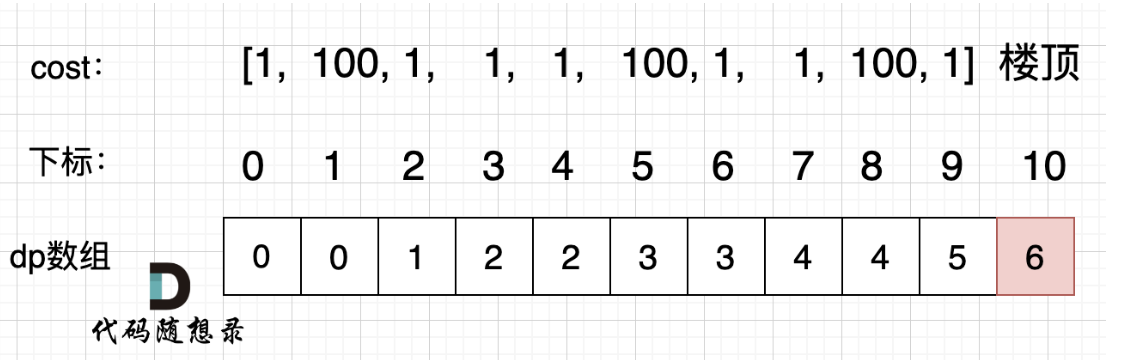





















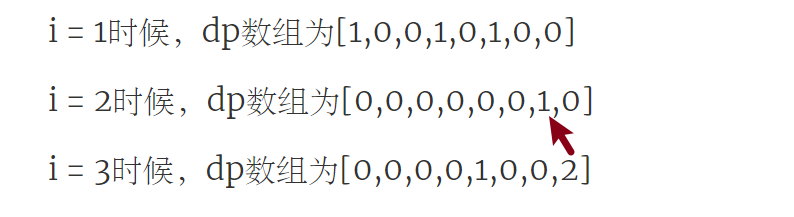




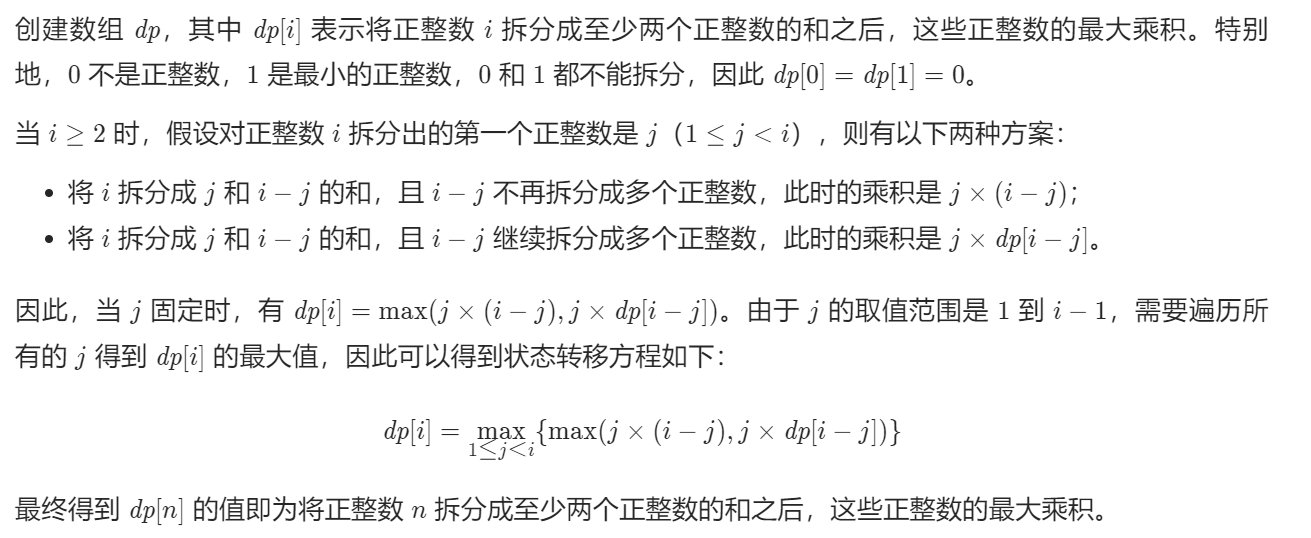












 写了80行,一题三解!不分析复杂度了。。
 YYDS
YYDS