2023 2023 Leetcode Cup Graph Theory List

2022年(上)

2368. 受限条件下可到达节点的数目 Rank:1477
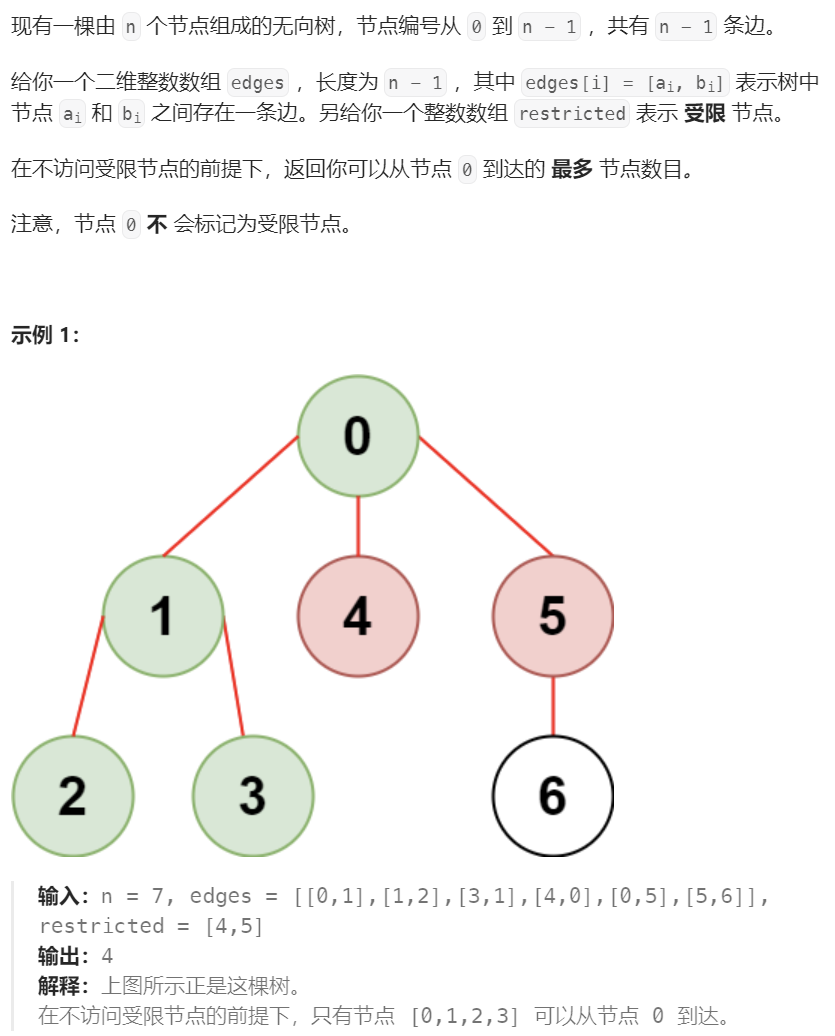
方法一:DFS

Map建图+dfs

1
2
3
4
5
6
7
8
9
10
11
12
13
14
15
16
17
18
19
20
21
22
23
24
25
26
27
28
29
30
31
32
33
34
class Solution {
public int reachableNodes(int n, int[][] edges, int[] restricted) {
this.n = n;
this.edges = edges;
this.restricted = restricted;
for (int[] edge : edges) {
int from = edge[0], to = edge[1];
graph.putIfAbsent(from, new ArrayList<>());
graph.putIfAbsent(to, new ArrayList<>());
graph.get(from).add(to);
graph.get(to).add(from);
}
for (int x : restricted)
banList.add(x);
dfs(0, -1);
return res;
}

public void dfs(int node, int parent) {
++res;
List<Integer> nexts = graph.get(node);
for (int next : nexts) {
if (next != parent && !banList.contains(next)) {
dfs(next, node);
}
}
}

int n, res = 0;
int[][] edges;
int[] restricted;
Map<Integer, List<Integer>> graph = new HashMap<>();
Set<Integer> banList = new HashSet<>();
}

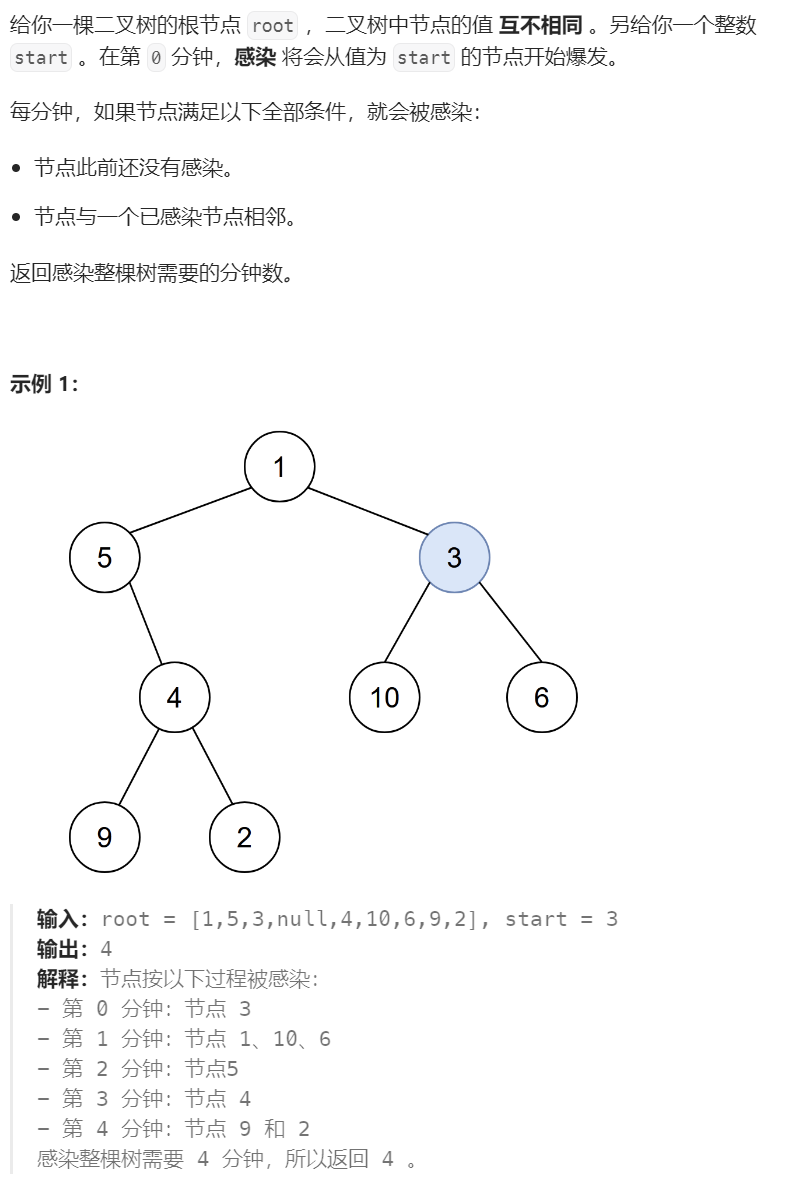
2385. 感染二叉树需要的总时间 Rank:1711

方法一:DFS + BFS

  • 每遍历一层,秒数加一
  • res初始化为-1,因为如果只有一个节点,答案是0秒,即不需要扩散
1
2
3
4
5
6
7
8
9
10
11
12
13
14
15
16
17
18
19
20
21
22
23
24
25
26
27
28
29
30
31
32
33
34
35
36
37
38
39
40
41
42
43
44
45
46
47
48
49
50
51
52
53
54
55
56
57
58
59
60
61
62
63
64
65
66
67
68
69
/**
* Definition for a binary tree node.
* public class TreeNode {
* int val;
* TreeNode left;
* TreeNode right;
* TreeNode() {}
* TreeNode(int val) { this.val = val; }
* TreeNode(int val, TreeNode left, TreeNode right) {
* this.val = val;
* this.left = left;
* this.right = right;
* }
* }
*/
class Solution {
public int amountOfTime(TreeNode root, int start) {
visited.add(start);
buildGraph(root);
// for (Map.Entry<Integer, List<Integer>> entry : graph.entrySet()) {
// System.out.print(entry.getKey() + ": ");
// for (int x : entry.getValue()) {
// System.out.print(x + " ");
// }
// System.out.println();
// }
Queue<Integer> queue = new LinkedList<>();
queue.offer(start);
while (!queue.isEmpty()) {
int size = queue.size();
++res;
for (int i = 0; i < size; ++i) {
int node = queue.poll();
visited.add(node);
List<Integer> list = graph.get(node);
for (int next : list) {
if (node != next && !visited.contains(next)) {
queue.offer(next);
}
}
}
}
return res;
}


public void buildGraph(TreeNode root) {
if (root == null)
return;
graph.putIfAbsent(root.val, new ArrayList<>());
if (root.left != null) {
graph.putIfAbsent(root.left.val, new ArrayList<>());
graph.get(root.val).add(root.left.val);
graph.get(root.left.val).add(root.val);
buildGraph(root.left);
}
if (root.right != null) {
graph.putIfAbsent(root.right.val, new ArrayList<>());
graph.get(root.val).add(root.right.val);
graph.get(root.right.val).add(root.val);
buildGraph(root.right);
}
}

Map<Integer, List<Integer>> graph = new HashMap<>();
int res = -1;
Set<Integer> visited = new HashSet<>();

}

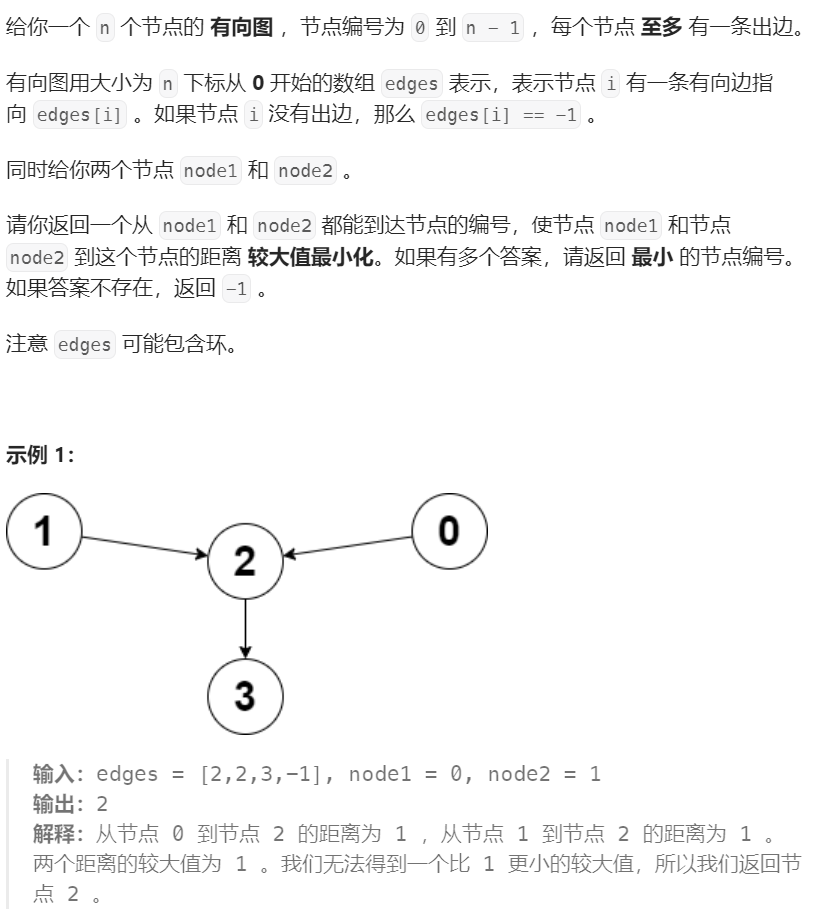
2359. 找到离给定两个节点最近的节点 Rank:1715

方法一:内向基环树

1
2
3
4
5
6
7
8
9
10
11
12
13
14
15
16
17
18
19
20
21
22
23
24
25
26
27
28
29
30
31
class Solution {
public int closestMeetingNode(int[] edges, int node1, int node2) {
n = edges.length;
this.edges = edges;
int minDist = inf;
int[] dist1 = calcDistance(node1), dist2 = calcDistance(node2);
for (int i = 0; i < n; ++i) {
int d = Math.max(dist1[i], dist2[i]);
if (d < minDist) {
res = i;
minDist = d;
}
}
return res;
}

public int[] calcDistance(int x) {
int[] dist = new int[n];
Arrays.fill(dist, inf);
int d = 0;
while (x != -1 && dist[x] == inf) {
dist[x] = d++;
x = edges[x];
}
return dist;
}


int inf = Integer.MAX_VALUE, n, res = -1;
int[] edges;
}

2360. 图中的最长环 Rank:1897

方法一:时间戳

也是内向基环树

1
2
3
4
5
6
7
8
9
10
11
12
13
14
15
16
17
18
19
20
21
class Solution {
public int longestCycle(int[] edges) {
int res = -1, n = edges.length, clock = 1;
int[] time = new int[n];
for (int i = 0; i < n; ++i) {
if (time[i] > 0)
continue;
int startTime = clock, x = i;
while (x != -1) {
if (time[x] > 0) {
if (time[x] >= startTime)
res = Math.max(res, clock - time[x]);
break;
}
time[x] = clock++;
x = edges[x];
}
}
return res;
}
}

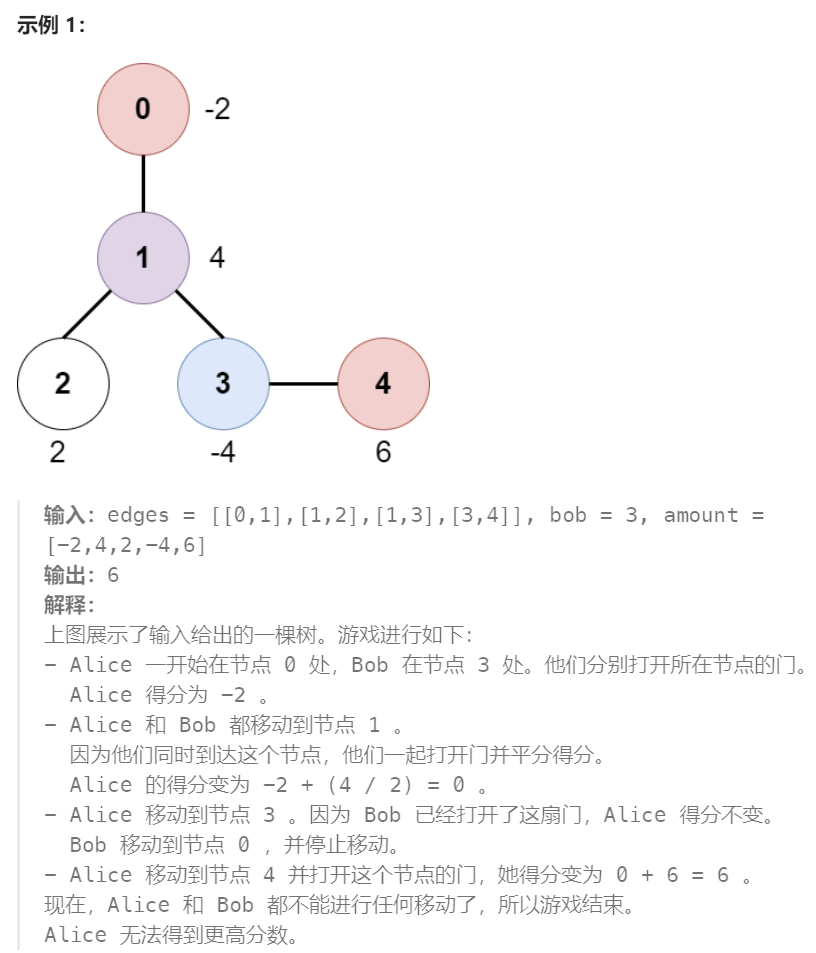
2467. 树上最大得分和路径 Rank:2053

方法一:时间戳 + 两次dfs

  • 先dfs一次bob的路径,只有找到0的最短路径的节点用时间戳记录
  • 根据规则再对alice路径dfs
1
2
3
4
5
6
7
8
9
10
11
12
13
14
15
16
17
18
19
20
21
22
23
24
25
26
27
28
29
30
31
32
33
34
35
36
37
38
39
40
41
42
43
44
45
46
47
48
49
50
51
52
53
54
55
class Solution {
public int mostProfitablePath(int[][] edges, int bob, int[] amount) {
n = edges.length + 1;
graph = new List[n];
this.amount = amount;
Arrays.setAll(graph, o -> new ArrayList<>());
time = new int[n];
Arrays.fill(time, n);
for (int[] edge : edges) {
int from = edge[0], to = edge[1];
graph[from].add(to);
graph[to].add(from);
}
graph[0].add(-1);
getDistFromRoot(bob, -1, 0);
dfs(0, -1, 0, 0);
return res;
}

private void dfs(int alice, int parent, int aliceTime, int score) {
if (aliceTime == time[alice])
score += amount[alice] / 2;
if (aliceTime < time[alice])
score += amount[alice];
if (graph[alice].size() == 1) {
res = Math.max(res, score);
return;
}
for (int next : graph[alice])
if (next != parent)
dfs(next, alice, aliceTime + 1, score);
}


private boolean getDistFromRoot(int cur, int parent, int t) {
if (cur == 0) {
time[cur] = t;
return true;
}
for (int next : graph[cur]) {
if (next != parent && getDistFromRoot(next, cur, t + 1)) {
time[cur] = t;
return true;
}
}
return false;

}

List<Integer>[] graph;
int[] time;
int n;
int[] amount;
int res = Integer.MIN_VALUE;
}

2022年(下)

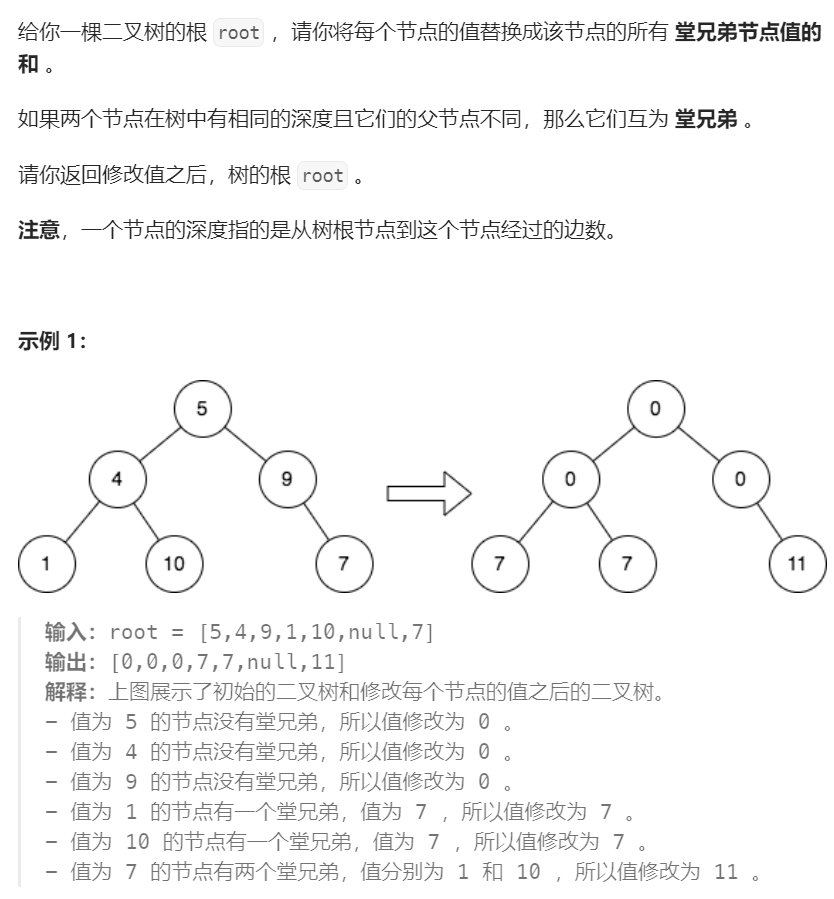
2641. 二叉树的堂兄弟节点 II Rank:1677

方法一:双BFS(双链表实现)

类似换根DP

  1. 首先算出下一层的节点值总和
  2. 再遍历一次当前层,给孩子节点赋值(如果用queue来遍历,无法重复遍历这一次,还需要用数组记录每一层的和)
1
2
3
4
5
6
7
8
9
10
11
12
13
14
15
16
17
18
19
20
21
22
23
24
25
26
27
28
29
30
31
32
33
34
35
36
37
38
39
40
41
42
43
44
45
/**
* Definition for a binary tree node.
* public class TreeNode {
* int val;
* TreeNode left;
* TreeNode right;
* TreeNode() {}
* TreeNode(int val) { this.val = val; }
* TreeNode(int val, TreeNode left, TreeNode right) {
* this.val = val;
* this.left = left;
* this.right = right;
* }
* }
*/
class Solution {
public TreeNode replaceValueInTree(TreeNode root) {
List<TreeNode> q = new LinkedList<>();
q.add(root);
root.val = 0;
while (!q.isEmpty()) {
List<TreeNode> temp = q;
q = new ArrayList<>();
int nextLevelSum = 0;
for (TreeNode node : temp) {
if (node.left != null) {
q.add(node.left);
nextLevelSum += node.left.val;
}
if (node.right != null) {
q.add(node.right);
nextLevelSum += node.right.val;
}
}
for (TreeNode node : temp) {
int childSum = (node.left != null ? node.left.val : 0) + (node.right != null ? node.right.val : 0);
if (node.left != null)
node.left.val = nextLevelSum - childSum;
if (node.right != null)
node.right.val = nextLevelSum - childSum;
}
}
return root;
}
}

2684. Maximum Number of Moves in a Grid Rank:1626
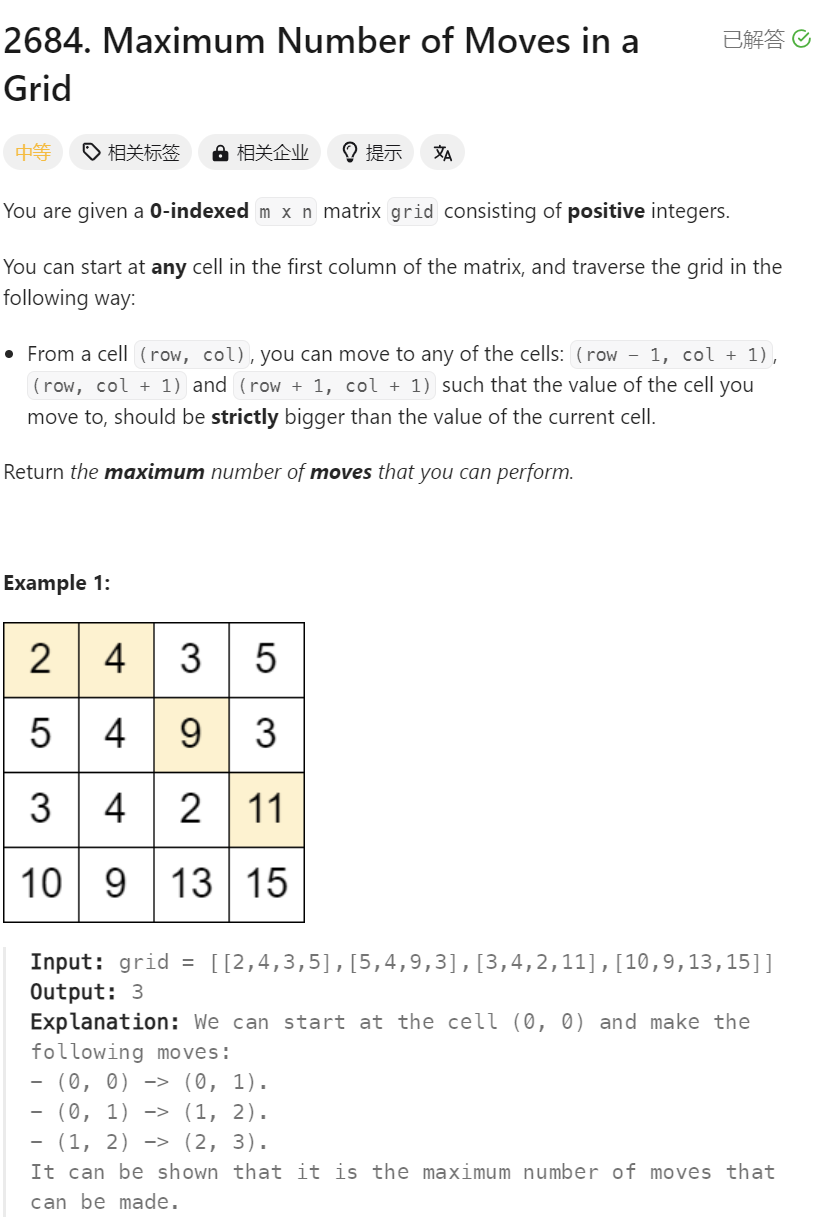
方法一:BFS

注意用visited数组剪枝

1
2
3
4
5
6
7
8
9
10
11
12
13
14
15
16
17
18
19
20
21
22
23
24
25
26
27
28
29
30
31
32
33
class Solution {
public int maxMoves(int[][] grid) {
m = grid.length;
n = grid[0].length;
Queue<int[]> queue = new LinkedList<>();
int[][] dirs = new int[][]{{-1, 1}, {0, 1}, {1, 1}};
boolean[][] visited = new boolean[m][n];
for (int i = 0; i < m; ++i)
queue.offer(new int[]{i, 0});
while (!queue.isEmpty()) {
int[] node = queue.poll();
int i = node[0], j = node[1];
res = Math.max(res, j);
for (int[] dir : dirs) {
int row = i + dir[0], col = j + dir[1];
if (isValid(row, col) && !visited[row][col] && grid[row][col] > grid[i][j]) {
visited[row][col] = true;
queue.offer(new int[]{row, col});
if (col == n - 1)
return n - 1;
}
}
}
return res;
}

int m, n, res = 0;

public boolean isValid(int i, int j) {
return i >= 0 && i < m && j >= 0 && j < n;
}

}

方法二:记忆化搜索

和半年前的提交完全一样!一个字母都不差,属实是肌肉记忆了

1
2
3
4
5
6
7
8
9
10
11
12
13
14
15
16
17
18
19
20
21
22
23
24
25
26
27
28
29
30
31
32
33
34
35
36
37
class Solution {
public int maxMoves(int[][] grid) {
m = grid.length;
n = grid[0].length;
this.grid = grid;
dp = new int[m][n];
for (int[] arr : dp)
Arrays.fill(arr, -1);
for (int i = 0; i < m; ++i)
res = Math.max(res, dfs(i, 0));
return res;
}

public int dfs(int i, int j) {
if (j == n - 1)
return 0;
if (dp[i][j] != -1)
return dp[i][j];
int ans = 0;
for (int[] dir : dirs) {
int len = 0;
int row = i + dir[0], col = j + dir[1];
if (isValid(row, col) && grid[row][col] > grid[i][j])
len = dfs(row, col) + 1;
ans = Math.max(ans, len);
}
return dp[i][j] = ans;
}

int m, n, res = 0;
int[][] dp, dirs = new int[][]{{-1, 1}, {0, 1}, {1, 1}}, grid;

public boolean isValid(int i, int j) {
return i >= 0 && i < m && j >= 0 && j < n;
}

}

2685. Count the Number of Complete Components
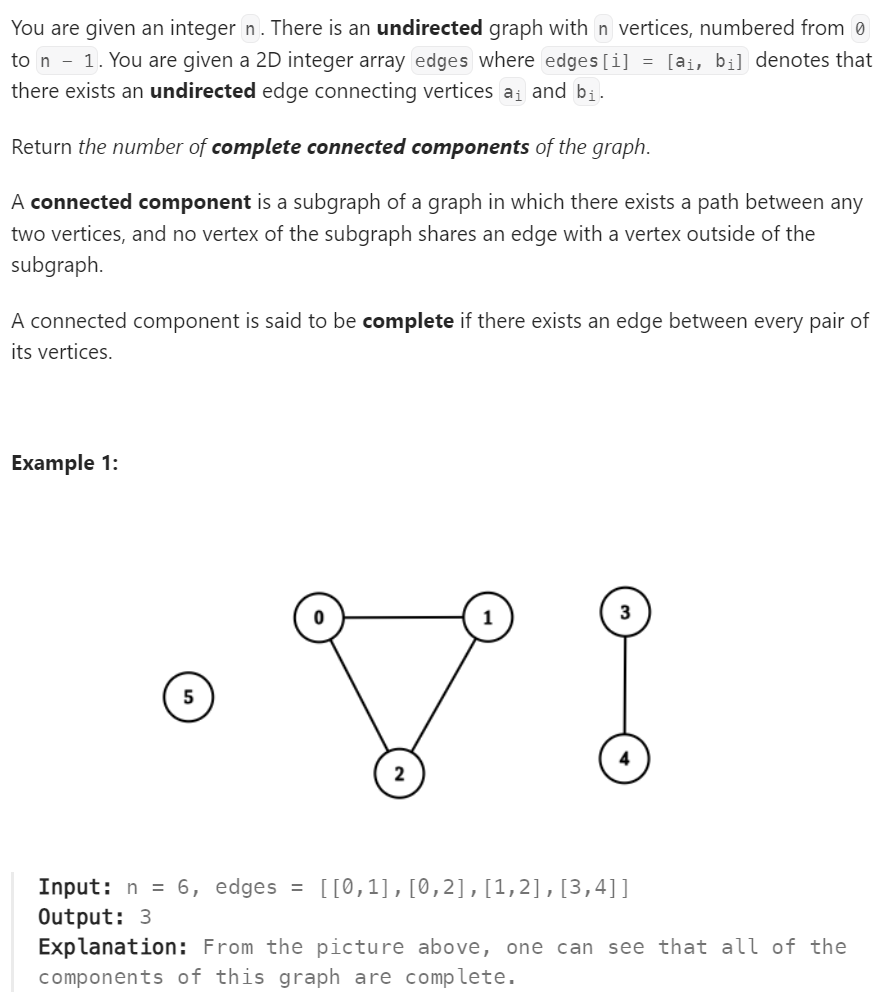
方法一:DFS

  • 遍历每个连通分量,将edge数加上当前节点的邻居数,最后这个连通分量的边会被计算两次
  • 如果是完全连通分量,e = (v - 1) * v / 2
  • 由于这里边计算了两次,如果e = (v - 1) * v,那么是完全连通分量
1
2
3
4
5
6
7
8
9
10
11
12
13
14
15
16
17
18
19
20
21
22
23
24
25
26
27
28
29
30
31
32
33
34
35
36
37
38
class Solution {
public int countCompleteComponents(int n, int[][] edges) {
graph = new ArrayList[n];
Arrays.setAll(graph, e -> new ArrayList<>());
visited = new boolean[n];
int cnt = 0;
for (int[] edge : edges) {
int x = edge[0], y = edge[1];
graph[x].add(y);
graph[y].add(x);
}
for (int i = 0; i < n; ++i) {
if (!visited[i]) {
e = 0;
v = 0;
dfs(i);
if (e == v * (v - 1))
++cnt;
}
}
return cnt;
}

public void dfs(int i) {
visited[i] = true;
List<Integer> nexts = graph[i];
++v;
e += nexts.size();
for (int next : nexts)
if (!visited[next])
dfs(next);
}

List<Integer>[] graph;
boolean[] visited;
int e, v;

}

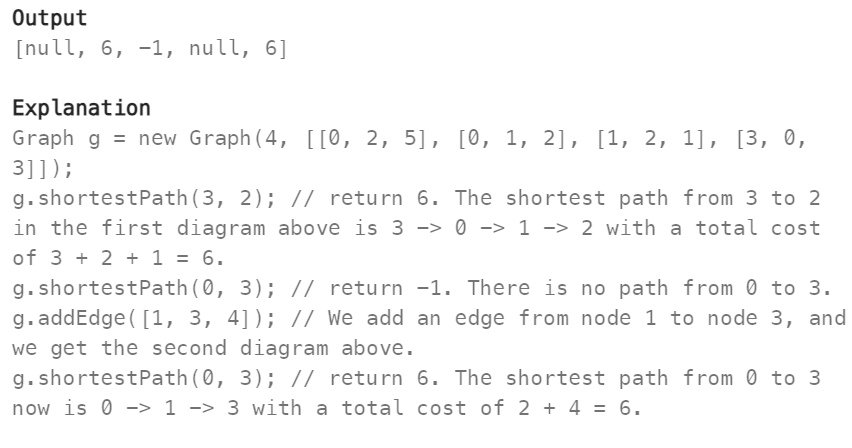
2642. Design Graph With Shortest Path Calculator Rank:1811
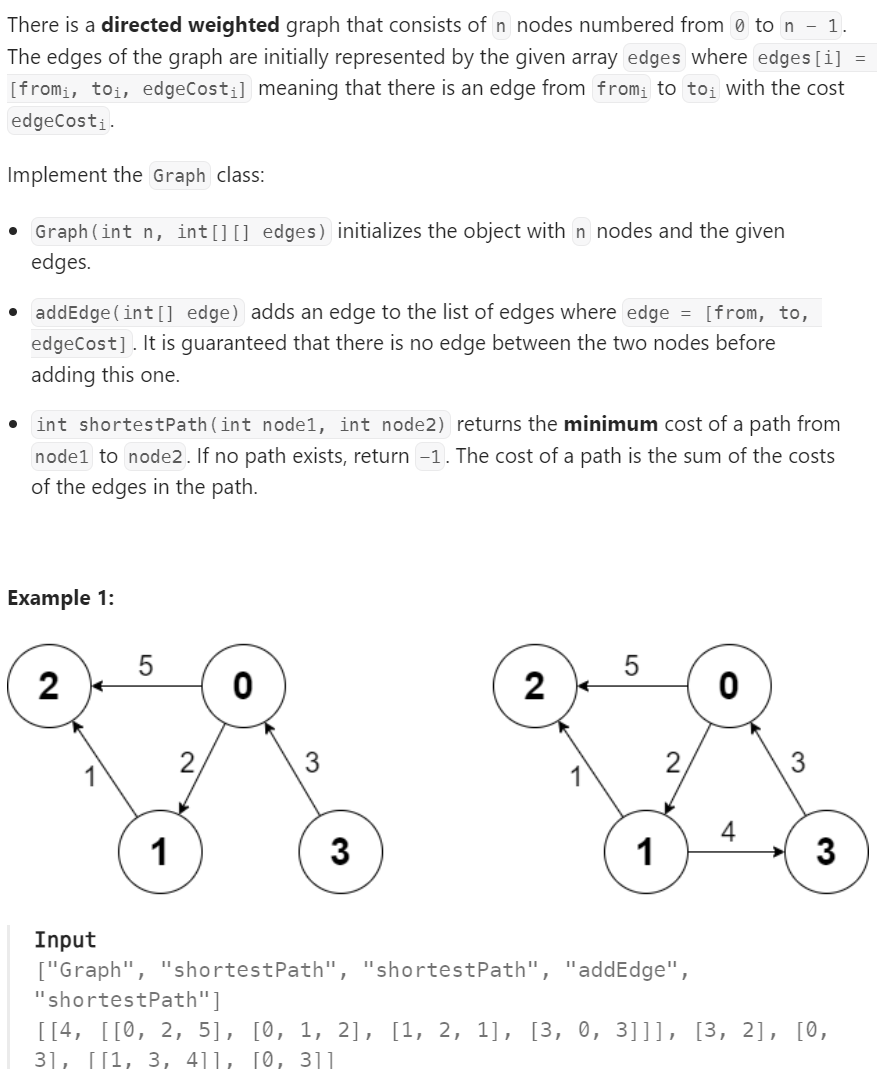
方法一:Dijkstra

1
2
3
4
5
6
7
8
9
10
11
12
13
14
15
16
17
18
19
20
21
22
23
24
25
26
27
28
29
30
31
32
33
34
35
36
37
38
39
40
41
42
43
44
45
46
47
48
49
50
51
52
53
54
class Graph {

int[][] graph;
int n, inf = Integer.MAX_VALUE >> 1;

public Graph(int n, int[][] edges) {
this.n = n;
graph = new int[n][n];
for (int[] arr : graph)
Arrays.fill(arr, inf);
for (int[] edge : edges) {
int from = edge[0], to = edge[1], weight = edge[2];
graph[from][to] = weight;
}
}

public void addEdge(int[] edge) {
int from = edge[0], to = edge[1], weight = edge[2];
graph[from][to] = weight;
}

public int shortestPath(int from, int to) {
boolean[] visited = new boolean[n];
int[] dist = new int[n];
Arrays.fill(dist, inf);
dist[from] = 0;
for (int i = 0; i < n; ++i) { // 每遍历一次,一个节点被visit,需要遍历n次
int minIndex = -1, minDist = inf;
for (int j = 0; j < n; ++j) {
if (!visited[j] && dist[j] < minDist) {
minIndex = j;
minDist = dist[j];
}
}
if (minIndex == -1) // 非连通
return -1;
if (minIndex == to)
return minDist;
visited[minIndex] = true;
for (int j = 0; j < n; ++j) {
if (!visited[j] && dist[j] > minDist + graph[minIndex][j])
dist[j] = minDist + graph[minIndex][j];
}
}
return dist[to];
}
}

/**
* Your Graph object will be instantiated and called as such:
* Graph obj = new Graph(n, edges);
* obj.addEdge(edge);
* int param_2 = obj.shortestPath(node1,node2);
*/

方法二:堆优化

1
2
3
4
5
6
7
8
9
10
11
12
13
14
15
16
17
18
19
20
21
22
23
24
25
26
27
28
29
30
31
32
33
34
35
36
37
38
39
40
41
42
43
44
45
46
47
48
49
50
51
52
53
class Graph {

int[][] g;
int n, inf = Integer.MAX_VALUE >> 1;

public Graph(int n, int[][] edges) {
this.n = n;
g = new int[n][n];
for (int[] arr : g)
Arrays.fill(arr, inf);
for (int[] e : edges) {
int from = e[0], to = e[1], cost = e[2];
g[from][to] = cost;
}
}

public void addEdge(int[] e) {
int from = e[0], to = e[1], cost = e[2];
g[from][to] = cost;
}

public int shortestPath(int from, int to) {
boolean[] visited = new boolean[n];
int[] dist = new int[n];
Arrays.fill(dist, inf);
dist[from] = 0;
PriorityQueue<int[]> queue = new PriorityQueue<>((o1, o2) -> o1[1] - o2[1]);
queue.offer(new int[]{from, 0});
while (!queue.isEmpty()) {
int[] arr = queue.poll();
int node = arr[0], d = arr[1];
if (visited[node])
continue;
visited[node] = true;
if (node == to)
return d;
for (int i = 0; i < n; ++i) {
if (!visited[i] && dist[i] > d + g[node][i]) {
dist[i] = d + g[node][i];
queue.offer(new int[]{i, dist[i]});
}
}
}
return -1;
}
}

/**
* Your Graph object will be instantiated and called as such:
* Graph obj = new Graph(n, edges);
* obj.addEdge(edge);
* int param_2 = obj.shortestPath(node1,node2);
*/

2608. Shortest Cycle in a Graph Rank:1904
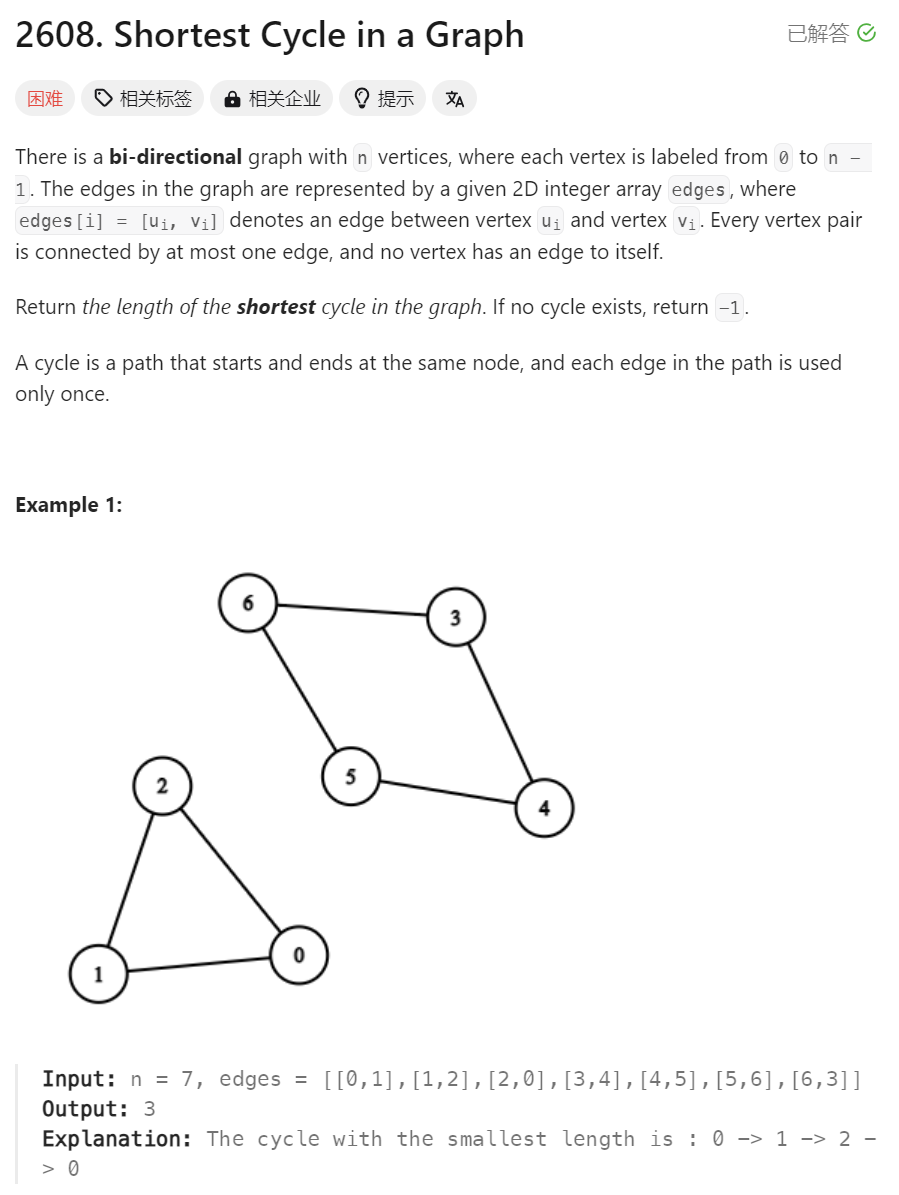
方法一:BFS
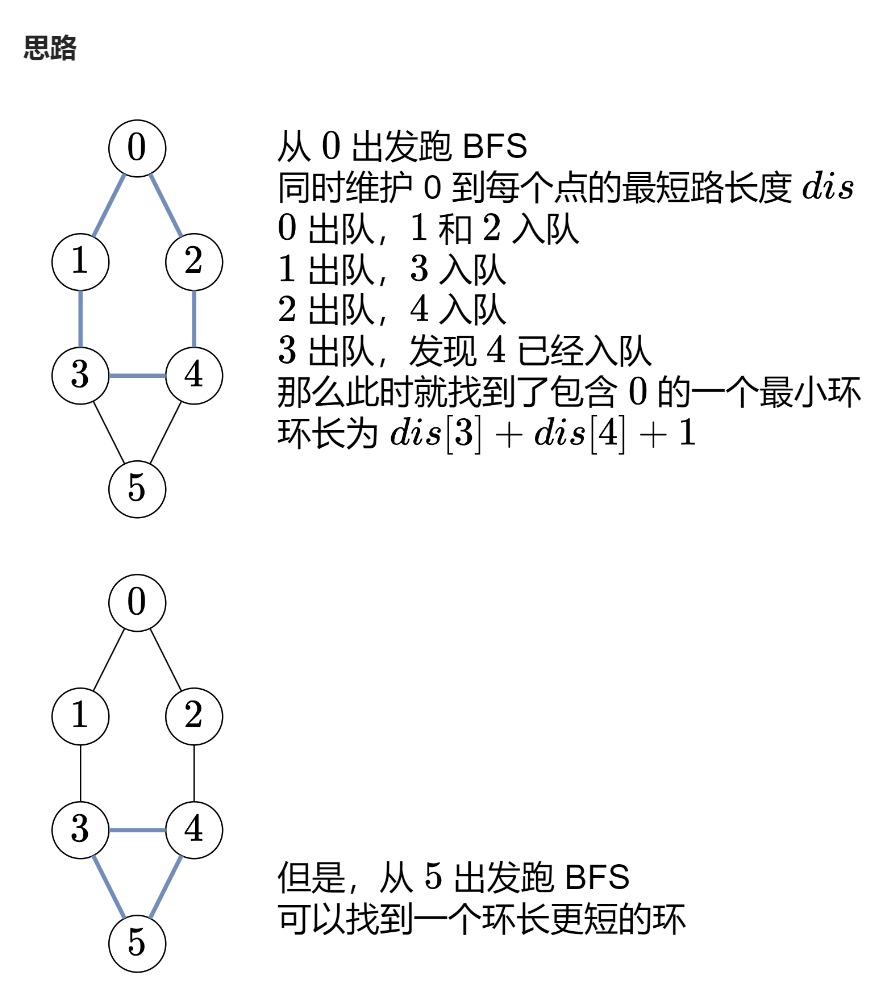
:为什么说发现一个已经入队的点,就说明有环?

:这说明到同一个点有两条不同的路径,这两条路径组成了一个环。

1
2
3
4
5
6
7
8
9
10
11
12
13
14
15
16
17
18
19
20
21
22
23
24
25
26
27
28
29
30
31
32
33
34
35
36
37
38
39
40
41
class Solution {
public int findShortestCycle(int n, int[][] edges) {
this.n = n;
graph = new List[n];
Arrays.setAll(graph, e -> new ArrayList<>());
for (int[] edge : edges) {
int from = edge[0], to = edge[1];
graph[from].add(to);
graph[to].add(from);
}
int res = inf;
for (int i = 0; i < n; ++i)
res = Math.min(res, bfs(i));
return res == inf ? - 1 : res;
}

public int bfs(int i) {
int[] dist = new int[n];
Arrays.fill(dist, -1);
dist[i] = 0;
Queue<int[]> queue = new LinkedList<>();
queue.offer(new int[]{i, -1});
int ans = inf;
while (!queue.isEmpty()) {
int[] node = queue.poll();
int x = node[0], y = node[1];
for (int next : graph[x]) {
if (dist[next] < 0) { // not visited
dist[next] = dist[x] + 1;
queue.offer(new int[]{next, x});
}
else if (next != y) // 访问过,且不是父节点,说明两条简单路径交汇,形成环
ans = Math.min(ans, dist[x] + dist[next] + 1);
}
}
return ans;
}

List<Integer>[] graph;
int n, inf = Integer.MAX_VALUE;
}

2577. Minimum Time to Visit a Cell In a Grid Rank:2356
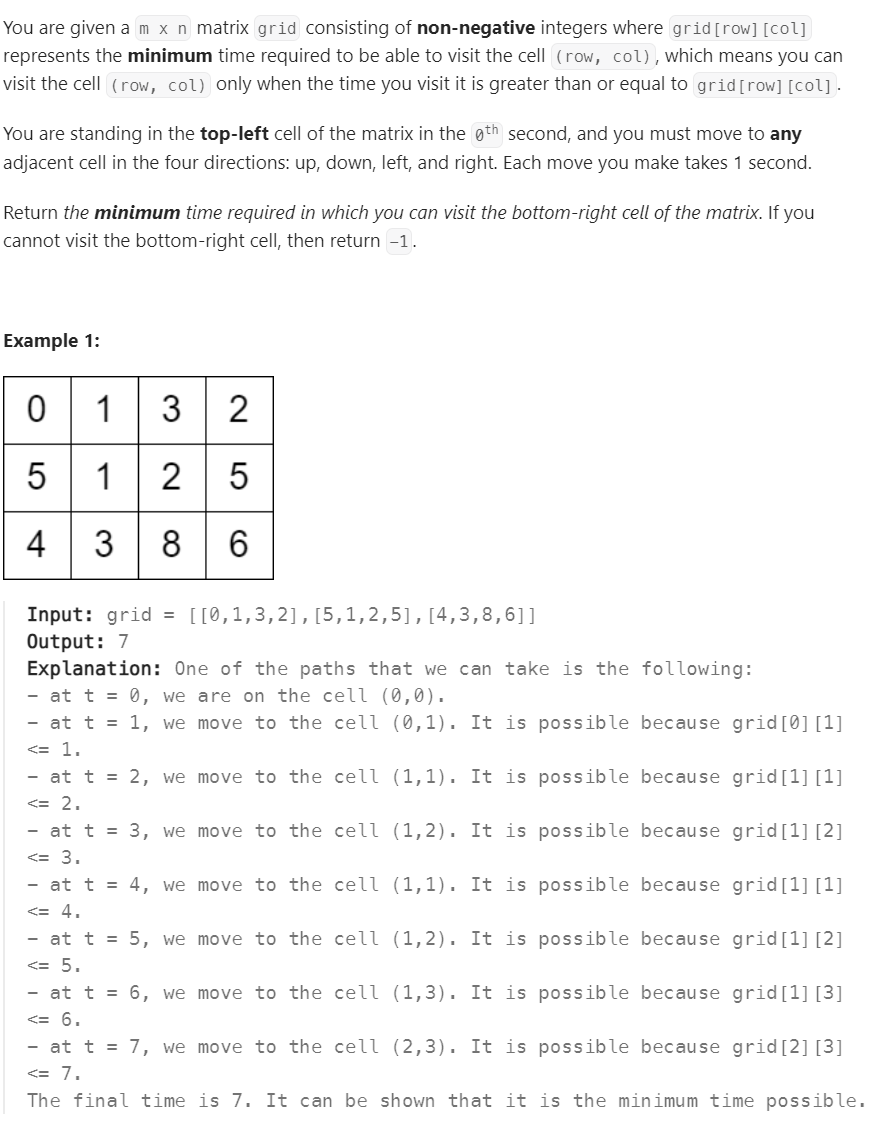
方法一:堆优化dijkstra

1
2
3
4
5
6
7
8
9
10
11
12
13
14
15
16
17
18
19
20
21
22
23
24
25
26
27
28
29
30
31
32
33
34
35
36
37
38
39
class Solution {
public int minimumTime(int[][] grid) {
if (grid[0][1] > 1 && grid[1][0] > 1)
return -1;
m = grid.length;
n = grid[0].length;
int[][] dist = new int[m][n];
for (int[] arr : dist)
Arrays.fill(arr, inf);
dist[0][0] = 0;
PriorityQueue<int[]> pq = new PriorityQueue<>((o1, o2) -> o1[2] - o2[2]);
pq.offer(new int[]{0, 0, 0});
while (true) {
int[] node = pq.poll();
int i = node[0], j = node[1], d = node[2];
if (i == m - 1 && j == n - 1)
return d;
for (int[] dir : dirs) {
int row = i + dir[0], col = j + dir[1];
if (isValid(row, col)) {
int nd = Math.max(d + 1, grid[row][col]);
nd += (nd - row - col) % 2;
if (nd < dist[row][col]) {
dist[row][col] = nd;
pq.offer(new int[]{row, col, nd});
}
}
}
}
}

int m, n, inf = Integer.MAX_VALUE;
int[][] dirs = new int[][]{{-1, 0}, {1, 0}, {0, -1}, {0, 1}};

public boolean isValid(int i, int j) {
return i >= 0 && i < m && j >= 0 && j < n;
}

}

方法二:二分 + BFS

1
2
3
4
5
6
7
8
9
10
11
12
13
14
15
16
17
18
19
20
21
22
23
24
25
26
27
28
29
30
31
32
33
34
35
36
37
38
39
40
41
42
43
44
45
46
class Solution {
public int minimumTime(int[][] grid) {
if (grid[0][1] > 1 && grid[1][0] > 1)
return -1;
m = grid.length;
n = grid[0].length;
int l = Math.max(m + n - 2, grid[m - 1][n - 1]), r = (int) 1e5 + m + n;
while (l <= r) {
int mid = (l + r) >> 1;
if (check(mid, grid))
r = mid - 1;
else
l = mid + 1;
}
return l + (l + m + n) % 2;
}

public boolean check(int limit, int[][] grid) {
boolean[][] visited = new boolean[m][n];
visited[m - 1][n - 1] = true;
Queue<int[]> queue = new LinkedList<>();
queue.offer(new int[]{m - 1, n - 1, limit - 1});
while (!queue.isEmpty()) {
int[] node = queue.poll();
int i = node[0], j = node[1], t = node[2];
if (i == 0 && j == 0)
return true;
for (int[] dir : dirs) {
int row = i + dir[0], col = j + dir[1];
if (isValid(row, col) && !visited[row][col] && t >= grid[row][col]) {
queue.offer(new int[]{row, col, t - 1});
visited[row][col] = true;
}
}
}
return false;
}

int m, n, inf = Integer.MAX_VALUE;
int[][] dirs = new int[][]{{-1, 0}, {1, 0}, {0, -1}, {0, 1}};

public boolean isValid(int i, int j) {
return i >= 0 && i < m && j >= 0 && j < n;
}

}

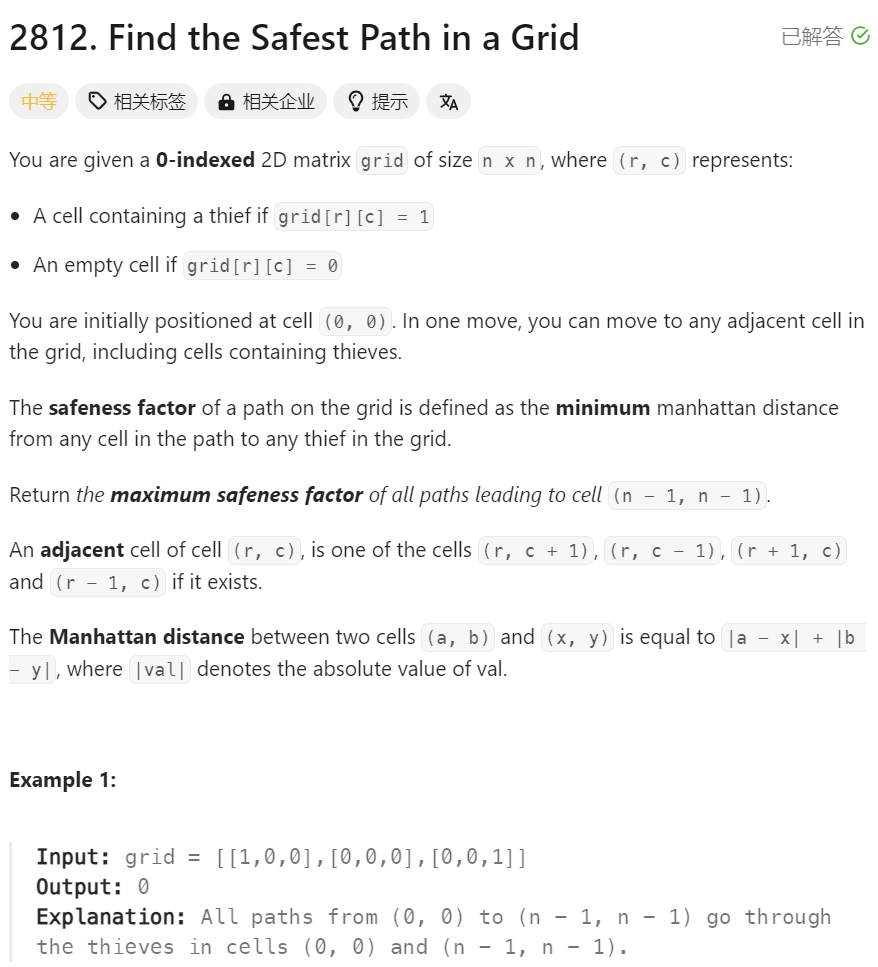
2812. 找出最安全路径 Rank:2154

方法一:多源BFS + 二分

1
2
3
4
5
6
7
8
9
10
11
12
13
14
15
16
17
18
19
20
21
22
23
24
25
26
27
28
29
30
31
32
33
34
35
36
37
38
39
40
41
42
43
44
45
46
47
48
49
50
51
52
53
54
55
56
57
58
59
60
61
62
63
64
65
66
67
class Solution {
public int maximumSafenessFactor(List<List<Integer>> grid) {
n = grid.size();
Queue<int[]> queue = new LinkedList<>();
dist = new int[n][n];
for (int[] arr : dist)
Arrays.fill(arr, -1);
for (int i = 0; i < n; ++i) {
for (int j = 0; j < n; ++j) {
if (grid.get(i).get(j) == 1) {
queue.offer(new int[]{i, j});
dist[i][j] = 0;
}
}
}
while (!queue.isEmpty()) {
int[] node = queue.poll();
int i = node[0], j = node[1];
for (int[] dir : dirs) {
int row = i + dir[0], col = j + dir[1];
if (isValid(row, col) && dist[row][col] < 0) {
dist[row][col] = dist[i][j] + 1;
queue.offer(new int[]{row, col});
}
}
}
int l = 0, r = 3 * n;
while (l <= r) {
int mid = (l + r) >> 1;
if (check(mid))
l = mid + 1;
else
r = mid - 1;
}
return r;
}

public boolean check(int limit) {
Queue<int[]> queue = new LinkedList<>();
boolean[][] visited = new boolean[n][n];
if (dist[0][0] < limit)
return false;
queue.offer(new int[]{0, 0, 0});
visited[0][0] = true;
while (!queue.isEmpty()) {
int[] node = queue.poll();
int i = node[0], j = node[1];
for (int[] dir : dirs) {
int row = i + dir[0], col = j + dir[1];
if (isValid(row, col) && !visited[row][col] && limit <= dist[row][col]) {
queue.offer(new int[]{row, col});
visited[row][col] = true;
}
}
}
return visited[n - 1][n - 1];
}


int n, inf = Integer.MAX_VALUE >> 1;
int[][] dirs = new int[][]{{-1, 0}, {1, 0}, {0, -1}, {0, 1}}, dist;

public boolean isValid(int i, int j) {
return i >= 0 && i < n && j >= 0 && j < n;
}

}

2023 2023 Leetcode Cup Graph Theory List
https://leopol1d.github.io/2024/01/14/2023-2023-Leetcode-Cup-Graph-Theory-List/
作者
Leopold
发布于
2024年1月14日
许可协议